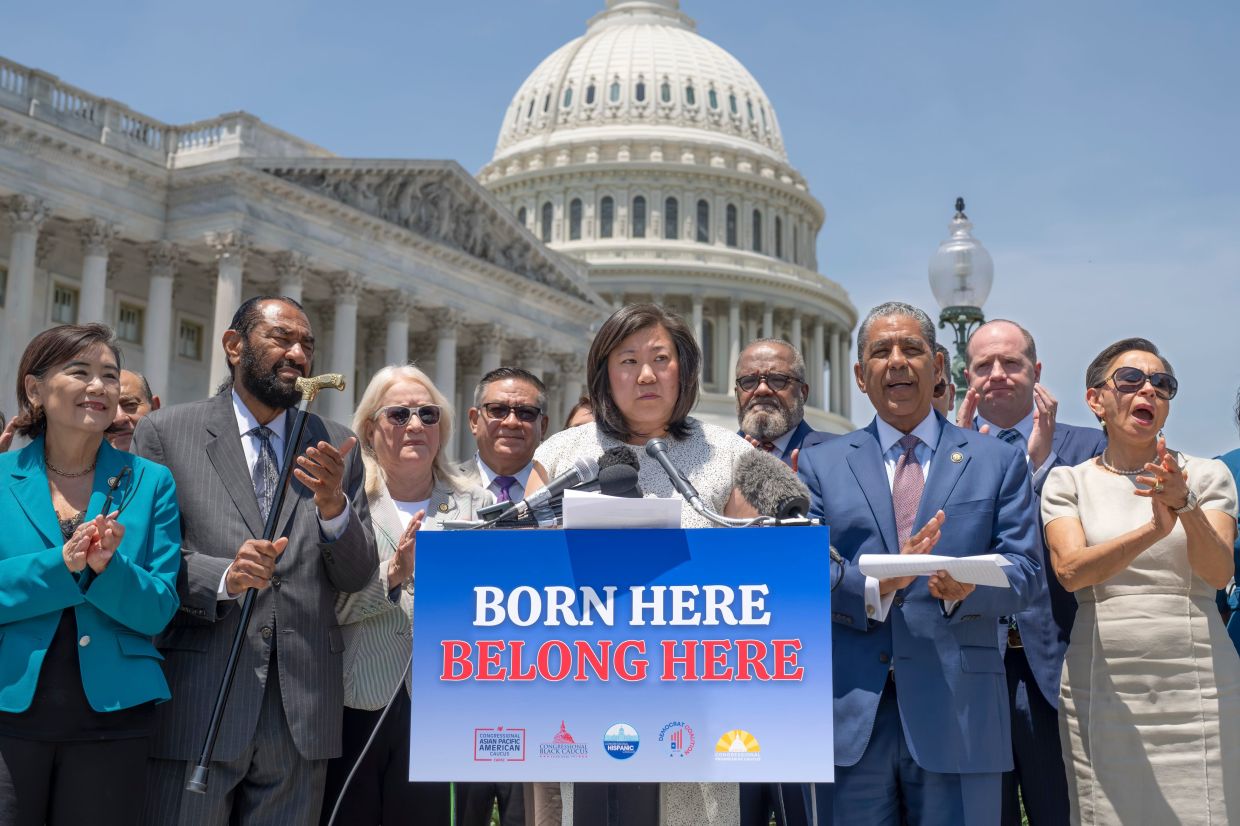
The United States Supreme Court has delivered a significant defeat to President Donald Trump's immigration agenda by striking down his executive order that would have restricted birthright citizenship. The court's 6-3 decision in Trump vs Barbara reaffirmed that children born on American soil are entitled to citizenship regardless of their parents' immigration status—a principle that has stood as foundational to American constitutional law for over 150 years. The ruling comes as the Trump administration continues to pursue aggressive immigration policies and signals the judiciary's willingness to act as a check on executive overreach in this contentious arena.
Trump had signed the birthright citizenship executive order in early 2025, explicitly targeting children whose parents were either undocumented or present on temporary visas. The policy was set to take effect the following month before legal challenges halted its implementation. Trump responded to the Supreme Court's decision with characteristic defiance, initially attempting to shift focus toward China by congratulating President Xi on a "massive Birthright Citizenship WIN," a puzzling statement that appeared designed to deflect from his domestic policy defeat. He subsequently characterised the ruling as "too bad" for the country while insisting that Congress could reverse the outcome through legislation, dismissing the need for a constitutional amendment.
What made Trump's order particularly controversial was its scope. Rather than limiting itself to undocumented immigrants—the traditional focus of birthright citizenship debates—the administration's directive would have stripped citizenship from children of individuals who were lawfully present in the United States on temporary visas. This encompassed highly skilled workers on H-1B and L-1 work visas, individuals on student visas, temporary labour visa holders, and those on achievement visas. All of these categories are designated as "lawful but temporary" by the US Citizenship and Immigration Services. The only exception would have protected children if one parent held US citizenship, revealing the order's fundamental tension with constitutional principles.
Chief Justice John Roberts' majority opinion anchored the court's reasoning in the historical foundations of American citizenship. The decision emphasised that citizenship represents "the right to have rights—to freely participate in our political community," a promise the Framers of the Fourteenth Amendment extended to all persons born in the United States. Roberts wrote that the court kept this promise by reaffirming what the Fourteenth Amendment's Citizenship Clause had long established: that nearly all children born on US soil possess citizenship regardless of their parents' immigration status. This interpretation traces back to 1868, when the Fourteenth Amendment was ratified immediately following the Civil War, a moment when Congress intended to protect former slaves and other minorities from discriminatory citizenship laws.
The legal foundations for this principle run deeper still. The modern understanding of birthright citizenship stems from the landmark 1898 Supreme Court case involving Wong Kim Ark, a Chinese-American who had been denied re-entry to the United States after visiting China. Despite his parents' status under the Chinese Exclusion Act, the Supreme Court at that time ruled that Wong possessed citizenship because he was born on American soil. That decision established a precedent that has endured through Jim Crow segregation and multiple attempts at restriction. Wong's descendants, including Norman Wong, his great-grandson, issued a statement praising the recent ruling, noting that their ancestor "was one man, only a cook, and yet he stood up for what was right." Norman Wong emphasised that his great-grandfather's 1898 victory remained as significant today as it was 128 years ago, providing continuity to constitutional protections across generations.
The court's decision carries particular resonance for Asian-American communities and immigrant advocacy groups. Stop AAPI Hate, an organisation tracking anti-Asian violence and discrimination, highlighted the special significance of the ruling for Asian-Americans while explicitly referencing Wong Kim Ark's historical case. The organisation observed that birthright citizenship has enabled the Asian-American community and other communities of colour to grow in both size and political power, precisely the outcome the Trump administration had attempted to undermine. Krish O'Mara Vignarajah, president of Global Refuge, a non-profit working with refugees, characterised the Supreme Court's action as preventing the executive order from transforming "the maternity ward into a customs checkpoint," capturing the profound implications of Trump's proposed policy.
Even as the Supreme Court rejected Trump's birthright citizenship order, the administration shifted its focus toward addressing what officials characterise as "birth tourism"—the practice of foreign nationals, particularly from China, entering the United States specifically to give birth and secure citizenship for their children. This issue, while less prominent in traditional birthright citizenship debates, has increasingly featured in Trump's immigration rhetoric and policy arguments. The Justice Department issued a memo on Tuesday afternoon directing federal prosecutors to prioritise investigations into birth tourism schemes, with Colin McDonald, a senior Justice Department official, vowing to "zealously protect the sanctity of United States citizenship by investigating and prosecuting those who fraudulently exploit our immigration system."
To illustrate its commitment to this enforcement priority, the Justice Department referenced a 2024 case involving Michael Wei Yueh Liu and Jing Dong, a husband and wife who operated a birth tourism scheme. They had charged Chinese clients tens of thousands of dollars to facilitate childbirth in the United States, and each received 41-month prison sentences. During Supreme Court oral arguments in April, Trump's Solicitor General and top litigator D. John Sauer argued that birthright citizenship had "spawned a sprawling industry of birth tourism," claiming that "uncounted thousands of foreigners from potentially hostile nations have flocked to give birth" in America. This framing reflects how the Trump administration has attempted to reframe the birthright citizenship debate away from undocumented immigration toward concerns about sophisticated schemes allegedly centred on Chinese nationals.
The strategic shift toward birth tourism allegations reveals deeper tensions within immigration policy debates. Chinese nationals became the focal point of disputed claims of abuse amplified throughout Trump's immigration campaign in 2026, creating a narrative that positioned birthright citizenship as vulnerable to foreign exploitation. However, critics counter that this represents a narrow sliver of a much broader phenomenon and that targeting it does not justify wholesale elimination of birthright citizenship rights for the millions of children born to lawfully present immigrants. The gap between the administration's rhetoric about birth tourism and the actual scope of Trump's executive order—which would have affected far more children of lawfully present visa holders than birth tourists—underscores the political dimensions of the debate.
Trump's insistence that Congress can resolve this matter through legislation represents his next strategic move, claiming that no constitutional amendment is necessary. His calls for Congressional action on "ending expensive and unfair" birthright citizenship, coupled with assertions of "Complete and Total Support" for such efforts, signal that the Trump administration views this Supreme Court defeat as merely one battle in a longer legislative war. However, any Congressional attempt to restrict birthright citizenship would face its own constitutional and political hurdles, and the Supreme Court's clear reaffirmation of the Fourteenth Amendment's protections provides a substantial legal barrier to future executive or legislative action.
For Malaysian and Southeast Asian observers, the birthright citizenship dispute reflects broader patterns in wealthy nations reassessing immigration and citizenship policies amid demographic and economic anxieties. The controversy demonstrates how fundamental constitutional protections can become politically contested, and how immigration enforcement can expand into unexpected domains. The court's decision affirming birthright citizenship protections, despite executive branch pressure, also illustrates how institutional checks and judicial review function to constrain executive power—mechanisms absent or substantially weakened in some regional contexts. As countries throughout Southeast Asia develop their own immigration frameworks and citizenship policies, the American birthright citizenship debate offers instructive lessons about balancing security concerns against fundamental constitutional principles and historical commitments to inclusive citizenship.

