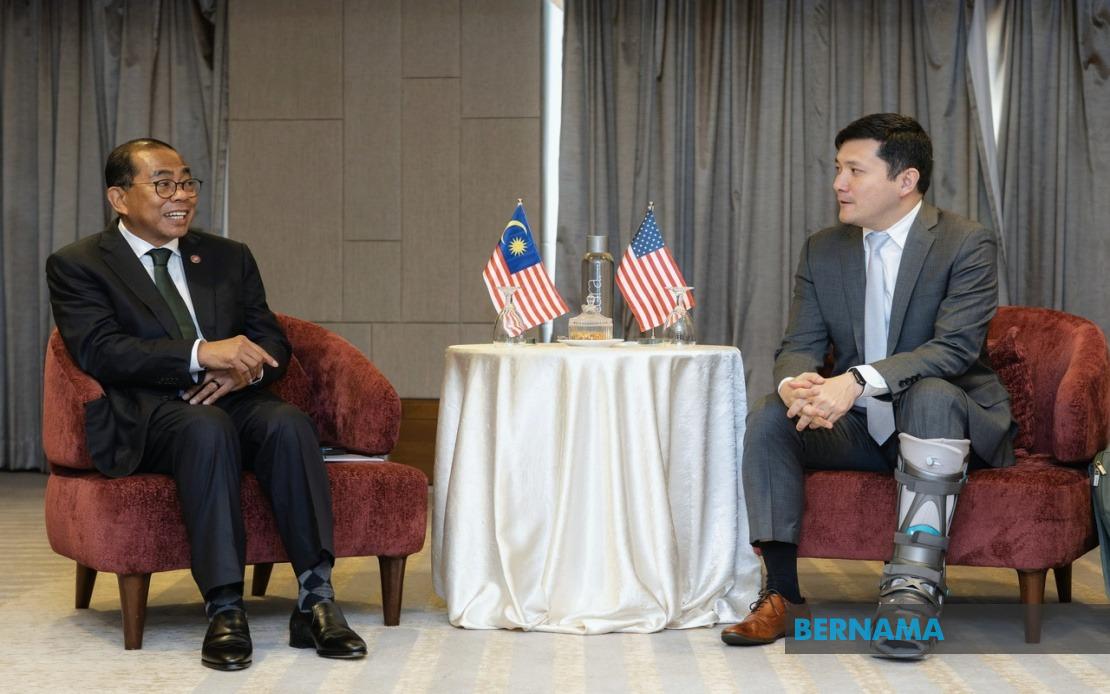
Defence Minister Datuk Seri Mohamed Khaled Nordin has announced that the United States remains dedicated to deepening its defence relationship with Malaysia, highlighting commitments made during high-level diplomatic engagements at the 37th Annual Military Law and Operations Conference currently underway in the capital. The assurance came following a courtesy call by US Ambassador to ASEAN Kevin Kim, who conveyed Washington's strategic priorities in the region during discussions centred on bilateral defence cooperation and regional security challenges facing Southeast Asia.
The ambassador's visit underscores the significance the United States places on maintaining robust military and defence partnerships within ASEAN, a region of considerable geopolitical importance given its strategic location and influence on international trade routes and regional stability. For Malaysia, which has increasingly emphasised its role as a bridge between major powers and a custodian of regional balance, such affirmations from Washington provide validation of its defence modernisation efforts and international standing in an era marked by great power competition and shifting security dynamics across the Indo-Pacific.
According to Mohamed Khaled, the discussions with the US envoy focused primarily on consolidating existing defence relations rather than introducing substantive policy shifts or new strategic initiatives. This measured approach reflects the incremental nature of contemporary defence diplomacy, where both nations prefer to strengthen foundational frameworks and operational partnerships through sustained engagement rather than pursuing dramatic expansions. The emphasis on continuity and enhancement suggests both countries view their defence relationship as stable and mutually beneficial, requiring refinement rather than fundamental restructuring.
Beyond his engagement with the American ambassador, Mohamed Khaled also hosted ASEAN Secretary-General Dr Kao Kim Hourn, with whom he discussed the multifaceted security challenges confronting the ten-member organisation. These conversations addressed how ASEAN's defence establishments can better contribute to the grouping's core principles of centrality, non-interference, and consensus-building, while simultaneously addressing transnational threats ranging from maritime security concerns to cyber warfare and terrorism. The defence minister's concurrent diplomatic outreach reflects Malaysia's commitment to positioning itself as an active participant in shaping ASEAN's collective security architecture during a period of considerable uncertainty.
The ministerial meeting with Singapore's newly appointed Permanent Secretary for Defence Joseph Leong introduced another dimension to Malaysia's defence diplomacy, spanning bilateral cooperation with a key regional neighbour and broader multilateral frameworks. Leong's emphasis on sustained Malaysia-Singapore defence cooperation carries particular weight given the two nations' shared maritime boundaries, overlapping security interests, and long history of military-to-military relations. Beyond direct bilateral channels, the discussion encompassed ASEAN-level cooperation and involvement in the Five Power Defence Arrangements, a security mechanism linking Australia, Britain, Malaysia, New Zealand, and Singapore in regional defence coordination.
The Five Power Defence Arrangements constitute a particularly significant dimension of Malaysia's defence posture, representing a legacy framework through which Southeast Asian security interests intersect with those of established Pacific powers. For Malaysia and other Southeast Asian participants, the FPDA provides a structured mechanism for addressing regional security challenges while maintaining relationships with Western allies without compromising ASEAN unity or appearing to align too closely with any single major power. Leong's reaffirmation of Singapore's commitment to this multilayered cooperative approach signals continued regional commitment to established security architectures even as new mechanisms and partnerships emerge.
The 37th MILOPS conference itself serves as a crucial platform for such high-level strategic engagement, bringing together government and military representatives from over thirty countries to address evolving operational and legal dimensions of contemporary security challenges. Hosted in Kuala Lumpur through August 6, the conference reflects Malaysia's role as a serious participant in regional security discussions and its capacity to convene meaningful dialogue among diverse stakeholders. The gathering's focus on military operations and legal aspects of defence cooperation indicates growing recognition that modern security challenges—from cyber threats to maritime disputes—require both operational readiness and robust legal frameworks.
For Malaysian policymakers and defence planners, the convergence of these high-level diplomatic engagements during MILOPS provides valuable reassurance regarding the country's strategic positioning. The reinforcement of defence ties with the United States, combined with sustained commitment from Singapore and broader ASEAN solidarity on security matters, suggests Malaysia maintains multiple pathways for advancing its defence interests. This diplomatic pluralism proves particularly valuable given the complex regional environment where Malaysia must balance relationships with major powers while upholding ASEAN's principles of equality and non-alignment.
The emphasis on strengthening defence sector contributions to regional peace and stability reflects a shared understanding among Southeast Asian nations that security challenges increasingly transcend traditional military concerns. Climate change, pandemics, economic disruption, and technological transformation all possess security dimensions requiring coordinated defence and security sector responses. Malaysia's active participation in these discussions positions it advantageously for addressing both traditional and emerging security threats while maintaining its central role in ASEAN affairs. The ongoing diplomatic engagement during MILOPS demonstrates that Malaysia continues attracting significant international attention as a valued defence partner and regional security actor, a position reflecting decades of consistent engagement and professional military relations.

