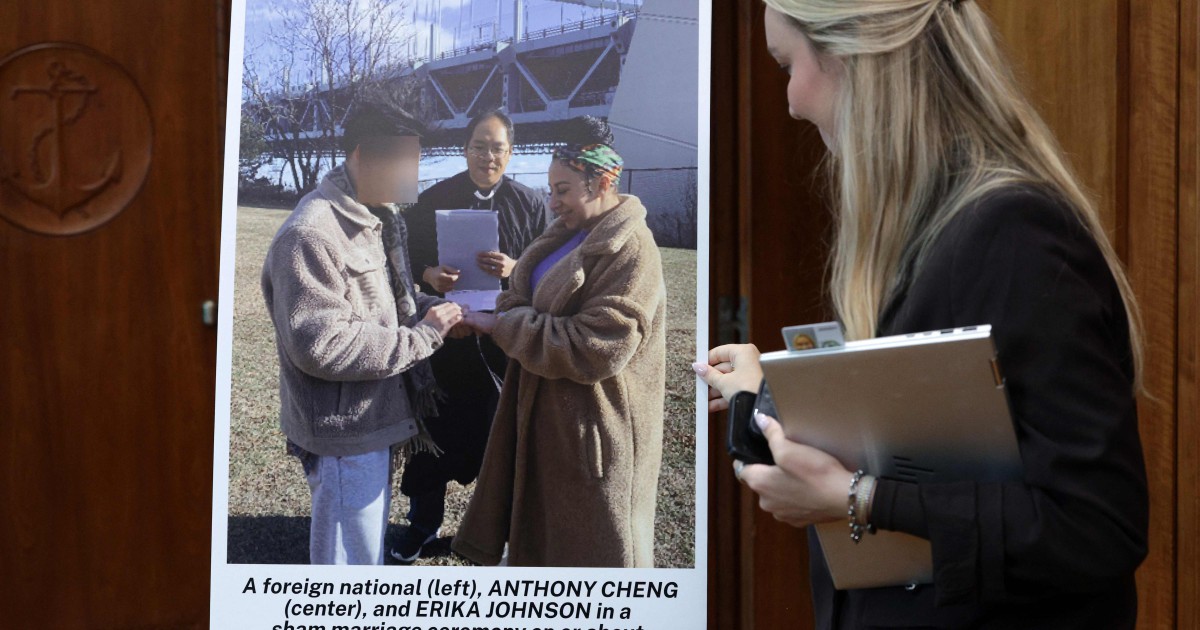
Federal prosecutors in Washington have brought criminal charges against 11 defendants accused of operating what court documents describe as a sophisticated and prolonged conspiracy to facilitate sham marriages between American citizens and foreign nationals seeking to enter the United States unlawfully. The alleged scheme, which operated continuously over a ten-year period, is believed to have resulted in the successful placement of around 1,000 individuals—predominantly Chinese citizens—into fraudulent marital arrangements designed to secure legal immigration status.
The charges represent an intensified enforcement effort against marriage fraud, a category of immigration crime that has long presented enforcement challenges for American authorities due to the inherent difficulty in distinguishing genuine relationships from purely transactional arrangements entered into solely for immigration benefit. The timing of these prosecutions follows recent policy initiatives from the Trump administration targeting various pathways to US residency, reflecting a broader hardline approach toward immigration enforcement that extends beyond traditional border security measures.
Marriage-based immigration represents one of the primary pathways for foreign nationals to obtain permanent residency in the United States. However, this mechanism has repeatedly been exploited by criminals who recruit American citizens willing to participate in fraudulent ceremonies in exchange for payment. The defendants in this case apparently facilitated multiple marriages across various jurisdictions, suggesting an organized network rather than isolated criminal acts. Such operations typically involve coordinated roles: recruiters who identify willing participants, facilitators who manage logistics, and handlers who maintain contact with the foreign nationals throughout the process.
The targeting of Chinese nationals is particularly significant given the substantial diaspora community within the United States and the documented demand among prospective Chinese migrants for expedited pathways to American residency. China remains a leading source country for immigration to the United States, driven by economic aspirations and family reunification desires. The alleged scheme's focus on this population indicates that criminal networks have identified and exploited a demographic segment perceived as having both motivation and financial resources to pay for fraudulent marriage arrangements.
For Malaysian readers and observers in Southeast Asia, this case underscores the regional implications of US immigration enforcement. As enforcement intensifies against traditional fraud schemes, criminal networks may redirect their operations toward other jurisdictions or explore alternative pathways. Additionally, the case serves as a reminder that immigration fraud carries serious federal consequences in the United States, including lengthy prison sentences and permanent deportation for foreign nationals convicted of participating in such schemes.
The mechanics of marriage fraud prosecutions typically involve substantial investigative work to establish that marriages were entered into without genuine intention to maintain a spousal relationship. Investigators examine communication records, financial transactions, testimony from the individuals involved, and evidence of whether the parties lived together or took actions consistent with legitimate marital intent. The prosecution must prove that the marriage was fraudulent specifically to circumvent immigration law, not merely that the relationship was troubled or destined to fail.
The scale suggested by the charging documents—approximately 1,000 successful placements over a decade—indicates that the scheme operated with notable efficiency and coordination. This volume raises questions about what safeguards may have been bypassed in the immigration adjudication process. US Citizenship and Immigration Services examiners face substantial caseloads, and determining fraudulent intent necessarily relies on documentary evidence and interviewed responses. Large-scale schemes sometimes exploit procedural efficiencies or pattern recognition limitations within bureaucratic systems.
The prosecution follows a pattern of elevated immigration enforcement priorities during the current administration. Previous policy directives have targeted visa overstays, asylum processing, and documented immigration pathways. By prosecuting marriage fraud conspirators, federal authorities are attempting to demonstrate comprehensive enforcement across multiple entry mechanisms. The message appears directed both at potential participants in such schemes and toward foreign nationals considering whether various immigration pathways remain viable.
From a regional perspective, Southeast Asian countries should recognize that US immigration law enforcement extends substantially beyond border control. Nationals from any source country engaging with marriage fraud operations face significant legal jeopardy regardless of their home country. Malaysian citizens, while not apparently targeted in this particular scheme, remain subject to equivalent prosecutorial standards should they become entangled in immigration fraud. The Justice Department has consistently prosecuted marriage fraud across multiple nationality groups over the years.
The investigation likely involved interagency coordination between federal law enforcement, immigration authorities, and potentially international partners who could assist in identifying foreign nationals who participated in the scheme. The duration of the conspiracy—spanning ten years—suggests that detection eventually resulted from accumulated evidence, witness cooperation, or financial investigations revealing the systematic nature of the operation. Success in dismantling such networks typically requires identifying either recruiters or actual foreign nationals willing to provide testimony about how they were approached and processed.
For individuals considering any form of immigration fraud, whether marriage-based or otherwise, the prosecutorial record demonstrates that federal authorities maintain capacity to investigate, prosecute, and secure convictions even where schemes operate across extended timeframes and multiple locations. The criminal consequences include not only imprisonment but also permanent bars to future immigration benefits, deportation consequences, and collateral impacts on family members.
The broader context reflects the contemporary tension within US immigration policy between restrictionist approaches focused on law enforcement and enforcement against fraud, versus advocates for more accessible immigration pathways. Cases like this one typically feature prominently in policy debates as evidence that fraud safeguards require enhancement or that certain pathways themselves merit reconsideration. As enforcement priorities continue evolving under the current administration, similar prosecutions targeting other fraudulent immigration schemes may follow.

