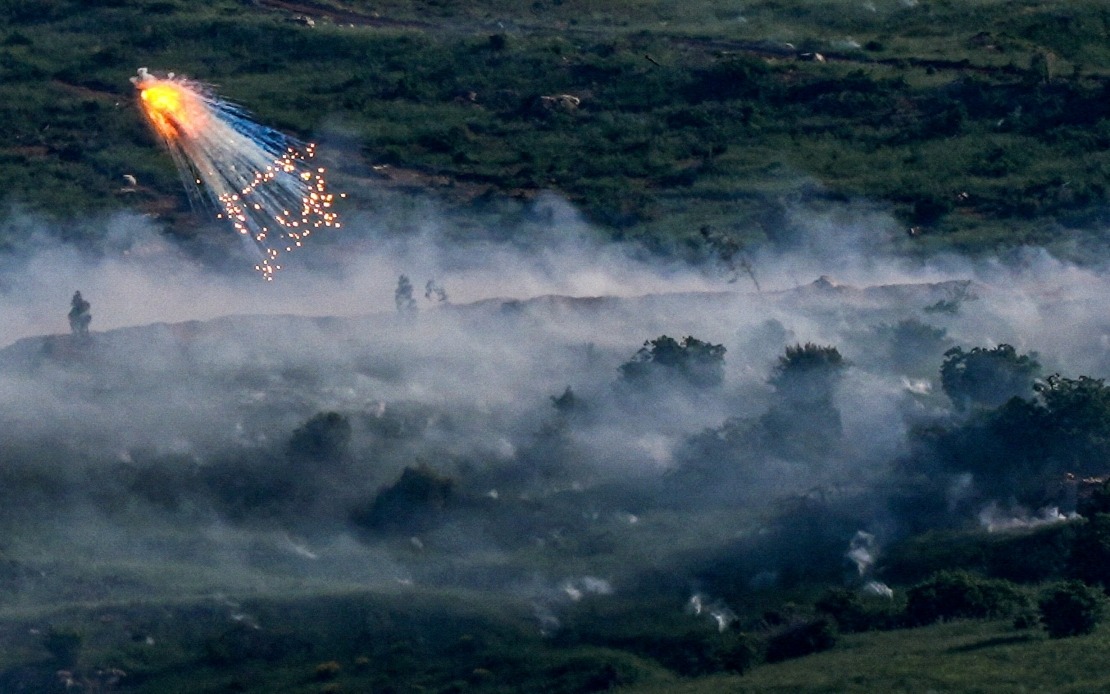
The United States government has advised its nationals to avoid travel to Lebanon and Israel's northern territories, with both its embassy in Beirut and diplomatic mission in Jerusalem issuing formal warnings on Saturday. The cautionary directives represent a significant escalation in Washington's assessment of security risks across the Middle East, signalling deepening concern about a region already destabilised by multiple overlapping conflicts and geopolitical rivalries.
According to the American Embassy in the Lebanese capital, the decision stems from "high tensions in West Asia" where "the security environment remains complex with the potential for unforeseen escalation." This language reflects the administration's worry that existing flashpoints could rapidly spiral into wider confrontation, with consequences that officials themselves cannot fully predict or prevent. The embassy's statement underscores how fragile the current equilibrium has become, with multiple armed actors and state players operating within close proximity and with competing strategic interests.
The Jerusalem-based embassy issued parallel guidance that extended beyond Israeli territory, instructing Americans to avoid Gaza entirely and to reconsider all travel plans throughout West Asia more broadly. The warning specifically prohibits movement to northern Israel and the Egyptian border region, with the single exception of the Taba crossing point. This granular approach to risk assessment suggests that American officials have mapped out specific corridors and zones they consider more or less dangerous, based on intelligence assessments and the current disposition of hostile actors in the region.
These travel advisories arrive at a moment of considerable strategic uncertainty in the Middle East. The region has become a theatre for US-Iran antagonism, with both powers conducting military operations against each other despite a Pakistan-brokered memorandum of understanding signed in June that was intended to establish a framework for de-escalation and long-term peace. The fact that hostilities have persisted despite this diplomatic initiative highlights the limitations of mediation efforts and the depth of mutual mistrust between Washington and Tehran.
For Malaysian and Southeast Asian travellers, these warnings carry practical implications. Lebanon has historically attracted Arab diaspora communities and business professionals from across the developing world, including from Malaysia. The advisory effectively closes off a previously accessible destination for regional visitors, with potential knock-on effects for tourism, trade, and people-to-people connections. Similarly, northern Israel's coastal regions and historic sites have drawn Malaysian tourists and pilgrims seeking both leisure and religious experiences.
The deterioration in security assessments reflects a pattern of mounting pressure across multiple conflict zones. Beyond the US-Iran dimension, the region contends with Israeli military operations, Palestinian resistance activities, the presence of various armed groups, and the broader aftermath of conflicts in Syria and Iraq. Each of these elements creates unpredictable interactions, and incidents in one location can rapidly trigger responses elsewhere, generating cascading escalation that official channels struggle to contain or reverse.
For Southeast Asian governments and citizens with interests in the Middle East, the American travel warnings serve as a barometer of international risk perception. Countries that depend on trade with the region or have significant diaspora populations there must factor in the possibility of further warnings, evacuation complications, or disruptions to business operations. Malaysia, as a nation with historic ties to the Arab world and significant Muslim population, maintains important economic and cultural connections that could be strained by prolonged security deterioration.
The persistence of tensions despite the Pakistan-brokered agreement suggests that structural factors driving competition between the United States and Iran remain unresolved. Both powers harbour deep strategic concerns about the other's regional influence, and these concerns cannot be easily addressed through diplomatic formulas alone. The memorandum of understanding may have created a framework for communication, but it has evidently failed to prevent either side from continuing military pressure against the other, indicating that the underlying competition continues beneath the surface of formal agreements.
American citizens working in Lebanon—including diplomats, journalists, aid workers, and business professionals—will face decisions about remaining in country or relocating. The embassy warning does not necessarily mandate evacuation but signals that Washington cannot guarantee protection if circumstances deteriorate further. This creates an ambiguous position for US nationals with professional commitments in Beirut, where American interests remain significant despite the security advisory.
The breadth of the warning, encompassing both Lebanon and northern Israel, indicates that American officials view the threat as region-wide rather than localised to specific flashpoints. This assessment suggests concern that a triggering incident anywhere in the area could rapidly spread, drawing in multiple parties and overwhelming local containment efforts. For potential visitors from Malaysia and the broader region, the practical effect is the same: destinations that were previously accessible have become categorised as high-risk, at least in the judgment of the world's largest diplomatic establishment.
Going forward, the trajectory of these warnings will depend on whether escalatory dynamics can be arrested through diplomatic or military means, or whether competitive pressures between major powers and regional actors continue to mount. Any further deterioration will likely prompt additional restrictions on movement and potentially force larger-scale evacuations of foreign nationals. Meanwhile, the cautionary guidance serves as a public signal about American confidence in regional stability—or lack thereof—during a particularly volatile period in Middle Eastern affairs.

