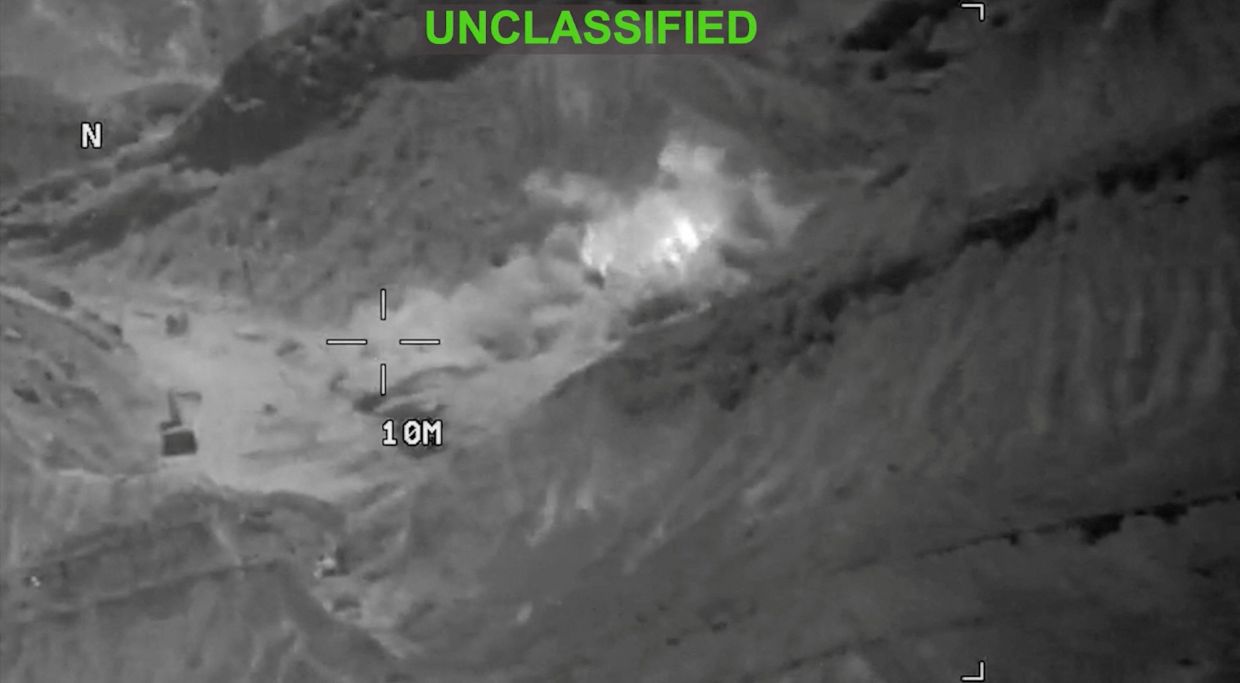
The United States carried out its eighth consecutive night of military strikes against Iran on Saturday, following the deaths of two American service members killed in a simultaneous Iranian attack on a Jordan-based installation. The fresh assault, directed by President Donald Trump, represents the latest chapter in a rapidly escalating cycle of retaliation between Washington and Tehran that threatens to plunge the region into full-scale warfare just days after a month-long interim ceasefire unravelled.
According to US Central Command, the latest strikes commenced at 6 p.m. Eastern Time on Saturday and were explicitly designed to degrade Iran's maritime threat capabilities in the Strait of Hormuz and to target Islamic Revolutionary Guard Corps units responsible for the previous evening's attack in Jordan. The assault targeted Iranian military coastal surveillance systems and air defence installations across the country. Iranian state media reported that American aircraft struck locations near Sirik in the nation's southern region and close to Shadegan, near the Iraqi border, though Tehran claimed no casualties or infrastructure damage resulted from these attacks.
Of particular concern to international observers was the reported US strike on a nuclear power plant under construction at Darkhovin, which Iran's Atomic Energy Organization condemned through the Mehr news agency. The timing and nature of targeting nuclear facilities raises troubling questions about the conflict's potential to inflict catastrophic civilian and environmental consequences, adding another destabilising dimension to an already volatile confrontation.
Iran responded swiftly to the American airstrikes by launching drone attacks against US military installations at Kuwait's Al-Adiri camp and Ali Salem Air Base, according to Iranian state television. These retaliation strikes represented part of a broader pattern of Iranian attacks against American and allied positions throughout the Persian Gulf region that has intensified over the past week. Kuwait's defence systems successfully intercepted Iranian missiles and drones on Sunday morning, marking at least the second consecutive day the Gulf state has come under Iranian assault. Bahrain similarly reported intercepting an Iranian attack through its air defence network, though neither Kuwait nor Bahrain reported casualties or material losses from the interceptions.
The human toll of this escalating conflict has become increasingly apparent. The confirmation that two American service members died in Friday's Iranian attack on the Jordan base, along with a third reported missing in action, brings total US military fatalities since hostilities began to sixteen, with over 420 additional personnel wounded. Iranian authorities, meanwhile, claimed that fifty people had been killed and more than five hundred wounded across the country during American airstrikes conducted over the previous three weeks alone.
Concerns about regional security extended to civilian infrastructure when the US embassy in Jordan announced the evacuation of Aqaba's international airport and seaport due to what it termed a "specific and credible threat". This announcement created confusion as Jordanian authorities stated they had detected no tangible threats in recent hours and had not issued any evacuation directive, highlighting the fog of war and miscommunication that can characterise escalating military crises.
The conflict has introduced unprecedented disruption to global maritime commerce and energy security. Both powers have weaponised the Strait of Hormuz, through which approximately one-fifth of the world's oil supply normally transits. The US claims to be enforcing a naval blockade on Iran, while Tehran asserts it is enforcing its own navigation rules through the waterway. Iran's Revolutionary Guard stated that four vessels attempted to transit using an "unsafe route" with American backing on Sunday, claiming two abandoned the attempt while the other two encountered an unspecified "accident". Such disputes over maritime passage threaten to trigger wider economic disruption affecting global oil markets and inflation.
The broader geopolitical context remains deeply troubling for Southeast Asian nations dependent on stable energy supplies and predictable shipping routes. The conflict, which commenced when the United States and Israel launched coordinated strikes on February 28 aimed at degrading Iran's nuclear programme and regional proxy networks, has already created significant economic ripple effects. Higher energy costs and supply chain uncertainty have direct implications for Malaysia and neighbouring economies that rely heavily on petroleum imports and regional trade through the Strait of Hormuz.
Supreme Leader Ayatollah Mojtaba Khamenei issued a strongly worded statement through Iranian state media late Saturday, characterising American commitments as fundamentally worthless and devoid of credibility. His message warned of "heavier costs and further humiliation" awaiting the United States, suggesting Iranian leadership sees no near-term path toward de-escalation. Notably, Khamenei has not appeared publicly since before his predecessor Ali Khamenei was killed in the initial February 28 American-Israeli airstrike, adding an element of uncertainty regarding Iran's leadership continuity and decision-making capacity during this critical period.
The collapse of last week's interim ceasefire agreement represents a critical turning point in the trajectory of US-Iran hostilities. Rather than serving as a foundation for sustained peace negotiations, the brief respite appears to have merely provided both sides time to regroup and prepare for intensified operations. The pattern of escalation—with each side striking in response to previous attacks—suggests a dangerous momentum that may prove difficult to arrest without serious diplomatic intervention from regional powers or the international community.
Defence Secretary Pete Hegseth's statement that American casualties "stiffen our resolve" signals continued American commitment to military pressure on Iran. This rhetorical framing indicates the Trump administration views further escalation as the appropriate response to Iranian actions rather than pursuing immediate negotiations, a posture that risks transforming the current crisis into a protracted regional conflict with unpredictable consequences for global stability and the economies of nations dependent on Middle Eastern stability.

