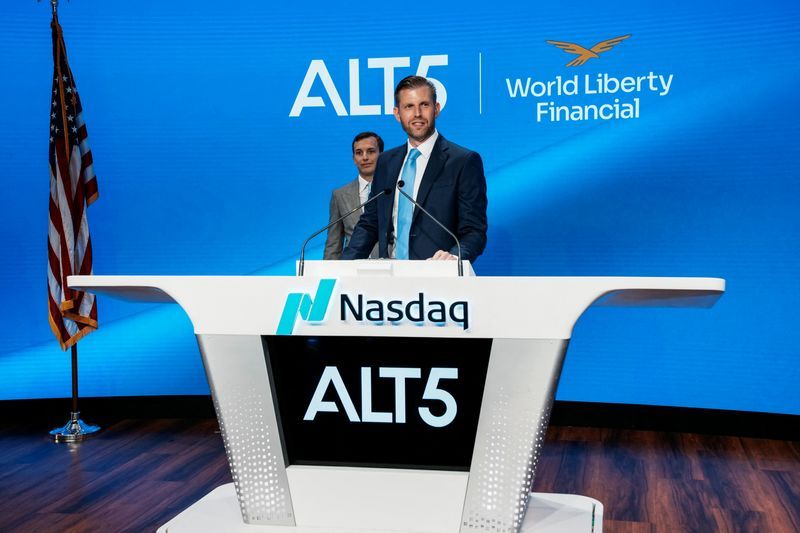
The United States Office of the Comptroller of the Currency has conditionally approved a national trust bank charter for World Liberty Trust Company, marking a significant regulatory milestone for the cryptocurrency venture owned by President Donald Trump and his family. The OCC, a division of the Treasury Department, issued this conditional preliminary approval in a letter published on Friday, clearing the way for World Liberty Financial to substantially expand its stablecoin operations under federal banking oversight.
The charter application, first submitted in January, represents a major strategic move for the Trump-aligned crypto company. Once fully finalized, the trust bank charter would fundamentally reshape World Liberty's operational structure, allowing it to directly manage customer assets, facilitate faster payment settlements, and handle the critical functions of issuing and custodying its flagship USD1 stablecoin. Notably, these essential operations are currently outsourced to a third-party partner, BitGo, which handles both the issuance and custody responsibilities for the dollar assets that back the stablecoin.
Trust bank charters differ from traditional banking licenses in important ways that reflect the evolving financial landscape. While they do not permit deposit-taking or consumer lending activities associated with conventional banks, they do grant crypto companies the ability to provide comprehensive asset servicing under a single federal charter. This structure is particularly attractive for digital asset firms seeking to build institutional client bases, as it enables nationwide operations under uniform regulatory standards. Several other cryptocurrency firms, including notable players such as Ripple and Circle, have similarly secured preliminary approval for comparable charters during the tenure of Comptroller Jonathan Gould, whom Trump appointed to the position last year.
World Liberty Financial has emerged as a centerpiece of the Trump family's cryptocurrency portfolio, which has generated substantial financial returns. According to Reuters calculations, the family earned approximately USD50 million from USD1 stablecoin operations alone through the end of June 2026, while the broader World Liberty Financial enterprise has transferred more than USD1.6 billion to the president and his family as of April. The USD1 stablecoin itself has achieved remarkable market traction since its March 2025 introduction, currently ranking as the fourth largest stablecoin by market capitalisation at around USD4 billion. This rapid growth underscores the commercial success of the venture despite its controversial political dimensions.
Zach Witkoff, who serves as president and chairman of World Liberty Trust, characterised the conditional approval as a milestone achievement, emphasizing that the structure would bring stablecoin issuance, custody, and reserve management under unified OCC supervision. Witkoff is the son of Steve Witkoff, Trump's special diplomatic envoy, and represents the deeply intertwined relationship between the venture's leadership and Trump's inner circle. The Witkoff family members, alongside Trump and his three sons, co-founded World Liberty Financial in late 2024, cementing the family's central role in the organisation. Beyond Zach's appointment as CEO, his uncle Robert Witkoff, a former insurance executive, is positioned as a director of the trust, while Scott Alper, president of the Witkoff family's real estate operations, has been proposed as another board member.
The conditional approval comes with several regulatory requirements that World Liberty must satisfy to obtain final charter status. The company must maintain a minimum capital reserve of USD20 million, notify regulators of any substantial changes to its business strategy, and recruit a qualified internal audit manager. These conditions reflect standard regulatory prudence, yet they also underscore the OCC's determination to exercise meaningful oversight over this politically sensitive venture. The regulator specifically addressed concerns raised during the approval process regarding foreign investors in World Liberty Financial, clarifying that such investors would not be considered principal shareholders and requiring passivity agreements from international stakeholders, including Eric Trump, the president's son, who signed on behalf of a Trump family investment vehicle.
The approval process has not proceeded without controversy, particularly regarding national security considerations. In February, two Democratic members of the US Senate Banking Committee requested that Trump's Treasury secretary examine potential national security implications stemming from a reported USD500 million investment stake in World Liberty Financial connected to the United Arab Emirates' national security adviser. This inquiry reflected broader concerns among Democrats about the appropriateness of granting banking privileges to a venture so closely tied to the incumbent administration. The political dimensions of the decision gained further prominence when Democratic lawmakers pressed Comptroller Gould during a February congressional hearing to disclose the company's unredacted application, noting that the publicly released version omitted crucial details regarding capital structure and operational plans.
The OCC's defence of its decision emphasised institutional integrity and professional standards, stating in the approval letter that Comptroller Gould and his staff had acted in accordance with their statutory obligations and ethical responsibilities. The regulator further noted that career staff conducted the review and would oversee ongoing supervision through nonpolitical examiners, suggesting a deliberate effort to insulate the decision from accusations of political favoritism. This rhetorical positioning becomes particularly relevant given that the OCC, unlike most other federal financial regulators, operates without a bipartisan governance structure, raising questions about accountability mechanisms when the regulator is controlled entirely by a single party.
World Liberty Financial has positioned itself as part of the Trump administration's broader embrace of cryptocurrency innovation, a stance markedly different from the cautious regulatory approach characterizing earlier administrations. The company's leadership has articulated a mission to democratise financial access by enabling individuals to circumvent what they characterise as an overly restrictive traditional banking system. This populist framing aligns with Trump administration rhetoric but carries significant implications for financial regulation and institutional integrity. For Malaysian and Southeast Asian observers, the approval of a trust bank charter for a politically connected cryptocurrency venture raises important questions about regulatory independence, conflict of interest management, and the governance frameworks governing emerging digital finance sectors across the region.
The USD1 stablecoin, presented as World Liberty's flagship offering, is framed as a safe, dollar-backed digital asset designed to provide blockchain-based financial access. Its rapid ascent to become the fourth largest stablecoin globally demonstrates substantial market demand, though it remains unclear whether this adoption reflects genuine utility, investor confidence in the backing mechanisms, or simply the promotional advantages conferred by Trump family association. The integration of stablecoin issuance and custody under OCC supervision theoretically provides greater regulatory oversight than third-party custodial arrangements, potentially enhancing transparency and accountability in reserve management. However, the broader question of whether regulatory approval of politically sensitive financial ventures sets appropriate precedents for the financial system merits ongoing scrutiny from investors, policymakers, and the broader public.

