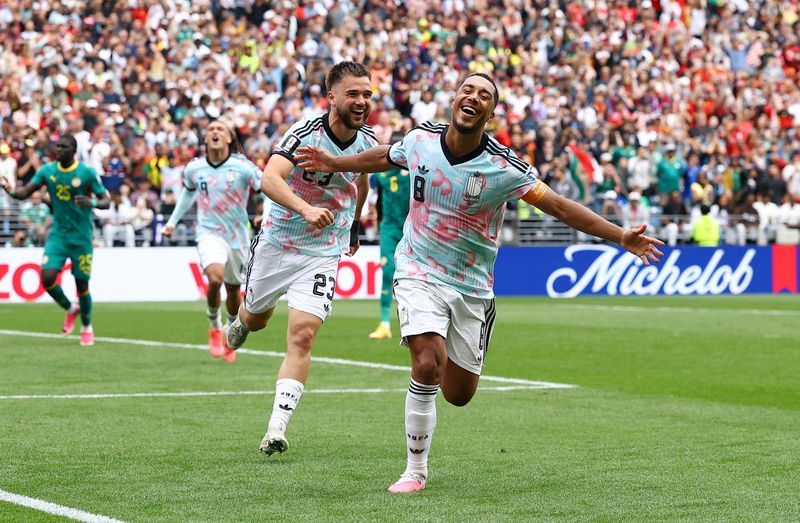
The United States and Belgium will clash in one of the World Cup's most intriguing last-16 encounters when they meet at the Seattle Seahawks' home stadium, a venue renowned for its deafening atmosphere and partisan crowds. The match on July 4 carries enormous implications for both nations, though they arrive at this crossroads from markedly different positions within the tournament. For the American side, momentum has built steadily with each passing match, while Belgium faces mounting questions about whether their storied generation of players can deliver when it matters most.
Preparations for this tournament saw American observers setting modest targets, with qualification to the final 16 teams widely regarded as a credible achievement for a squad still rebuilding its global standing. Yet Mauricio Pochettino's team has systematically exceeded those initial benchmarks, dismantling Paraguay and Australia during the group phase before executing a disciplined defensive display against Bosnia that proved particularly impressive given the team played the final 36 minutes with a numerical disadvantage following Folarin Balogun's sending-off. Each success has raised the ceiling of what supporters now dare to envision, transforming this match from a potential outlier into what many view as a genuine opportunity to advance deeper into the competition.
Belgium's trajectory through the tournament has been considerably more turbulent. The European nation required dramatic intervention to progress from their group assignment, trailing Senegal for extended periods before conjuring two goals to level and ultimately advancing through a controversial penalty decision awarded after video assistant referee consultation in extra time. That narrow escape has done little to inspire confidence among observers tracking their performance metrics, with many analysts questioning whether the team possesses sufficient cohesion and tactical discipline to sustain a prolonged campaign at this level.
For Belgium, this World Cup represents something approaching a final examination for what the football world has long termed their "Golden Generation." Midfielders and attacking talent of the calibre of Kevin De Bruyne, combined with the goal-scoring prowess of Romelu Lukaku and the goalkeeping excellence of Thibaut Courtois, represents a constellation of world-class players that rarely aligns within a single national program. The window for converting individual brilliance into collective silverware has been narrowing steadily, lending particular poignancy to this fixture and potentially their campaign more broadly.
The American defensive unit, which entered the tournament saddled with reputation for vulnerability, has emerged as an unexpected source of stability and organizational strength. Against Bosnia, the backline maintained shape and discipline despite playing at a significant numerical disadvantage, showcasing precisely the type of resilience that determines outcomes in knockout football. However, their concentration will face a serious examination when confronting Jeremy Doku, the Belgian winger whose performances throughout the group stage have been conspicuously muted by his considerable standards. Tactical analysis suggests that Doku, operating with space and freedom, could prove a game-changing presence during the knockout phase, making his potential breakthrough performance a critical variable in determining the match's flow.
This encounter carries unmistakable echoes of 2014, when these nations last met in the round of 16 at Brazil. That previous meeting is etched into American football consciousness primarily through the lens of Tim Howard's monumental 16-save goalkeeping display, demonstrating at the highest level of global competition despite ultimately falling short in extra time. The narrative of American near-misses and valiant efforts that fall marginally short has defined the national team's World Cup experience for decades. A reversal of that outcome nine years later would represent something more significant than simple match victory—it would signal a genuine inflection point in the program's competitive standing.
The absence of Balogun, who collected a red card during the Bosnia encounter despite scoring in that same match, complicates Pochettino's tactical calculations considerably. The striker's two-match suspension removes a proven goal contributor precisely when the team's attacking potency becomes most critical. The selection puzzle facing the coaching staff will determine whether the Americans maintain their group-stage attacking approach or pivot toward a more conservative setup that prioritizes defensive organization and counter-attacking efficiency.
The Seattle venue adds another dimension to what is already a laden fixture. The Seahawks' stadium ranks among North American sports' most intimidating environments, with crowd noise levels regularly exceeding 130 decibels—sufficient to impair opponents' ability to execute set-piece plays and coordinate defensive movements. For a Belgian side whose communication and organization have already shown signs of strain, this acoustic assault could prove particularly destabilizing. Conversely, the American players will experience the psychological lift of performing before a rabidly supportive home crowd, creating an additional marginal advantage in a competition where such increments frequently prove decisive.
America's progression thus far has captured the national sporting imagination in ways the men's team has struggled to achieve during previous World Cup campaigns. The combination of early tournament success, the compelling storyline of a young squad exceeding pre-tournament expectations, and the prospect of advancing further on home soil has transformed casual observers into engaged followers. Media coverage has intensified proportionally, creating an environment where the team's continued advancement has become intertwined with broader cultural conversations about American soccer's maturation and global competitiveness.
The ramifications for Southeast Asian football observers merit attention as well. The development trajectory of the American program, its recruitment of emerging talent, and its tactical approaches to international football competition all influence broader regional dynamics. An American team that advances deep into the knockout rounds elevates the tournament's quality and provides instructive demonstrations of how smaller footballing nations might organize defensively and exploit limited attacking opportunities. The match thus carries significance extending beyond the bilateral contest itself, touching upon questions about competitive standards, tactical innovation, and the continued evolution of football's global landscape.

