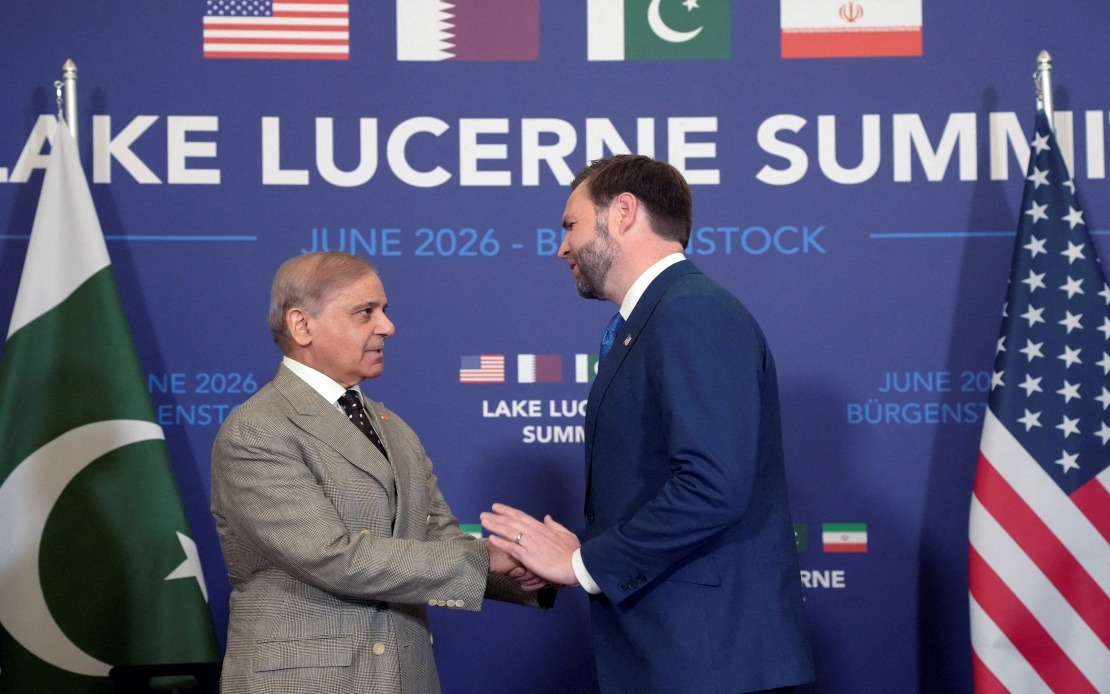
High-ranking American and Pakistani officials commenced substantive discussions in the Swiss mountain resort of Burgenstock on Sunday, marking a significant diplomatic engagement between the two countries. The White House confirmed that Vice President JD Vance, alongside special presidential envoys Steve Witkoff and Jared Kushner, received Pakistan's Prime Minister Shehbaz Sharif and Pakistan Army Chief Field Marshal Asim Munir for talks that proceeded immediately following their formal greeting. The timing of this bilateral meeting—taking place alongside broader multilateral negotiations involving Iran, Qatar, and the United States—underscores the interconnected nature of regional security architecture in South and West Asia.
The Burgenstock gathering represents a delicate diplomatic moment for Pakistan, which has historically maintained complex relationships with both the United States and Iran. As a country situated at the intersection of these geopolitical interests, Pakistan's participation in these talks reflects its role as both a technical mediator and a stakeholder in regional stability. The involvement of Field Marshal Asim Munir, the country's highest military authority, emphasizes that Pakistan views these discussions with sufficient importance to warrant involvement at the most senior command level. This underscores military leadership's investment in shaping the outcomes of negotiations that will directly influence Pakistan's security environment and economic interests.
The broader context involves technical-level discussions on a memorandum signed remotely by Iran and the United States overnight into June 18. This agreement represents a dramatic shift in bilateral relations, committing both nations to ending military hostilities that commenced on February 28. The accord establishes concrete mechanisms for de-escalation, including timelines for the American naval blockade to be lifted and for Iranian shipping operations to resume in the Strait of Hormuz. For Malaysian and Southeast Asian observers, these developments carry significance given regional dependence on stable maritime commerce through critical shipping lanes and the broader implications for global energy markets.
Iran's commitment under the memorandum to refrain from acquiring nuclear weapons constitutes perhaps the most consequential element for international security architecture. However, the agreement deliberately compartmentalizes the nuclear question, designating it for resolution through separate negotiations scheduled to conclude within sixty days. This bifurcated approach suggests both parties recognized that nuclear matters required distinct treatment from military de-escalation protocols. The nuclear negotiations will determine whether comprehensive sanctions relief materializes for Tehran—a key Iranian objective that could reshape regional economic dynamics and potentially affect global oil supplies given Iran's significant petroleum reserves.
For Pakistan, these discussions carry particular weight given the country's geographic proximity to Iran and its existing economic vulnerabilities. Pakistani leadership has long sought to balance relationships with both Western powers and Iran while managing internal security threats that sometimes intersect with broader regional conflicts. The presence of both civilian leadership under Prime Minister Sharif and military command in the form of Field Marshal Munir suggests a coordinated national approach to these negotiations, indicating consensus within Pakistan's power structure regarding strategic objectives.
The choice of Switzerland as the negotiating venue reflects careful diplomatic calculation, as the country's traditional neutrality and sophisticated infrastructure provide neutral ground for contentious parties. The discreet nature of these discussions—described as occurring behind closed doors—enables candid conversations without public pressure or immediate media scrutiny. This working method allows negotiators flexibility to explore creative compromises that might prove politically difficult if conducted transparently.
Qatar's role as a mediator alongside Pakistan emphasizes the Persian Gulf region's stakes in these negotiations. Both nations serve as bridges between the American-led Western sphere and Iran, and their participation lends legitimacy to whatever arrangements emerge. For regional states including Malaysia and other Southeast Asian nations, the restoration of stability between Iran and the United States carries implications for shipping security, energy pricing, and the broader balance of power in Asian geopolitics.
The memorandum's provisions regarding maritime commerce restoration in the Strait of Hormuz deserve particular attention for its global economic ramifications. As one of the world's most critical chokepoints for energy transit, any sustained disruption to Hormuz shipping affects prices and availability of crude oil in Asian markets, including Malaysia. The agreement's timeline for lifting the naval blockade therefore extends beyond bilateral Iranian-American concerns to encompass the economic interests of trading nations throughout the region.
Looking forward, the sixty-day window for nuclear negotiations will test whether the initial framework can withstand detailed implementation discussions. Historical experience with Iranian nuclear negotiations suggests that technical details often prove more contentious than broad frameworks. Pakistan and Qatar's roles as mediators may prove crucial during these critical discussions if either side interprets specific provisions differently. The success of these negotiations will fundamentally shape not only Iranian-American relations but also the security environment across South Asia and the Middle East for years to come.
The participation of high-level Pakistani civilian and military leadership suggests Islamabad intends to extract maximum benefit from its mediating position and to ensure that whatever arrangement emerges reflects Pakistani security interests. As a nuclear-armed nation with its own complex relationship to international nonproliferation agreements, Pakistan brings distinctive perspectives to discussions about Iranian nuclear limitations. The meetings in Burgenstock thus represent not merely technical discussions but pivotal moments in shaping how major regional and global powers will interact throughout the remainder of this decade.
%22%2F%3E%3C%2Fpattern%3E%3C%2Fdefs%3E%3Crect%20width%3D%22100%25%22%20height%3D%22100%25%22%20fill%3D%22url(%23ph20e1dg)%22%2F%3E%3Crect%20width%3D%22100%25%22%20height%3D%22100%25%22%20fill%3D%22url(%23ph20e1dp)%22%2F%3E%3Ctext%20x%3D%2250%25%22%20y%3D%2250%25%22%20text-anchor%3D%22middle%22%20dominant-baseline%3D%22central%22%20fill%3D%22rgba(255%2C255%2C255%2C0.95)%22%20font-family%3D%22Georgia%2C%20'Times%20New%20Roman'%2C%20serif%22%20font-weight%3D%22700%22%20font-size%3D%22272%22%20letter-spacing%3D%22-0.02em%22%3EMITRA%3C%2Ftext%3E%3C%2Fsvg%3E)
%22%2F%3E%3C%2Fpattern%3E%3C%2Fdefs%3E%3Crect%20width%3D%22100%25%22%20height%3D%22100%25%22%20fill%3D%22url(%23ph29qdrg)%22%2F%3E%3Crect%20width%3D%22100%25%22%20height%3D%22100%25%22%20fill%3D%22url(%23ph29qdrp)%22%2F%3E%3Ctext%20x%3D%2250%25%22%20y%3D%2250%25%22%20text-anchor%3D%22middle%22%20dominant-baseline%3D%22central%22%20fill%3D%22rgba(255%2C255%2C255%2C0.95)%22%20font-family%3D%22Georgia%2C%20'Times%20New%20Roman'%2C%20serif%22%20font-weight%3D%22700%22%20font-size%3D%22320%22%20letter-spacing%3D%22-0.02em%22%3ERim%3C%2Ftext%3E%3C%2Fsvg%3E)
%22%2F%3E%3C%2Fpattern%3E%3C%2Fdefs%3E%3Crect%20width%3D%22100%25%22%20height%3D%22100%25%22%20fill%3D%22url(%23phnm1xg)%22%2F%3E%3Crect%20width%3D%22100%25%22%20height%3D%22100%25%22%20fill%3D%22url(%23phnm1xp)%22%2F%3E%3Ctext%20x%3D%2250%25%22%20y%3D%2250%25%22%20text-anchor%3D%22middle%22%20dominant-baseline%3D%22central%22%20fill%3D%22rgba(255%2C255%2C255%2C0.95)%22%20font-family%3D%22Georgia%2C%20'Times%20New%20Roman'%2C%20serif%22%20font-weight%3D%22700%22%20font-size%3D%22320%22%20letter-spacing%3D%22-0.02em%22%3EPM%3C%2Ftext%3E%3C%2Fsvg%3E)