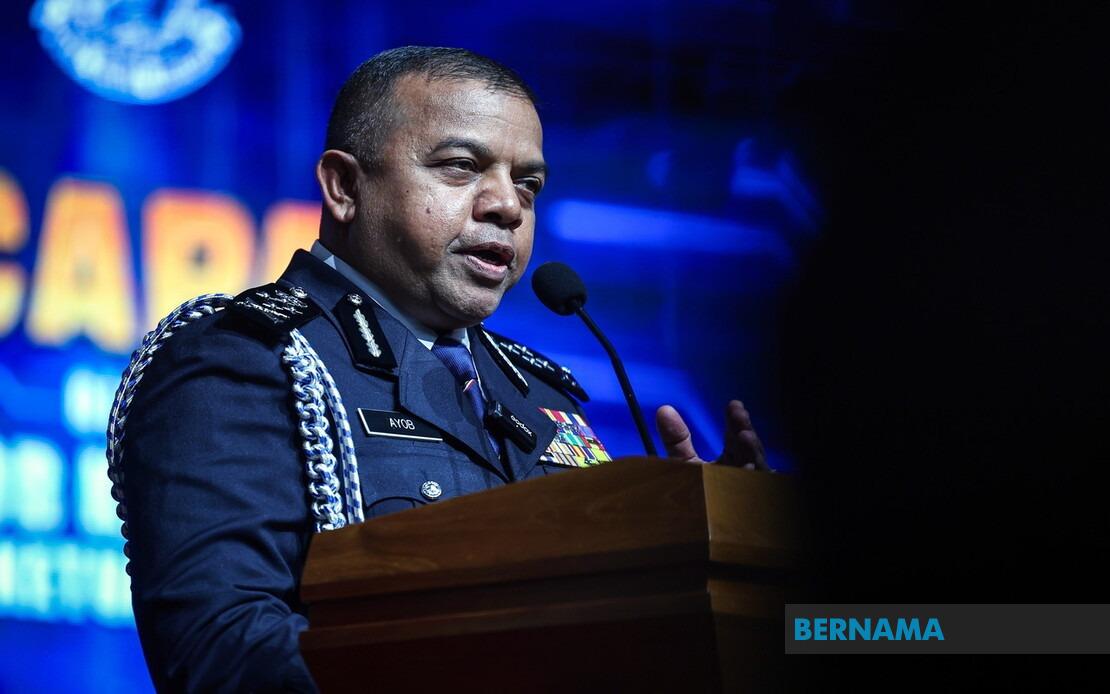
Tan Sri Ayob Khan Mydin Pitchay delivered an emotionally charged farewell message today as he officially retired from the Royal Malaysia Police after nearly 35 years of service, imploring the entire force to remain steadfast in upholding the institution's integrity and honour. Speaking during the formal handover ceremony at the Police Training Centre (PULAPOL) here, with Inspector-General of Police Tan Sri Mohd Khalid Ismail in attendance, the outgoing 29th Deputy Inspector-General issued a stark warning to all ranks about the corrosive effects of personal misconduct on an institution built through generations of sacrifice.
In his address, Ayob Khan reminded police officers and personnel that the badge they wear represents far more than their individual careers—it symbolises the expectations of a public seeking justice and protection. He articulated a vision of institutional stewardship that transcends the immediate gratification of rank or financial gain, emphasising that the force's reputation rests on the collective conduct of its members. His message resonated with particular relevance in an era when public confidence in law enforcement agencies across Southeast Asia has come under scrutiny, with high-profile corruption cases and abuse allegations creating reputational damage that takes years to remedy.
Ayob Khan's remarks carried an unmistakable moral dimension, grounded in both professional ethics and religious principle. He explicitly cautioned against selling one's dignity for financial reward, weaponising authority to oppress vulnerable populations, and abandoning institutional values for personal enrichment. The retiring deputy chief framed integrity not as a performance to be maintained only under observation, but as an intrinsic quality that should persist when institutional oversight is absent. This distinction—between superficial compliance and genuine moral conduct—represents a sophisticated understanding of organisational culture that acknowledges the limitations of external monitoring and surveillance.
The philosophical foundation of his message extended beyond pragmatic concerns about scandal or oversight failure. Ayob Khan invoked a transcendent accountability, reminding officers that human superiors may remain ignorant of misconduct and colleagues may never witness wrongdoing, yet divine scrutiny remains constant and inescapable. This framework attempts to establish conscience as the primary mechanism of accountability, suggesting that sustainable institutional reform must be rooted in internalised values rather than fear of external punishment. For Malaysian police personnel, accustomed to a hierarchical command structure and formal disciplinary procedures, this appeal to personal conscience represents an alternative approach to maintaining standards.
The ceremony itself marked a formal transition in police leadership, with Datuk Seri Ibrahim Darus, the Bukit Aman Special Branch Director, assuming the role of Acting Deputy Inspector-General effective immediately. This succession occurs at a juncture when Malaysia's police force continues navigating complex challenges including counterterrorism operations, transnational crime investigation, and evolving public expectations around policing practices. The handover represents not merely an administrative transition but a moment for institutional reflection on the standards and values that should characterise police leadership during turbulent times.
Ayob Khan's career trajectory illuminated the pathway through Malaysia's police hierarchy over three and a half decades. His progression encompassed several strategically important positions: he directed the Special Branch Counter-Terrorism Division, served as Johor Police Chief overseeing one of the nation's most demanding jurisdictions, headed the Narcotics Crime Investigation Department during the government's intensified war on drugs, and managed the Bukit Aman Criminal Investigation Department before ascending to the deputy inspector-general position in June 2023. This varied experience provided him with institutional perspective across multiple operational domains, from frontline counterterrorism to drug trafficking interdiction to serious crime investigation.
Born in Kota Setar, Kedah, Ayob Khan characterised his police service as transcending the boundaries of ordinary employment. He acknowledged the personal toll that police work exacts—the necessity of separating from family in pursuit of duty assignments, the psychological burden of operating under sustained pressure, and the frequent absence of public recognition for conscientious service. Yet he counselled against allowing such hardships to justify ethical compromise or institutional betrayal. His message implied that sacrifice itself becomes meaningless if the institution serving is corrupted from within, suggesting that authentic police work requires both personal resilience and organisational integrity.
The timing of Ayob Khan's departure and his parting exhortation coincides with broader conversations across Malaysia and the Southeast Asian region regarding police reform and institutional accountability. Various civil society organisations, international observers, and academic institutions have highlighted the necessity for law enforcement agencies to strengthen internal accountability mechanisms, enhance transparency in complaint processes, and cultivate institutional cultures that actively discourage misconduct. Ayob Khan's emphasis on personal conscience and individual ethical responsibility intersects with these external reform pressures, suggesting that lasting change requires commitment from within the institution itself.
For Malaysian readers and observers of policing policy, Ayob Khan's farewell address offers insights into how senior leadership conceptualises institutional challenges and transmits values to subordinate ranks. His explicit rejection of corruption, abuse of authority, and dignity-surrendering behaviour establishes clear normative expectations, yet his rhetorical approach—emphasising conscience and transcendent accountability rather than enforcement mechanisms—suggests his understanding that sustainable reform cannot rely solely on disciplinary systems. The address implicitly acknowledges that institutional cultures are shaped through leadership messaging, collective example, and the values systems that senior figures visibly embody and articulate.
The broader implications for Malaysia's police force extend beyond this particular moment of transition. Ayob Khan's insistence that officers remain faithful to institutional integrity even in the absence of observation addresses a fundamental challenge in hierarchical organisations: ensuring that distributed authority is exercised responsibly across thousands of personnel in diverse circumstances. His appeal to conscience represents an attempt to establish an internal moral compass that functions independently of formal supervision—a potentially more sustainable approach to institutional integrity than systems dependent on constant external monitoring.
As Datuk Seri Ibrahim Darus assumes the acting deputy inspector-general position, the standards articulated by his predecessor will likely shape expectations regarding his own tenure and leadership approach. The Police Training Centre ceremony served as a formal moment for transmitting institutional values across generational lines within the force, with the incoming leadership inheriting both the operational responsibilities of the position and the moral imperatives that Ayob Khan forcefully articulated in his farewell remarks.

