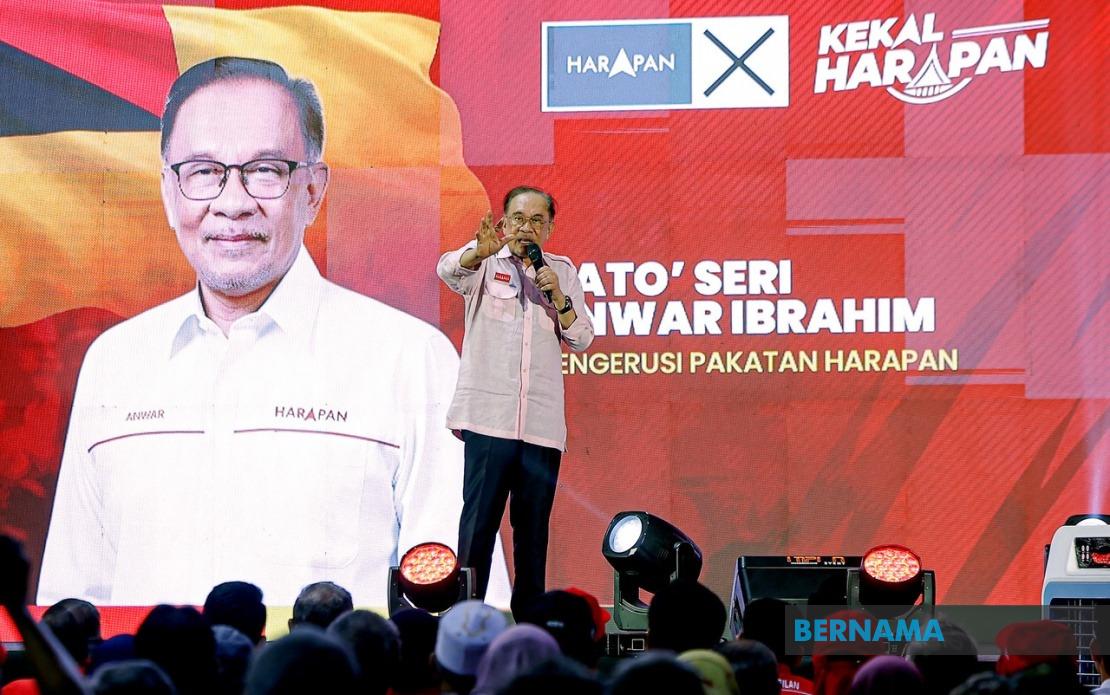
Prime Minister Datuk Seri Anwar Ibrahim has sought to reassure the nation that the federally-constituted Unity Government maintains its stability and strength, emphasizing the administration's commitment to preserving economic momentum and sustaining investor confidence in the country. Speaking in Seremban, Anwar stressed that despite competing political interests at state level, the coalition governing Malaysia at the federal tier has demonstrated its capacity to function effectively and pursue the nation's economic agenda without disruption.
The Prime Minister's remarks come amid ongoing discussions about potential shifts in the political landscape following recent elections. Anwar pointed to the practical evidence of federal coalition cohesion, noting that Cabinet meetings continue to proceed smoothly with regular attendance and active participation from key ministerial figures across the coalition's member parties. He specifically referenced recent gatherings that included Minister of Agriculture and Food Security Datuk Seri Mohamad Sabu, Transport Minister Anthony Loke, Deputy Prime Minister Datuk Seri Dr Ahmad Zahid Hamidi, and other senior leaders, all working within established governmental frameworks.
The distinction Anwar drew between state-level and federal-level dynamics reflects a nuanced political reality in Malaysia's multi-tiered governance structure. While state governments operate independently with their own electoral mandates and political configurations, the federal coalition has successfully compartmentalized competitive electoral behaviour at the state level without allowing such rivalry to destabilize national administration. This separation, according to the Prime Minister, has proven essential in maintaining the predictability and coherence that foreign and domestic investors require when considering long-term commitments to the Malaysian economy.
Investor confidence represents a critical consideration for Malaysia's economic outlook, particularly as the nation seeks to recover from post-pandemic economic challenges and maintain its competitive position within Southeast Asia's investment landscape. The Prime Minister's emphasis on preserving governmental stability directly addresses the concerns of global and regional capital markets, where political uncertainty can trigger capital outflows and discourage new foreign direct investment. By publicly affirming the Unity Government's structural integrity, Anwar is essentially signalling to international financial institutions and multinational corporations that Malaysia remains a dependable and stable destination for investment.
The cooperation mechanisms within the federal cabinet appear to function through established institutional channels and formal protocols that transcend factional or party-based divisions. Anwar's reference to the regular conduct of Cabinet meetings suggests that procedural consistency and professional administration have created sufficient buffers against political fragmentation at the federal level. This institutional resilience becomes particularly important in a coalition government structure, where divergent political interests must be accommodated within a single executive framework while maintaining unified policy direction and implementation capacity.
The implicit acknowledgment that tensions exist at the state level, while asserting they have not significantly infected federal governance, reflects the reality of Malaysia's political competition. State governments controlled by different coalition partners or opposition parties naturally pursue divergent agendas, and electoral contests at that level generate partisan intensity that cannot easily be suppressed. However, the federal tier operates under different constraints and incentives, where governing parties share common interests in economic performance, fiscal management, and maintaining international standing that can override factional differences at lower levels of government.
Anwar's invocation of religious trust, stating "Insha'Allah" regarding the continuation of federal stability post-elections, combines pragmatic political messaging with a broader appeal to Malaysian values and aspirations. This rhetorical approach acknowledges both the uncertainty inherent in electoral transitions and the shared national interest in maintaining governmental continuity. The comment anticipates potential concerns among Malaysians about what might occur following upcoming electoral contests, whether state or national, by expressing confidence in the resilience of federal institutions regardless of electoral outcomes.
The economic dimension underscores the utilitarian logic binding the federal coalition together. Regardless of partisan affiliation or historical rivalries, member parties of the Unity Government share an interest in economic growth and job creation, which benefit their electoral prospects and legitimize their governance. Conversely, economic stagnation or contraction damages all coalition partners equally, creating powerful incentives for pragmatic cooperation even amid political differences. The Prime Minister's framing positions economic performance as the ultimate measure of governmental success and the shared responsibility of all federal coalition partners.
The stability that Anwar describes appears contingent on maintaining existing institutional arrangements and avoiding the escalation of disagreements that might destabilize coalition cohesion. His emphasis on Cabinet unity and consistent administration suggests that the government's strategy relies on professional governance, respect for established procedures, and the judicious management of inter-party tensions through formal institutional channels rather than through public confrontation or media campaigns. This approach may prove vulnerable if underlying coalition tensions intensify or if members increasingly compete for credit for government successes while avoiding blame for failures.
For Malaysia's regional position and engagement with Southeast Asian neighbours, federal political stability carries additional significance. ASEAN's emphasis on non-interference and respect for national sovereignty means that Malaysia's internal political arrangements command less attention in regional forums, yet persistent instability or perceived ineffectiveness at the federal level could gradually erode Malaysia's diplomatic influence and soft power within the region. Anwar's assurances about federal stability thus serve not only domestic audiences but also signal to regional partners that Malaysia remains a reliable and coherent actor within ASEAN and broader Indo-Pacific frameworks.
The test of these stability claims will arrive through time and through responses to inevitable policy disagreements and resource allocation disputes that emerge within any complex coalition. The government's capacity to manage such conflicts through institutional mechanisms while preserving public confidence in federal governance will determine whether current assertions of stability translate into genuine long-term coherence or mask underlying fragilities that may only become apparent during subsequent electoral cycles or economic downturns.

