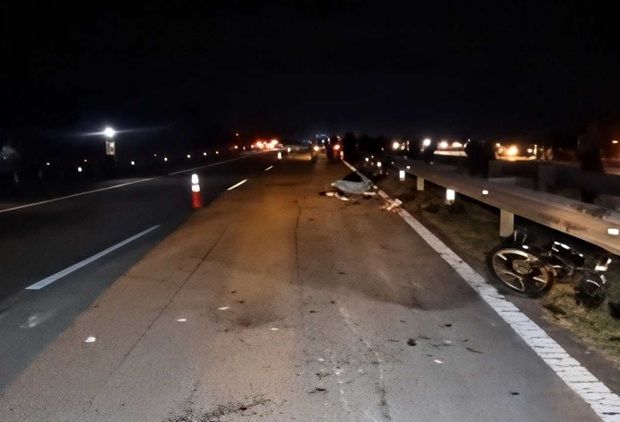
Last Saturday's catastrophic collision on the East Coast Expressway delivered a brutal reminder of the fragility of ordinary lives. The 1am crash scattered motorcycle debris across the carriageway and claimed four lives—three at the scene and another in hospital. Thirteen more sustained injuries ranging from minor to severe. The incident inevitably triggered social media outrage and finger-pointing, with armchair critics rushing to assign blame and debate questions of negligence and reckless conduct. Yet beneath the noise of public judgment lay a quieter, more profound tragedy that demanded urgent attention but received comparatively little.
In the seconds it took for the crash to unfold, eight children—aged between one and 13 years old—lost their fathers. The four men who had woken that morning as breadwinners, providers, and protectors were gone. What followed was not just grief, but the urgent practical challenge of survival facing their widows. Rent does not pause for mourning. Grocery bills still arrive. School fees remain due. The families now faced the daunting prospect of maintaining their households on resources that had suddenly vanished, their economic foundation crumbled in an instant.
This tragedy inadvertently illuminates a chronic gap in Malaysian public understanding of social security. Many citizens regard their PERKESO contributions as grudging payroll deductions—money extracted from their salaries that disappears into an bureaucratic void. Few truly grasp that social security operates on a principle of collective solidarity, where the healthy subsidise the sick, the fortunate support the afflicted, and those spared by disaster stand with those who have suffered. It is, fundamentally, a societal covenant that no family should be left destitute when catastrophe strikes.
The architects of social security understood that a safety net must catch people before they fall into poverty. It is not a reward bestowed on those who have never stumbled. It is not merely compensation paid after death, medical treatment provided after injury, or a pension granted when someone's earning capacity is compromised. Rather, it represents a solemn commitment that when disaster threatens to collapse the roof over a family's head, that family—especially the children within it—will not be abandoned to degradation and want.
For the families affected by the East Coast tragedy, this protection materialises in tangible, monthly form. Three of the deceased had contributed to PERKESO, making their families eligible for Survivors' Pensions. The family of Che Mohd Suffian Che Gani qualified for RM2,207.63 monthly. The family of Muhammad Hafiz Al Hakim Mazlan received RM1,258.33, while the family of Mohd Aizat Husni was allocated RM708.33. These amounts, distributed according to prescribed formulas, provided the widows with RM1,325, RM755, and RM425 respectively for life. When calculated across 30 years, these pensions represent cumulative benefits of RM477,000, RM271,800, and RM153,000—substantial sums that would have been entirely absent without social security infrastructure.
Beyond the widows' support, PERKESO allocated a collective monthly sum of RM1,670 for the eight children. Over the 15-year period until they reach adulthood, this allocation totals RM300,600, a critical contribution toward the costs of feeding, clothing, educating, and nurturing eight young lives through their formative years. Combined, the total long-term benefits flowing to families affected by this single tragedy exceeded RM1.2 million. Those small payroll deductions—once invisible and resented—now flowed back as a steady stream of protection, keeping families anchored during their darkest hours.
The magnitude of these benefits deserves emphasis precisely because it contradicts the dismissive attitude many Malaysians harbour toward social security contributions. Workers often view PERKESO deductions as an inconvenient tax rather than an investment in collective resilience. Yet this tragedy demonstrated that the principle underlying these contributions is neither abstract nor inconsequential. When a 35-year-old father dies unexpectedly, leaving a widow and several young children, the difference between having systematic social security and lacking it becomes the difference between potential stability and certain destitution.
Equally significant is the transformation effected by the Lindung 24 Jam scheme, introduced before the June 1 deadline. Five of the 13 injured victims in the East Coast crash qualified for benefits under this expanded framework. Before that date, these injured workers might simply have swelled the statistics of applications that PERKESO was legally constrained to reject. The Lindung 24 Jam extension represented a philosophical shift—broadening the safety net to catch those whom previous regulations would have left without support. For workers injured in accidents regardless of contribution duration, this scheme offers immediate assistance when they are most vulnerable.
The Malaysian public's relationship with social security remains complicated by insufficient understanding of its purpose. Many workers see their contributions as money lost to government, unaware that they are participating in a mechanism designed to protect themselves and their families. The East Coast tragedy, painful as it is, provides a sobering case study in why this protection matters profoundly. Those eight children will grow up knowing that their mothers did not have to choose between keeping a roof over their heads and feeding them adequately. That outcome did not occur by accident; it resulted from systematic contributions and a social insurance framework designed with human vulnerability in mind.
As Malaysia continues developing its social security infrastructure, the conversation must shift from viewing contributions as burdensome to understanding them as foundational to family stability and national resilience. The widows of the East Coast crash did not become wealthy from their husbands' PERKESO contributions, but neither were they cast into poverty. That distinction—between adequate support and complete destitution—may seem modest in the abstract, but for families rebuilding after tragedy, it represents the difference between hope and despair. Lindung 24 Jam and similar expansions deserve recognition not as charity or temporary relief, but as expressions of a mature society's commitment to ensure that loss does not cascade into generational poverty.

