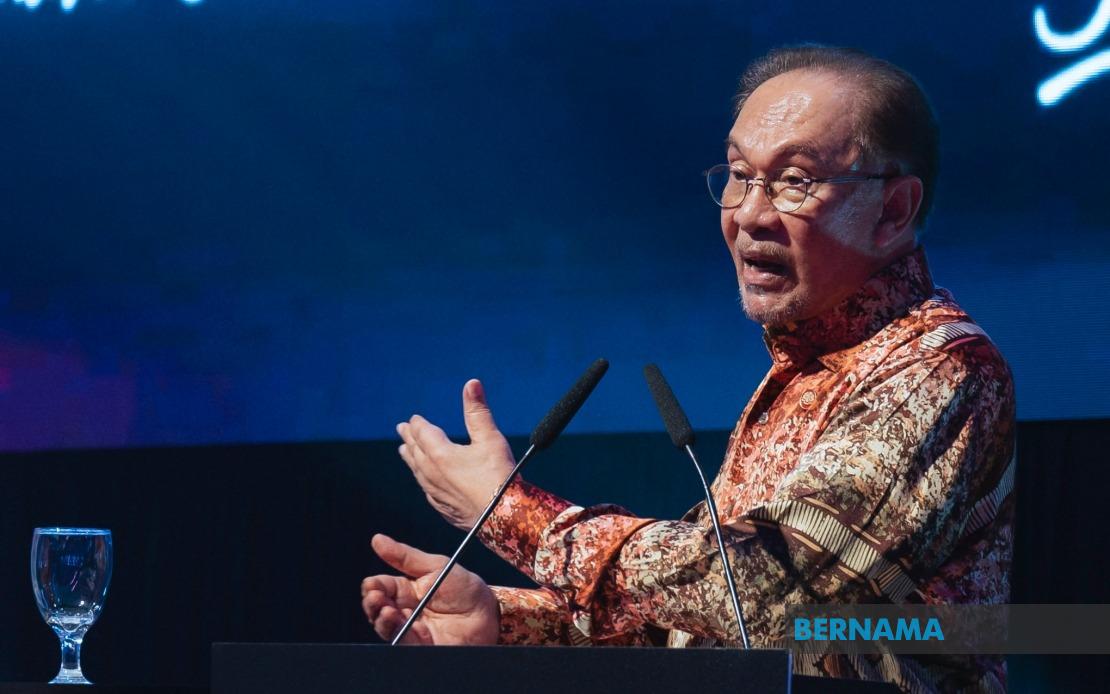
Prime Minister Datuk Seri Anwar Ibrahim's recent remarks regarding Taiwan sparked considerable debate, particularly his acknowledgment of China's position that force may be employed if peaceful reunification efforts fail. Yet interpreting these comments as support for military action would misrepresent the Prime Minister's underlying argument, which instead engages with the classical geopolitical concept of deterrence as an instrument for maintaining peace and preventing territorial dismemberment.
The essence of Anwar's position rests on a foundational principle of state conduct: no government willingly accepts the fragmentation of its territory without mounting resistance. To illustrate this principle, he drew a parallel with Malaysia itself, positing that no Malaysian administration would acquiesce to the breakup of the Malaysian federation merely through passive acceptance. This analogy serves to explain why Beijing views Taiwan through the lens of national sovereignty and territorial integrity rather than as an external geopolitical dispute. The argument pivots on understanding motivations rather than endorsing actions.
Crucially, maintaining the theoretical capacity to defend territorial integrity differs substantially from prioritising military solutions. Anwar's framework explicitly positions negotiation, legal mechanisms, and political settlements as the primary avenues for dispute resolution. Force, within this conception, functions as a backstop—a final recourse when all diplomatic channels have been exhausted, rather than a first instinct or preferred approach. This distinction proves vital for comprehending the difference between possessing military capability and choosing to deploy it.
The logic of deterrence underpins much of international security doctrine. A credible deterrent operates precisely because an adversary acknowledges the possibility of consequences, thereby discouraging challenges to the status quo. Paradoxically, a deterrent remains most effective when never actually employed; its value lies in preventing conflict rather than in winning one. However, should a state entirely renounce the option of force, it risks inviting instability by removing the calculation of risk that might otherwise restrain aggressive moves. In this sense, reserving the right to defend one's borders is conceptually distinct from wielding force as a tool of first resort.
Within the specific context of Malaysia's One China policy, Anwar's remarks acquire additional nuance. Malaysia officially recognises the People's Republic of China and does not accord Taiwan separate sovereign status in diplomatic relations, yet maintains substantial economic engagement and people-to-people exchange with Taipei. This balancing act requires acknowledging legitimate interests on multiple sides. If Malaysia accepts the One China framework, the argument proceeds, then it cannot simultaneously dismiss Beijing's concerns over territorial integrity as inherently illegitimate. This does not mean endorsing any particular method of addressing those concerns, but rather recognising them as genuine geopolitical interests rather than pretexts.
Taiwan's government and democratic advocates fundamentally reject this perspective, viewing the island as an established sovereign democracy with its own right to self-determination. From this vantage point, any reference to force as an option risks providing rhetorical cover for coercion and international pressure. This disagreement reflects a genuine collision between competing principles—sovereignty and self-determination on one hand, territorial integrity and reunification on the other. Anwar's remarks, however, address the logic of Beijing's position rather than validating its preferred outcomes.
Regional stability presents a paramount concern that transcends theoretical debate about deterrence. A military conflict in the Taiwan Strait would unleash devastating consequences for Southeast Asia's trading networks, global supply chains, and the peace architecture that ASEAN has laboriously constructed. The region possesses profound interests in restraint, continued dialogue between all parties, and the pursuit of peaceful resolution mechanisms. Malaysia, as both an ASEAN member and a participant in regional stability frameworks, must consistently advocate for de-escalation and dialogue, not merely between China and Taiwan but across the international community.
The substance of Anwar's argument reflects classical realist thinking in international relations: states do not pre-commit to accepting territorial dissolution, and they maintain defensive capacities precisely to forestall situations in which they might face dismemberment unprepared. This represents a neutral observation about state behaviour rather than advocacy for any particular conflict. Many scholars and policymakers across diverse geopolitical traditions accept this premise as a fundamental characteristic of the international system, where no higher authority reliably protects weaker entities from coercion.
Malaysia's diplomatic position necessarily remains calibrated to navigate these tensions without abandoning principle. The country can simultaneously uphold the One China framework that it has adopted, steadfastly oppose coercion regardless of its source, and actively champion mechanisms for peaceful dispute settlement. This balanced approach acknowledges the complexity of great power competition without sacrificing commitment to regional stability or the interests of smaller nations.
Ultimately, Anwar's remarks should be understood as articulating a realist perspective on state behaviour in an anarchic international system, not as cheerleading for military confrontation. The fundamental proposition—that states preserve capacity for self-defence to avoid being forced to choose between capitulation and unpreparedness—describes how nations typically operate rather than prescribing how they should behave. Malaysia's challenge lies in maintaining this sophisticated understanding while consistently promoting the restraint and dialogue that the region desperately requires, ensuring that deterrence functions as a guarantor of peace rather than a harbinger of conflict.

