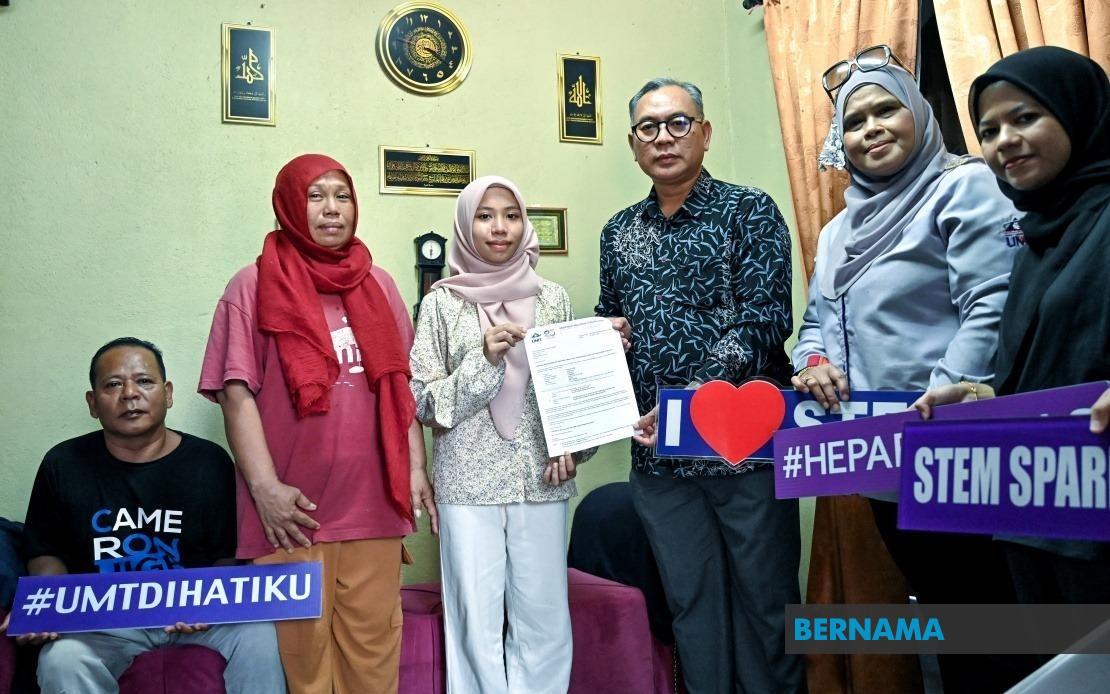
An 18-year-old student from Parit Jawa in Bagan Serai nearly abandoned her university dreams after receiving an acceptance letter, unable to find the funds for registration and tuition fees. Nurul Amira Abdul Hamid's situation changed dramatically when Universiti Malaysia Terengganu (UMT) intervened with a comprehensive support package, allowing her to enrol in the one-year Science, Technology, Engineering and Mathematics (STEM) Foundation programme before progressing to a Bachelor's degree in Science (Nautical Science and Maritime Transportation). Her family's precarious financial position—with her father Abdul Hamid Othman suffering from health complications and her mother Asmah Che Ros working as a housewife—had forced the teenager to take up employment at a goods store earning RM1,300 monthly to contribute to household expenses.
The financial barrier that threatened to derail Nurul Amira's educational trajectory reflects a broader challenge facing Malaysian students from underprivileged backgrounds. After completing her SPM (Sijil Pelajaran Malaysia) examinations with three A grades at Sekolah Menengah Kebangsaan Sri Kurau, she had already resigned herself to putting tertiary education on hold. The prospect of accumulating debt through tuition fees appeared unrealistic given her family's circumstances, particularly when her father's medical expenses compounded their financial strain. This situation is not isolated; thousands of capable Malaysian students face similar crossroads annually, where academic merit alone cannot guarantee access to higher education without additional support mechanisms.
UMT's intervention demonstrated a proactive institutional approach to ensuring equitable access to university education. Rather than waiting for students to fail, the university actively engaged with Nurul Amira and her parents to understand their constraints and identify practical solutions. The institution secured the Al-Ikhlas Scholarship worth RM500 for the student, supplemented by additional financial assistance that collectively reduced the burden on her family. Beyond the scholarship component, UMT covered RM400 of her registration and related fees, effectively removing the immediate financial roadblock. This multifaceted support framework acknowledges that merely offering a scholarship is insufficient when families lack capacity to bridge the gap between assistance provided and total costs incurred.
The university's support extended beyond financial aid into the realm of practical accessibility. Since Nurul Amira's family could not afford transportation and accommodation costs associated with campus visits and enrolment procedures, UMT arranged for her to come to campus at the institution's expense. This level of support recognition that financial hardship often manifests in multiple, overlapping constraints that a single intervention cannot address. Living allowances throughout her study period form another crucial component of the support package, enabling her to concentrate on academic pursuits without the distraction of finding part-time work to cover basic expenses. Such holistic assistance represents a shift from traditional scholarship models that address tuition costs alone.
UMT Vice-Chancellor Prof Dr Mohd Zamri Ibrahim articulated the university's philosophy on student support, emphasizing that institutional responsibility extends to proactive engagement rather than passive administration. His statement that students facing financial difficulties should approach the university directly, with the assurance of assistance availability, invites a cultural shift in how institutions relate to economically vulnerable students. Rather than viewing such students as exceptions or burdens, the vice-chancellor framed support provision as a core institutional responsibility aligned with the university's broader mission. This messaging is significant for other potential applicants, particularly those from rural areas or low-income households who might assume higher education is financially inaccessible regardless of their academic capabilities.
The scale of UMT's intervention this year provides insight into the prevalence of financial barriers in Malaysian higher education. The vice-chancellor disclosed that more than ten students from underprivileged backgrounds received assistance from UMT during the current academic cycle. While this figure demonstrates meaningful institutional commitment, it also suggests that hundreds or thousands of similarly deserving students across Malaysia's public and private universities may lack comparable support. The concentration of such cases within a single institution raises questions about whether systemic approaches to student financial assistance adequately match the scale of need across the higher education sector.
Nurul Amira's background in Nautical Science and Maritime Transportation represents a particularly strategic field for Malaysian economic development. The maritime sector remains vital to Malaysia's trade, shipping, and logistics industries, with persistent demand for skilled professionals. By supporting students in such strategically important disciplines, universities like UMT are simultaneously addressing individual student needs and contributing to human capital development in sectors critical to national competitiveness. Her pursuit of tertiary education in this specialized field would have been entirely foreclosed without UMT's intervention, representing a loss to the nation's maritime workforce development pipeline.
The emotional dimension of Nurul Amira's story deserves emphasis in understanding why institutional support matters profoundly. She described experiencing near-despair when initial acceptances seemed financially unachievable, followed by palpable relief and gratitude when UMT's assistance materialized. Such emotional pivots have lasting psychological effects, influencing not only immediate academic engagement but also long-term confidence and aspiration trajectories. Students who experience institutional support during vulnerable moments often develop stronger institutional loyalty and community commitment, potentially translating into enhanced academic performance and future contributions to their communities.
The Al-Ikhlas Scholarship specifically, mentioned as the primary funding mechanism, carries cultural and religious significance within Malaysian Islamic charitable traditions. By utilizing existing Islamic philanthropic frameworks, UMT demonstrates institutional understanding of diverse funding mechanisms within the Malaysian context. This approach to financial aid, drawing on multiple sources including Islamic endowments and university-administered funds, provides a model for other institutions seeking to expand support capacity without relying exclusively on government allocations or international partnerships.
UMT's experience with student financial hardship intervention offers practical lessons for other Malaysian universities and policymakers developing higher education accessibility strategies. The emphasis on direct university-family engagement, rather than purely formalized application procedures, acknowledges that economically vulnerable families may lack information about available support or confidence navigating bureaucratic processes. Creating pathways for informal communication about financial difficulties, coupled with assured institutional response, lowers barriers to accessing help. Furthermore, recognizing that students often work immediately post-SPM to contribute to family expenses highlights the importance of early intervention during the critical transition period between secondary and tertiary education.
Looking forward, Nurul Amira's progress through the STEM Foundation programme and subsequent Bachelor's degree will provide valuable data on support effectiveness. Her ultimate success—measured through degree completion, employment outcomes, and career trajectory—will offer evidence regarding whether comprehensive financial and living assistance translates into meaningful academic achievement and professional mobility. Such longitudinal tracking is essential for refining institutional policies and developing more targeted, effective support interventions. Additionally, her experience may serve as inspiration and practical evidence for other potential applicants from similar socioeconomic backgrounds, demonstrating that financial constraints need not be insurmountable barriers to university education in Malaysia's institutional landscape.

