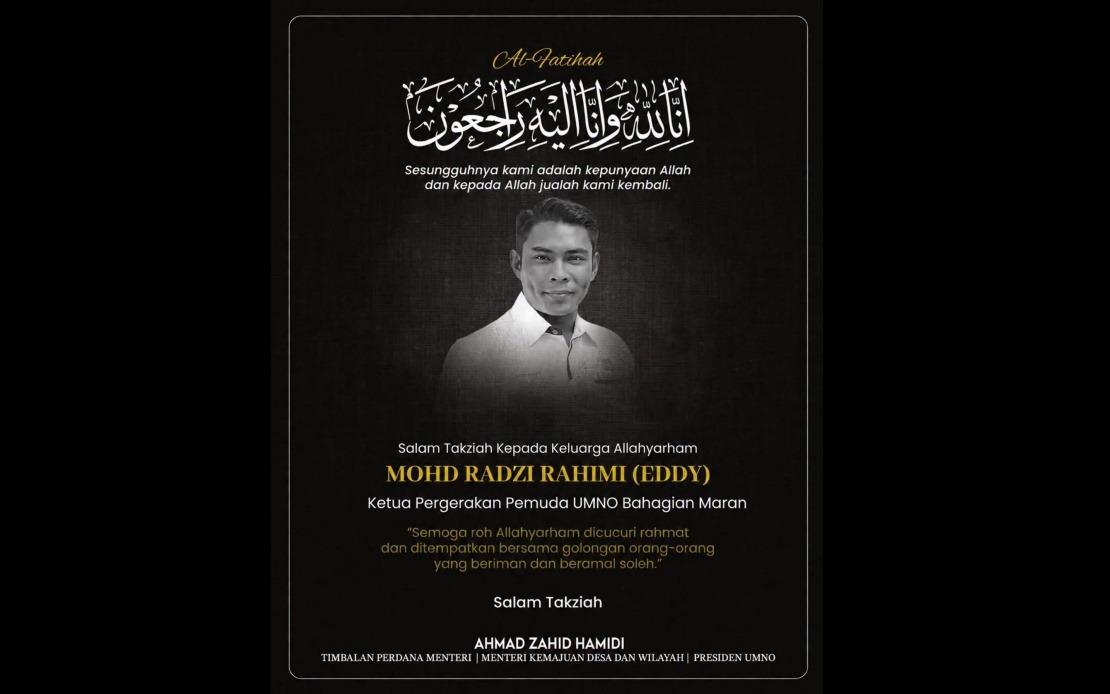
UMNO president Datuk Seri Dr Ahmad Zahid Hamidi has expressed profound condolences following a tragic accident in Bentong that claimed the lives of Maran UMNO Youth chief Mohd Radzi Rahimi, his wife, and his brother-in-law. The incident, which occurred on August 3, also left a young boy dead and another injured, marking a devastating loss to the ruling party's leadership structure and the broader Malaysian political community.
Ahmad Zahid, in a Facebook statement, characterised Mohd Radzi's passing as an immense loss to the UMNO family, with particular emphasis on the impact for the Maran division and Pahang UMNO Youth, where the deceased held significant organisational responsibility. The timing of the statement underscores the gravity with which the party views the incident and reflects the customary political acknowledgement of such tragedies within Malaysia's established political networks.
The 40-year-old Mohd Radzi was travelling in a vehicle with family members when a falling tree struck their car during what appears to have been severe weather conditions. The accident resulted in the immediate deaths of three adults and a young child, creating a humanitarian crisis that extended beyond political circles to affect an entire family unit. A second child, believed to be the twin of the deceased boy, survived the incident but sustained injuries requiring hospitalisation at Bentong Hospital.
Ahmad Zahid's condolence message employed measured but emotionally resonant language, acknowledging the profound grief experienced by the bereaved family. The UMNO president noted that conventional words proved inadequate to capture the scale of suffering endured by those close to the deceased, a sentiment that reflects the emotional weight of sudden, violent loss. Such statements serve both as formal acknowledgements of tragedy and as markers of institutional sympathy within Malaysia's political establishment.
The loss carries particular significance for UMNO's youth wing structure and for Pahang state-level politics. Youth wings represent important recruitment and organisational pipelines within Malaysian political parties, and the death of a division chief removes both institutional experience and leadership continuity from the party's grassroots operations. This type of loss can create vacuums in local political organisation that may take months to address through formal succession processes.
Mohd Radzi's position as Maran UMNO Youth chief placed him within a critical tier of party management, responsible for mobilising younger party members, organising activities, and serving as a bridge between national party leadership and ground-level operatives. His death removes a voice from internal party deliberations and eliminates the relationships and networks that he had cultivated within Pahang's political landscape.
The inclusion of family members in the tragedy compounds the personal loss experienced by Mohd Radzi's immediate relatives and highlights the unpredictability of accidents involving environmental hazards. The death of a spouse and the near-total loss of a family unit within a single incident creates a humanitarian dimension that extends beyond political considerations into broader questions about community support for bereaved families.
For the Malaysian political establishment more broadly, the incident represents a stark reminder of the vulnerabilities that affect public figures and their families, regardless of protective measures or status. Tree-fall incidents, while often preventable through proper maintenance and environmental management, remain occasional occurrences during weather events across the country.
Ahmad Zahid's invocation of Islamic sentiment in his condolence message, specifically calling upon Allah SWT to grant strength to the bereaved family, reflects the Islamic cultural context within which Malaysian political discourse operates. This framing provides spiritual comfort while reinforcing the shared religious values that unite Malaysia's Muslim-majority political leadership.
The immediate practical implications for UMNO include the need to arrange state-level replacement processes for the Maran Youth chief position and to address any organisational disruptions that may result from Mohd Radzi's absence. Political parties typically have succession frameworks to manage such contingencies, though the sudden and tragic nature of such losses inevitably creates periods of uncertainty and emotional processing within affected divisions.
This tragedy also serves as an occasion for Malaysian society to reflect on public safety issues related to vegetation management in urban and suburban areas, particularly given the frequency of tree-related incidents during storms and adverse weather. Government agencies responsible for maintaining public spaces may face renewed scrutiny regarding maintenance protocols and emergency preparedness.
The incident demonstrates how personal tragedy and political significance intersect in Malaysia's public sphere, where leaders at all levels remain vulnerable to circumstances beyond institutional control. For UMNO specifically, the loss represents not merely the passing of an individual but the removal of institutional memory, personal networks, and organisational capacity that individual leaders accumulate during their tenure.
As the Malaysian political community processes this loss, the incident may prompt broader conversations about party succession planning, family protection for public figures, and environmental hazard management at local government levels. The bereaved family's experience will likely resonate across UMNO's membership, reinforcing the shared vulnerabilities that bind political communities together beyond matters of policy and partisan advantage.

