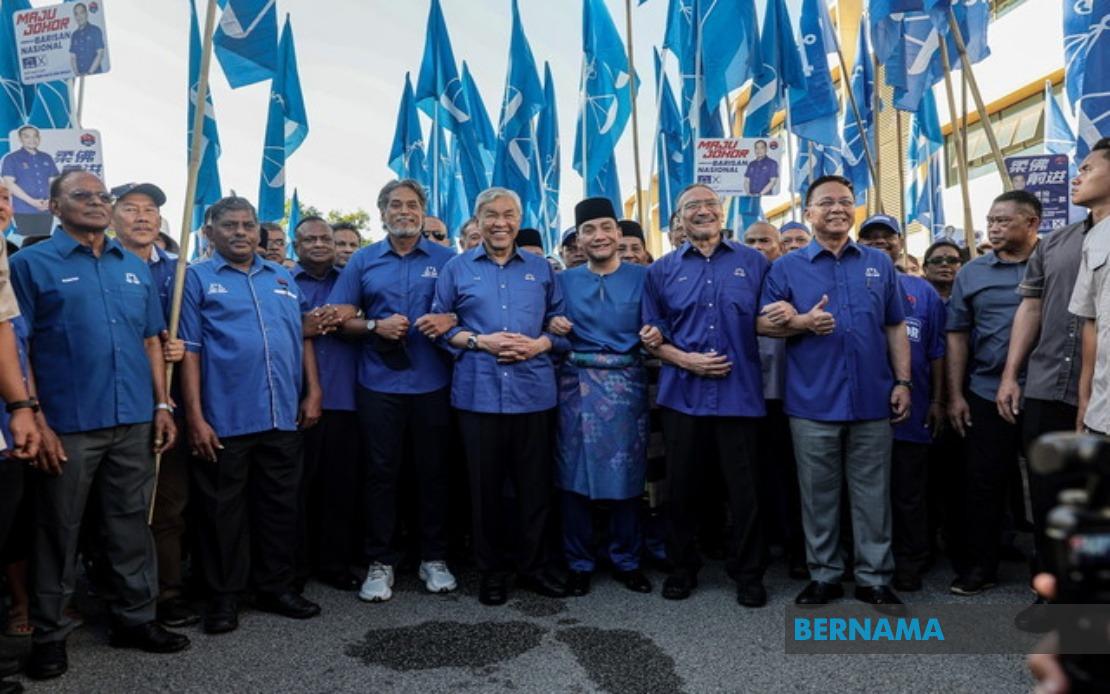
Johor's political establishment turned out in force on Thursday morning as Barisan Nasional chairman Datuk Onn Hafiz Ghazi officially launched his state election campaign, submitting his nomination documents at 9.10 am at the Muafakat Hall in Simpang Renggam District Council. The ceremonial filing underscored the strategic significance of the incumbent Machap assemblyman's candidacy, with the party mobilising senior leadership to project unity and organisational strength ahead of the 16th state election.
The show of support was notable for its breadth across UMNO's hierarchy. UMNO president Datuk Seri Dr Ahmad Zahid Hamidi made the journey to Simpang Renggam alongside Sembrong MP Datuk Seri Hishammuddin Tun Hussein and former minister Khairy Jamaluddin, signalling that the party's top tier regards Onn Hafiz's election prospects as integral to its broader regional ambitions. The presence of these figures reflected the calculated messaging that Johor remains a battleground where UMNO must consolidate its traditional support base to maintain relevance in an increasingly competitive electoral landscape.
Former Johor Menteri Besar Datuk Seri Hasni Mohammad also attended the nomination filing, adding an additional layer of institutional continuity to the proceedings. His participation served as a reminder of past BN governance in the state and the party's efforts to reconnect that historical legacy with contemporary electoral positioning. Such symbols of continuity matter significantly in Malaysian state politics, where voters often respond to narratives of stability and experience.
The immediate surroundings of the nomination centre reflected the energy that major state elections generate among grassroots supporters. Supporters from various BN component parties had gathered in the vicinity, identifiable by their party colours and armed with banners and flags to demonstrate their backing for candidates standing in the contest. This visual display of organised support, however carefully orchestrated, serves multiple purposes in Malaysian electoral campaigning: it generates local media coverage, signals campaign momentum to undecided voters, and maintains party activist morale during the intense weeks leading up to polling day.
Onn Hafiz's nomination filing marks a critical juncture in the Johor electoral cycle. As the BN chairman at state level, his own political fortunes carry significance beyond his individual seat, as his performance becomes a barometer for BN's capacity to retain control of the state. The depth of leadership support mobilised for his nomination suggests the party views his victory as consequential to its overall electoral strategy in Johor, where demographic shifts and shifting voter preferences have created a more competitive environment than in previous election cycles.
The choice of venue—Simpang Renggam District Council—was itself strategically significant. Machap state seat encompasses this district, meaning the nomination filing took place in the heart of Onn Hafiz's own constituency. This localised approach to the formal nomination process allowed him to emphasise his rootedness in the community while simultaneously drawing senior party leaders into direct engagement with local voters and party machinery. The optics of such staging are carefully calibrated in Malaysian political campaigns.
The 16th Johor state election represents a crucial test for BN's ability to sustain governance in the state it has dominated for decades. Onn Hafiz's successful nomination filing and the party leadership's visible backing underscore BN's determination to present a unified front during what promises to be a contested campaign. The positioning of senior figures like Ahmad Zahid and Hishammuddin alongside the incumbent suggests that UMNO intends to leverage its national profile and institutional resources to support its state-level candidates.
For Malaysian observers, the scale of leadership engagement at nomination filings often correlates with the perceived competitiveness of a race. The fact that UMNO's president and other senior figures made themselves available for Onn Hafiz's nomination papers indicated that party strategists viewed this seat and this state election through a lens of strategic importance. In the context of Malaysia's fluid political environment, where state governments have become increasingly significant as power bases, Johor remains a prize worth significant organisational investment.
The broader implications of this nomination filing extend beyond individual political ambitions. As one of Malaysia's largest and most economically important states, Johor's governance trajectory influences regional development priorities, infrastructure investment, and the distribution of patronage networks that underpin BN's political machine. Onn Hafiz's nomination and the party's coordinated response reflected these higher stakes.
The visual and organisational investment evident at Simpang Renggam also served to set expectations for the election campaign ahead. By parading senior leadership alongside a state-level candidate, BN was signalling that it possessed the institutional cohesion and resource capacity to mount a serious contest. This symbolic communication to both supporters and opponents carries weight in Malaysian electoral contests, where perceptions of momentum and organisational discipline influence voter behaviour.
Moving into the campaign proper, Onn Hafiz will likely continue to benefit from high-level party support, though the intensity of such backing may shift depending on how the broader electoral landscape develops. The nomination process, in this context, represented the formal opening of a campaign that BN clearly intends to contest with the full machinery of the party mobilised behind it.

