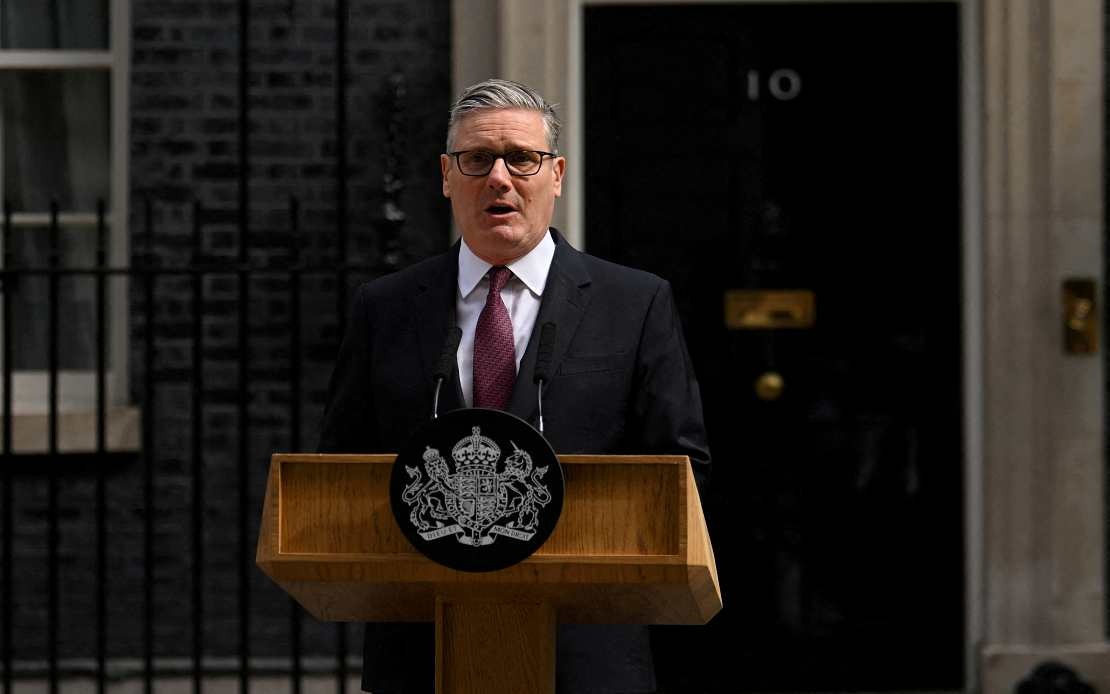
Prime Minister Keir Starmer declared on Monday that he intends to step down from his position, with a successor expected to be installed before the British parliament reconvenes in September. The announcement marks a dramatic reversal of fortunes for a leader who swept to power on a platform promising to restore stability to Westminster after years of political turbulence. Despite his overwhelming election triumph, Starmer's tenure has been beset by collapsing public confidence, forcing him to abandon his position well before the end of a typical five-year parliamentary term.
The implosion of Starmer's premiership accelerated dramatically on Friday when Andy Burnham, the long-serving mayor of Greater Manchester, secured a decisive victory in a parliamentary by-election. Burnham's triumph over a candidate backed by Nigel Farage's Reform UK party—which has dominated national polling for more than a year—suddenly shifted the Labour Party's calculus about its leadership crisis. Within days, this electoral win catalysed the prime minister's resignation announcement, suggesting that senior Labour figures viewed Burnham as the only figure capable of arrested the party's haemorrhaging support among working-class voters.
Burnham is widely respected within political circles for his oratorical abilities and long track record navigating complex government roles. His parliamentary history spans decades, and as mayor of a major English metropolitan area, he has built a reputation for tackling real-world problems rather than operating purely within Westminster's elite circles. This credibility gap between Burnham and Starmer reflects a broader exhaustion among Labour MPs with their current leader's approach. The prime minister's approval ratings have plummeted to levels unseen by any British leader in modern memory, a humiliation made sharper by his party's massive majority in parliament just months earlier.
However, Burnham has left substantial questions unanswered about his vision for government beyond rhetoric about national renewal and controlling living costs. His foreign policy stance remains opaque, his economic philosophy untested in the highest office, and his defence priorities unclear. These silences matter enormously given the precarious state of Britain's fiscal position and the mounting demands from international affairs. The new leader, whatever their identity, will inherit a landscape of constrained choices and limited policy space.
Britain's economic inheritance is particularly daunting for any incoming prime minister. The country carries the heaviest borrowing costs among the Group of Seven advanced economies, a consequence of elevated government debt, decades of sluggish economic growth, difficulty controlling public expenditure, and pressing infrastructure needs particularly in military capabilities. Bond market investors have grown increasingly nervous about British fiscal sustainability, imposing an invisible ceiling on ambitious spending plans. These market pressures have become a defining feature of UK governance, limiting what even the most reform-minded leader can accomplish.
Burnham's own previous comments about British fiscal policy may signal tension ahead. Last September, he publicly stated that the nation must break free from dependence on bond market sentiment and the constraints it imposes. Yet senior economists at Citibank have warned that a Burnham administration would confront a fragile economic position offering few mechanisms for delivering the transformative change he has promised. This tension between political rhetoric and financial reality will define the next premiership, much as it has constrained his predecessor.
Analysts and investors have split on whether Burnham possesses both the willingness and capacity to maintain the market-friendly fiscal discipline that kept Starmer in office, despite the latter's plummeting popularity. The political advisory group Eurasia has suggested that an orderly transition—with Starmer remaining as a figurehead until September—would allow the prime minister to attend a crucial UK-European Union reset summit scheduled for July while simultaneously giving Burnham several months to prepare for the transition to power. Such a staggered handover could ease market anxiety about governmental continuity.
The level of leadership churn now afflicting British politics has reached extraordinary proportions. With Starmer's departure, Britain will have cycled through seven prime ministers since the 2016 European Union referendum that fractured the political establishment. This turnover rate—the highest documented in nearly two centuries of modern British governance—reflects something far deeper than individual leadership failures. It reveals an electorate profoundly angry about stagnating living standards, deteriorating public services particularly in healthcare and welfare, and an immigration system perceived as broken and unresponsive to community concerns.
For Malaysian and Southeast Asian observers, the British political implosion offers instructive lessons about the fragility of electoral mandates when governing parties fail to deliver tangible improvements in citizens' material conditions. Despite controlling parliament overwhelmingly, Labour could not escape the gravitational pull of voter discontent. This dynamic resonates across the region, where rapid election cycles and shifting coalitions similarly reflect public frustration with governance performance rather than ideological preferences.
The succession of Burnham, should it occur, would represent a form of recalibration rather than a fundamental reset. He emerges from within the Labour mainstream, not as a dissident or reformer challenging the party's established orthodoxy. His elevation therefore suggests that Labour's challenge is one of political communication and leadership temperament rather than wholesale policy reorientation. Whether the British electorate will grant him the benefit of doubt that it withheld from Starmer remains uncertain, particularly given the structural economic constraints that will persistently resist his ambitions for renewal.