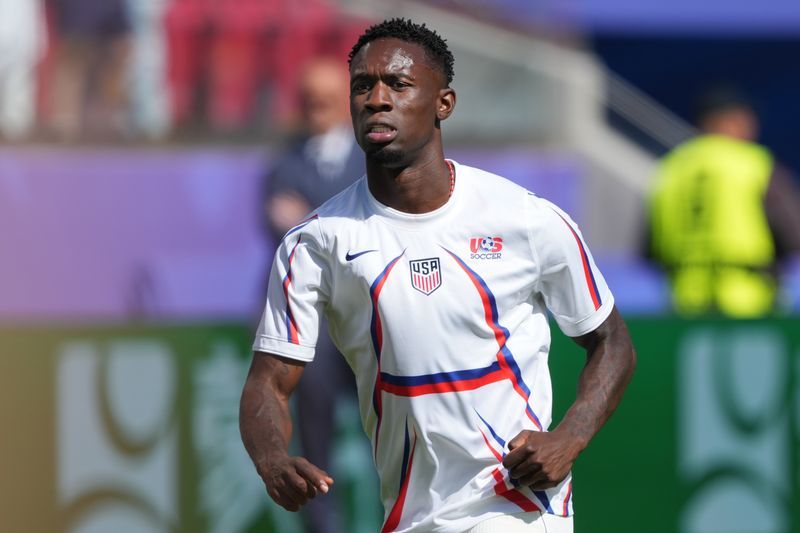
European football's governing body UEFA has launched a withering attack on FIFA's handling of American striker Folarin Balogun's disciplinary case, accusing the world body of crossing a fundamental line that threatens the sport's credibility. The controversy erupted after US President Donald Trump intervened directly with FIFA President Gianni Infantino to seek a review of the red card that would have sidelined Balogun from a crucial knockout match, prompting FIFA to take the extraordinary step of suspending the player's ban on a one-year probationary basis.
In a forceful statement released on Monday, UEFA declared itself in "disbelief" at what it characterised as an "unprecedented, incomprehensible and unjustifiable decision" by FIFA. The European body went further, suggesting that FIFA's action strikes at the heart of what makes professional football credible and fair. When governing bodies no longer enforce their own rules with consistency and certainty, UEFA argued, the entire competitive framework collapses. The organisation's pointed language reflects deep anxiety within European football about the precedent being set and the message such a decision sends to players, clubs and fans worldwide.
The incident that sparked the controversy occurred during the United States' round of 32 match against Bosnia, where Balogun, who has netted three goals in the tournament, received a straight red card following a Video Assistant Referee review. The infraction in question involved Balogun deliberately dragging his cleats down the back of Bosnia defender Tarik Muharemovic's leg and onto his foot—conduct that clearly violated the rules governing dangerous play. Under standard FIFA protocol, such a red card automatically triggers a suspension from the next match, a mechanism designed to deter reckless play and protect player safety.
Trump's unprecedented intervention introduced an entirely new dimension to the disciplinary process. By personally contacting Infantino and requesting that FIFA reconsider Balogun's suspension ahead of the round of 16 clash with Belgium, the US President effectively brought political pressure to bear on a sporting regulatory decision. While FIFA ultimately did not rescind the red card itself, the decision to suspend the implementation of the automatic ban represented a significant capitulation to external pressure, even if technically the card remained on the player's record.
The Royal Belgian Football Association responded with its own expression of astonishment at FIFA's move, understanding that the decision directly affected their team's upcoming opponent. According to reporting from The Athletic, the Belgian federation subsequently lodged a formal appeal with FIFA, signalling that the controversy would not die quietly and that affected parties planned to challenge the ruling through available channels. This escalation underscores how FIFA's decision has created diplomatic complications across multiple football associations.
For Malaysian and Southeast Asian observers, this situation carries important implications about how global sporting bodies balance rule enforcement against political and economic pressure. The World Cup represents one of the planet's most closely watched sporting events, generating enormous commercial value and national pride for participating countries. When decisions appear to bend under pressure from powerful nations or leaders, it raises uncomfortable questions about whether smaller football nations can expect consistent treatment in similar circumstances. The precedent established here—that persistent high-level intervention might succeed in overturning sporting decisions—could reshape how various stakeholders approach future disciplinary matters.
The fundamental tension at play concerns the autonomy of sports governance itself. FIFA, for all its institutional flaws and historical controversies, maintains that its authority rests partly on its independence from political interference. By capitulating to Trump's request, FIFA undermined its own argument that it operates according to objective sporting criteria rather than geopolitical considerations. This distinction matters enormously when FIFA claims legitimacy to govern a truly global sport with participants from every nation.
UEFA's criticism also reflects a broader European concern that American interests might receive preferential treatment within FIFA's structures, particularly given the United States' growing commercial importance to the organization. The controversy comes at a time when football governance faces intense scrutiny from multiple directions—corruption allegations, labour rights concerns, and questions about sustainability. When high-profile disciplinary decisions appear to bend under political pressure, it hands ammunition to those who argue that modern sports governance prioritizes power and money over principle.
The Balogun case demonstrates how contemporary football operates within a complex ecosystem where sporting decisions inevitably intersect with diplomatic, commercial and political considerations. While FIFA has attempted to navigate this particular situation by technically preserving the red card while suspending its consequences, such middle-ground approaches often satisfy no one. UEFA's forceful response signals that the European football establishment views this as a watershed moment that could fundamentally alter how FIFA enforces its own regulations. Whether FIFA will ultimately reverse course or defend its decision remains to be seen, but the damage to perceptions of impartial governance appears already done.

