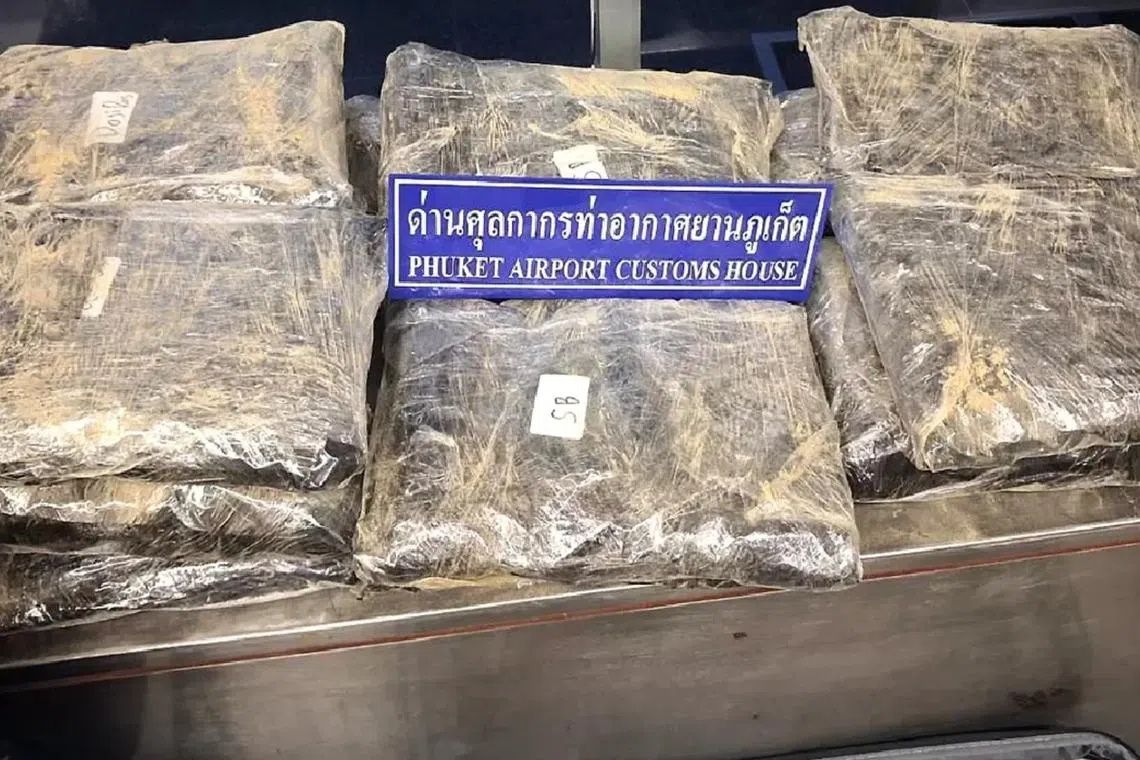
Customs enforcement at Phuket International Airport has intensified following the apprehension of two women attempting to illegally transport cannabis flowers out of Thailand. The arrests, made on Thursday, July 9, uncovered more than 32 kilograms of the controlled substance split across two separate luggage pieces. Officers from Phuket Airport Customs House and Sakhu Police Station collaborated on the interceptions within the international departures terminal, signalling a coordinated effort to strengthen border security against drug trafficking.
The first suspect, 18-year-old Filipino national Levannah Chelsea Guzman, was detained at approximately 11am when customs officers conducted a routine inspection of her black Pierre Cardin wheeled suitcase. The search revealed 14 vacuum-sealed packages containing cannabis flowers, with the total weight including packaging reaching 14.5 kilograms. During subsequent questioning, Guzman acknowledged ownership of the suitcase and its contents, a crucial admission that strengthens prosecutors' case against her.
Guzman now faces multiple charges reflecting the severity with which Thai authorities treat cannabis-related offences. The primary charge involves attempting to remove goods from Thailand without completing mandatory customs procedures, an infraction under the Customs Act BE 2560 (2017). Additional charges have been filed under the country's comprehensive Narcotics Code, alongside violations of the Protection and Promotion of Traditional Thai Medicine Wisdom Act BE 2542 (1999). Notably, prosecutors have also invoked the Public Health Ministry's 2025 notification governing controlled herbs, demonstrating Thailand's evolving legal framework for regulating cannabis substances.
Approximately two hours after Guzman's arrest, a second interception occurred at around 1pm when officers identified suspicious activity involving a green Swish Navy wheeled suitcase. The bag belonged to Penpitcha Phutsiang, a Thai national whose case carries distinct implications given her citizenship. Officers discovered 16 vacuum-sealed packages of cannabis flowers with a combined weight of 17.6 kilograms—substantially more than the quantity found in the first case. Like her Filipino counterpart, Phutsiang admitted to owning both the suitcase and all confiscated materials during questioning.
Phutsiang faces an identical battery of charges to Guzman, encompassing customs violations, narcotics offences, and breaches of pharmaceutical regulation acts. The parallel nature of both cases—similar packaging methods, comparable suitcase descriptions, and coordinated timing—suggests a potentially connected smuggling operation rather than isolated incidents. Thai authorities have transferred both women and the seized cannabis to Sakhu Police Station for continued investigation and prosecution preparation, where further details about potential supply networks may emerge.
These arrests underscore Thailand's ongoing struggle with cannabis trafficking despite the country's progressive medical cannabis policies introduced in recent years. While Thailand became the first Southeast Asian nation to decriminalize cannabis for medical purposes, the distinction between legal domestic use and international smuggling remains sharply enforced. The substantial quantities seized—totalling 32.1 kilograms across both cases—suggest commercial-scale operations rather than personal consumption, placing these incidents within trafficking rather than possession categories.
For Malaysian observers, the Phuket airport case carries particular relevance given Malaysia's far stricter drug enforcement posture and the geographical proximity of trafficking routes through Southeast Asia. Malaysia maintains some of the region's harshest penalties for drug-related offences, including capital punishment for trafficking substantial quantities. The detection methods employed by Thai customs officers—visual luggage profiling, systematic x-ray screening, and strategic timing around high-risk departure hours—mirror techniques increasingly adopted across Malaysian airports as transnational smuggling networks evolve.
The timing of both arrests within a two-hour window raises investigative questions about operational coordination between the two suspects. Phuket International Airport processes substantial passenger volumes daily, yet customs officers identified both suspicious suitcases through what authorities characterise as enhanced vigilance. This suggests either improved detection technology or intelligence-led inspections targeting specific flight routes or passenger profiles—information that Malaysian authorities monitor closely given shared maritime and air transportation corridors.
Thailand's Public Health Ministry notification from 2025 referenced in the charges highlights the country's recent regulatory evolution. While medical cannabis has been decriminalised and integrated into the traditional medicine framework, export controls remain stringent. The invocation of this specific 2025 notification indicates Thailand continues refining its legislative approach, potentially in response to smuggling incidents and international drug control treaty obligations. These legal instruments provide prosecutors with multiple charging pathways, complicating defendants' defence strategies and enabling flexible plea negotiation frameworks.
The Phuket airport interceptions reflect broader Southeast Asian trends in drug enforcement. Unlike Europe or North America where cannabis legalisation spreads, the region maintains prohibition frameworks despite Thailand's medical exception. This creates opportunities for smuggling operations targeting markets where cannabis commands premium prices due to legal restrictions. Transit hubs like Phuket serve as natural chokepoints where enforcement agencies concentrate resources, yet the sheer volume of travellers ensures systematic inspection remains impossible without advanced screening technologies.
Both women's admissions during questioning significantly strengthen prosecution prospects, eliminating plausible deniability defences. However, their cooperation also suggests potential immunity negotiations in exchange for information about supplier networks, distributors, and funding sources. Thai authorities typically leverage such cooperation to dismantle larger trafficking organisations rather than pursuing isolated mules. This investigative dimension remains opaque from public reporting but likely occupies considerable focus in Sakhu Police Station's continuing inquiries.
The broader context of Phuket airport security demonstrates how popular tourist destinations become inadvertent trafficking hubs. Legitimate passenger flows camouflage smuggling attempts, while international flight schedules create opportunities for time-sensitive operations. The coordinated response by customs and police agencies suggests integrated operational protocols, potentially serving as models for enhanced cooperation across Southeast Asian border points. For Malaysian security agencies, such cases provide valuable intelligence about evolving trafficking methodologies and mule recruitment patterns that require monitoring.

