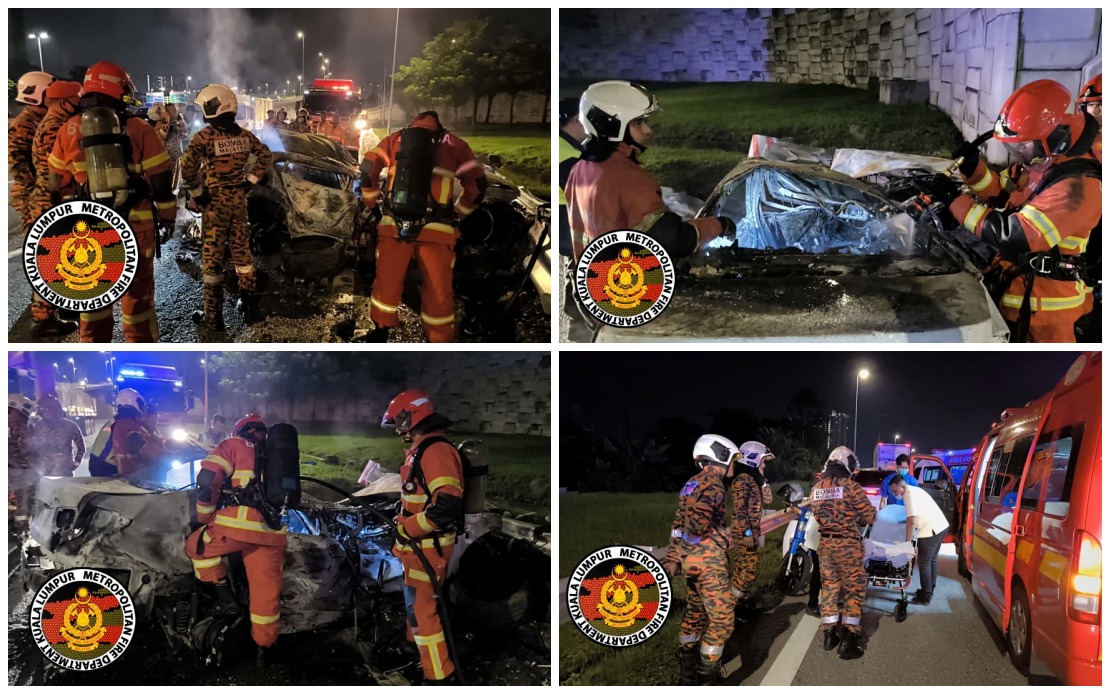
A tragic vehicular accident on the Duta-Ulu Kelang Expressway has claimed the lives of two Malaysian university students in what authorities believe was a speeding-related incident. The collision occurred at the Jalan Kuching exit ramp in the early hours of June 27, when a BMW 328i Sport veered across multiple lanes before striking the left road divider with such force that the vehicle erupted into flames. Both occupants trapped inside were pronounced dead at the scene, while a third passenger managed to escape the inferno with only minor injuries.
According to Kuala Lumpur Traffic Investigation and Enforcement Department chief ACP Mohd Zamzuri Mohd Isa, the vehicle was proceeding from Jalan Duta in the direction of Selayang when the driver allegedly lost control at excessive speed. The loss of traction caused the car to skid across the roadway before the violent impact with the barrier. The resulting fire consumed the vehicle so completely that authorities have initiated DNA analysis to formally identify the two charred victims, a procedure that underscores the severity of the thermal damage sustained.
The deceased have been identified as a 22-year-old male driver enrolled at Queensland University of Technology in Australia and a 21-year-old male front-seat passenger studying at Sunway University in Malaysia. Both young men were caught inside the burning vehicle and could not be extracted alive. The third occupant, a 20-year-old Singaporean male student, sustained only minor injuries despite the catastrophic nature of the crash and was transported to Kuala Lumpur Hospital for medical evaluation and observation.
This incident adds to Malaysia's persistent road safety challenges, particularly on major expressways where high speeds and heavy traffic create dangerous conditions. The DUKE expressway serves as a critical artery connecting multiple regions of the Klang Valley, and accidents of this magnitude periodically highlight the risks faced by commuters and long-distance travellers. Speed remains one of the most significant contributors to fatal accidents on Malaysian highways, often combined with driver fatigue, inexperience, or momentary lapses in concentration.
The investigation into the crash has been classified under Section 41(1) of the Road Transport Act 1987, allowing traffic police to examine all contributing factors comprehensively. Preliminary findings from the scene suggest excessive velocity before the loss of control, though authorities are continuing their examination to rule out mechanical failure, road surface conditions, or other potential causative factors. The Kuala Lumpur Traffic Investigation and Enforcement Department has appealed to the public for any dashcam footage or eyewitness accounts that might assist in reconstructing the precise sequence of events.
Closed-circuit television footage from nearby installations along the expressway will be reviewed as part of the standard investigative protocol. Such recordings often provide crucial evidence regarding vehicle speed, following distance, and lane positioning in the moments preceding impact. The survivor's statement will also be instrumental in understanding the circumstances that led to the collision and whether any warning signs or external factors preceded the loss of control.
For Malaysian motorists and families of university students, incidents such as this serve as sobering reminders of the catastrophic consequences of reckless driving behaviour. Young drivers, particularly those with limited experience navigating expressway conditions, face heightened risks when combined with excessive speed, peer pressure, or overconfidence. The presence of international students among the victims also underscores the vulnerability of overseas-bound Malaysian youth and the responsibility upon them to exercise appropriate caution while operating vehicles in unfamiliar environments.
The tragedy reflects broader concerns within Malaysia's transport sector regarding road safety culture and enforcement effectiveness. Despite numerous campaigns and awareness initiatives, fatal accidents continue to occur with disturbing regularity on major expressways. Questions persist about whether current speed enforcement measures, vehicle safety standards, and driver education programmes are adequately addressing the root causes of high-speed collisions.
Authorities have encouraged members of the public with relevant information to contact the Traffic Police Station at Jalan Tun H.S. Lee or the nearest police station. This appeal for public cooperation is standard practice in serious traffic incidents where comprehensive investigation requires multiple data sources and perspectives. The willingness of eyewitnesses and dashcam footage providers to come forward can significantly enhance investigative outcomes and potentially prevent similar incidents through identification of systemic hazards or patterns.
The case serves as a painful illustration of how quickly ordinary journeys can transform into tragedy. Two young men pursuing tertiary education—one internationally—have lost their lives in circumstances that preliminary evidence suggests were entirely preventable. Their families, friends, and educational institutions now grapple with the sudden loss, while investigators work methodically to establish precise causation and ensure accountability for any negligent actions that contributed to this preventable disaster.

