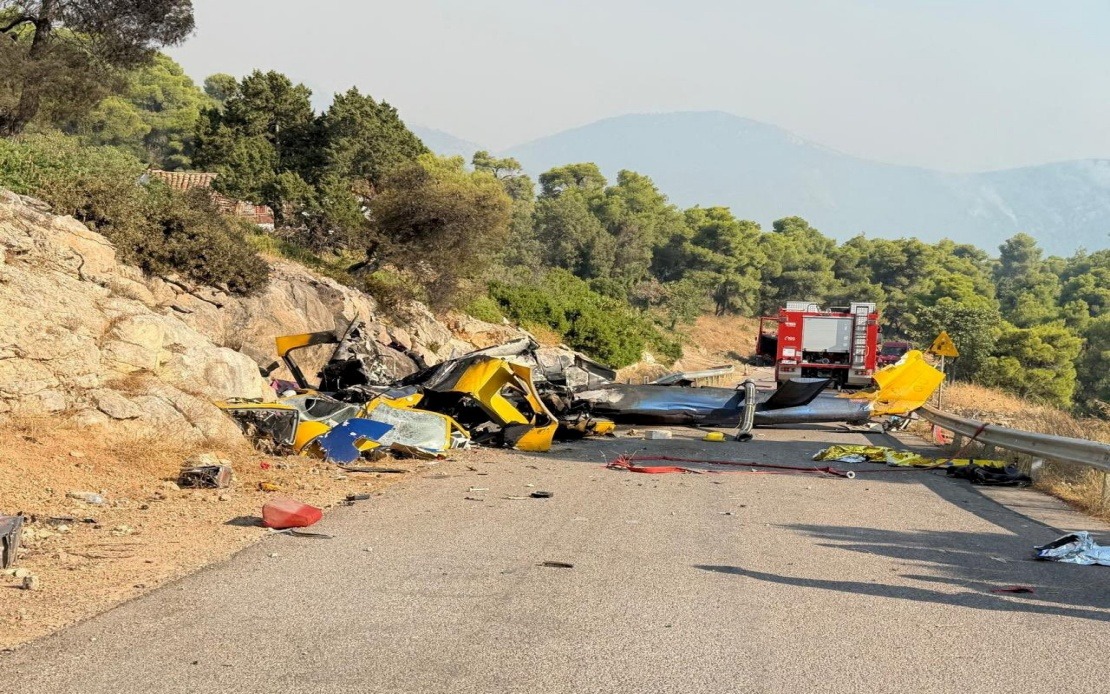
A tragic accident has claimed the lives of two aerial firefighting personnel in Greece, underscoring the dangerous conditions faced by those battling the Mediterranean's intensifying wildfire season. The collision between two Bell helicopters occurred on Sunday as crews engaged in active firefighting operations above the coastal area of Psatha in western Attica, with both aircraft carrying two crew members each. According to Greek Fire Service spokesperson Vassilis Vathrakogiannis, a Danish pilot and a Greek firefighting coordinator perished in the incident, while a British pilot and another Greek coordinator managed to survive, though one sustained injuries requiring medical attention.
The two rented helicopters were deployed as part of Greece's coordinated response to a substantial wildfire spreading across the Attica and Boeotia regions. These aircraft represent critical assets in aerial firefighting operations, where pilots must navigate challenging terrain and atmospheric conditions while maintaining precise positioning to deliver water and fire retardant to active fire zones. The deployment reflects the scale of the emergency facing Greek authorities, as the country grappled with multiple large fires simultaneously, a scenario that places enormous strain on available resources and personnel.
According to Greek authorities, the precise circumstances leading to the mid-air collision remain under investigation. Such accidents during emergency operations typically warrant comprehensive inquiries examining factors including communication protocols between aircraft, visibility conditions at the altitude where the collision occurred, and coordination procedures between ground control and airborne units. The investigators will likely scrutinize whether adequate spacing protocols were maintained between the helicopters and whether real-time positioning systems functioned correctly during the operation.
For Malaysia and other Southeast Asian nations, this incident carries particular relevance as climate change intensifies extreme weather patterns and wildfire seasons across the region. Indonesia and Malaysia have periodically faced severe transboundary haze and forest fires, particularly during El Niño episodes, requiring similar aerial firefighting interventions. The Greek tragedy underscores how even well-resourced European nations struggle with wildfire management during crisis periods, a sobering reminder for developing nations with limited firefighting infrastructure.
The broader context of Greece's wildfire emergency cannot be overlooked. The country has endured exceptionally hot, dry, and windy conditions that have created ideal circumstances for rapid fire spread across multiple regions simultaneously. When such conditions persist, firefighting agencies must stretch their personnel and equipment across wider areas, increasing operational tempo and potentially elevating accident risks. The deployment of rented foreign helicopters indicates that Greece's own aerial resources were likely already saturated with other emergency response missions.
The Danish pilot and Greek firefighting coordinator who lost their lives represent the human cost of emergency services work. Aerial firefighting stands among the most hazardous occupations globally, combining the risks inherent to helicopter operations with the unpredictable dynamics of active fire zones. Pilots must operate in dense smoke, navigate sudden wind shears caused by thermal effects from fires below, and coordinate with ground teams while maintaining precise altitudes and positions, all while fatigue from extended operations during emergency periods compounds the challenges.
The survival of the two other crew members, particularly the British pilot and injured Greek coordinator, offers some measure of consolation but also raises questions about the circumstances that allowed their escape. Emergency response helicopters are typically equipped with modern safety systems, but mid-air collisions represent among the most catastrophic aviation incidents, as crew have minimal time to respond to avoid collision or manage the aftermath. The fact that two survived suggests either that the collision was relatively low-speed or that the aircraft remained partially controllable immediately after impact.
Greece's experience this summer reflects a pattern increasingly common across the Mediterranean basin and beyond. Spain, Portugal, and Italy have also reported record-breaking wildfires in recent years, with 2023 marking particularly devastating seasons. Climate scientists attribute this trend partly to gradually warming temperatures and shifting precipitation patterns that extend fire seasons and increase vegetation desiccation. For nations in Southeast Asia, which face their own climate vulnerabilities, the Greek situation provides a cautionary example of how emergency response systems can be overwhelmed when natural disasters reach certain intensity thresholds.
The investigation into Sunday's collision will likely yield recommendations for improving coordination between aircraft during emergency operations, potentially including enhanced communication technologies, mandatory separation distances, or revised operational procedures during high-intensity firefighting campaigns. Such findings will be studied internationally by civil aviation authorities and emergency management agencies, including those in Malaysia and other ASEAN nations preparing for future wildfire seasons.
Beyond the immediate tragedy, this incident highlights the interconnected nature of modern emergency response. The deployment of helicopters from multiple nations—Danish, British, and Greek crews working together—demonstrates how international cooperation has become essential during crisis periods. Yet it also reveals vulnerability: when critical infrastructure is outsourced or relies on temporary rentals, coordination challenges multiply and accident risks potentially increase. As climate change continues reshaping environmental hazards globally, nations from Malaysia to Greece must invest in indigenous emergency response capacities while building robust international cooperation frameworks.

