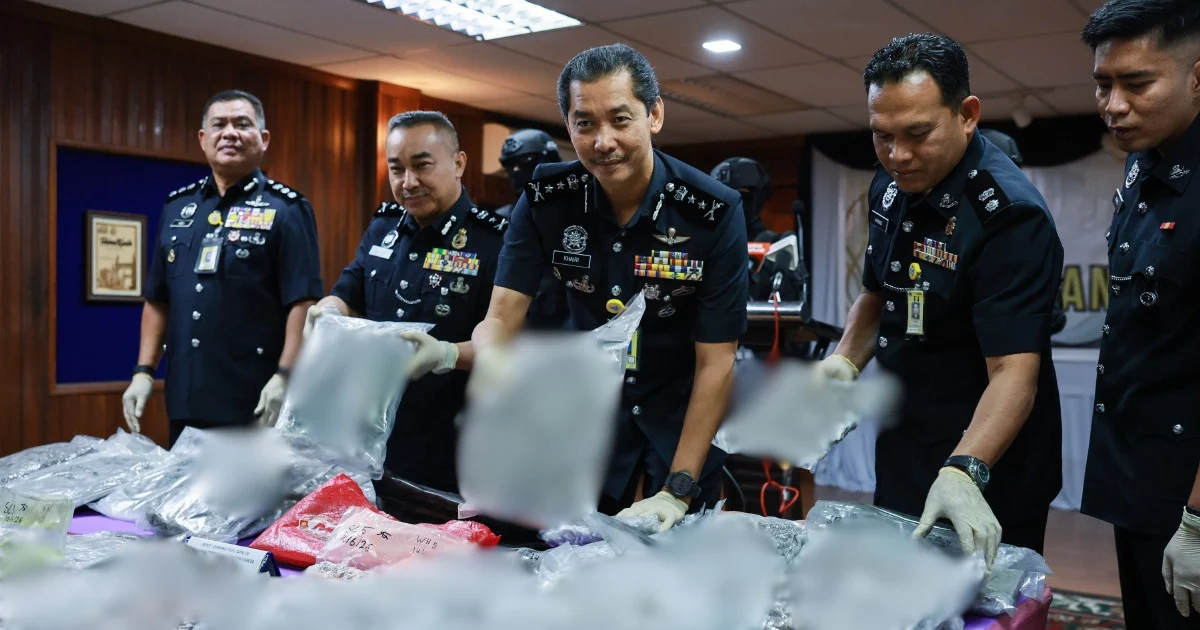
Police in Kuala Terengganu have arrested two brothers following an enforcement operation that uncovered a substantial cache of illegal drugs at their residence in Kampung Duyong Besar. The brothers are suspected of maintaining their family home as a distribution and storage hub for narcotics with a total estimated value of RM1.76 million, marking a significant interdiction in the state's ongoing battle against drug trafficking.
The operation reflects the intensified focus that law enforcement agencies across Malaysia have placed on dismantling drug supply networks operating from residential locations. Such premises-based trafficking operations represent a persistent challenge for authorities, as they enable traffickers to blend illicit activities into ordinary neighbourhood settings while maintaining distance from major transportation hubs where detection risks typically run higher.
The residential nature of this particular operation underscores how drug distribution networks have evolved across Malaysia and the broader Southeast Asian region. Rather than relying solely on traditional trafficking routes and distribution points, organised syndicates increasingly embed storage and processing facilities within private homes, exploiting the relative anonymity that suburban and village settings provide. This adaptation has forced police forces to deploy more sophisticated intelligence-gathering and community monitoring approaches.
Kampung Duyong Besar's situation reflects broader challenges facing Terengganu's law enforcement apparatus. The state has historically grappled with drug-related crime, positioned as it is along key trafficking corridors that connect major population centres with international smuggling routes. The presence of a RM1.76 million drug cache suggests the operation had reached considerable scale before intervention, indicating that the brothers may have been operating their facility for an extended period or managing inventory for a larger trafficking network.
The value of the seized narcotics provides important context regarding the operation's significance within regional drug trafficking hierarchies. A haul of this magnitude typically indicates involvement at mid-to-upper levels of distribution networks rather than street-level dealing. This suggests the investigation may ultimately extend beyond the two detained individuals and potentially implicate suppliers, customers, and logistics operators connected to their operation.
Police methodology in identifying the Kampung Duyong Besar location remains undisclosed, though such operations typically emerge from intelligence development, community tip-offs, or observation of unusual activity patterns. The success in converting intelligence into actionable enforcement operations demonstrates the importance of sustained investigative work and inter-agency coordination in combating organised drug trafficking. Malaysian authorities have increasingly emphasised intelligence-led policing approaches as a counterweight to the sophistication of trafficking organisations.
The detention of the two brothers opens investigative pathways that enforcement agencies will pursue to establish the full extent of their trafficking operation. Investigators typically seek to determine the origin of the seized drugs, intended distribution networks, financial flows, and connections to larger trafficking syndicates. Such intelligence often provides entry points for disrupting broader criminal enterprises operating across state boundaries and international borders.
From a broader Southeast Asian perspective, this enforcement action illustrates the persistent challenges that drug prevention agencies face despite increasing cooperation mechanisms. The region's porous borders, diverse transit routes, and substantial consumer demand create enduring opportunities for trafficking operations. Malaysia, as a transit nation and significant consumer market, remains strategically important to criminal organisations seeking to move drugs through Southeast Asia toward Australian and other distant markets.
The operation also highlights the particular vulnerability of coastal states like Terengganu to drug trafficking operations. Maritime access points, smaller ports, and fishing communities can serve as entry nodes for international shipments destined for inland distribution networks. Residential storage facilities then serve as intermediate holding points before final distribution, creating a tiered supply architecture that complicates enforcement efforts.
For Malaysian communities and policymakers, this case reinforces the reality that drug trafficking infrastructure often exists within seemingly ordinary residential neighbourhoods. The discovery challenges public perceptions that organised narcotics operations occur exclusively in obvious locations or remote areas. Such findings typically motivate enhanced neighbourhood vigilance and improved community-police communication channels, recognising that local residents often possess crucial intelligence about unusual activities occurring in familiar environments.
The legal proceedings against the two brothers will advance through Malaysia's drug laws, which provide severe penalties for trafficking and possession of controlled substances in quantities indicating distribution intent. Conviction on trafficking charges carries potential imprisonment sentences and substantial financial penalties, reflecting the legal system's graduated response to different trafficking levels.
Looking forward, this successful interdiction demonstrates that sustained law enforcement effort can significantly disrupt trafficking operations. However, the underlying conditions—including demand for drugs within Malaysia and the region, profit incentives driving trafficking, and logistical opportunities provided by geographic factors—remain fundamentally unchanged. Sustainable progress against drug trafficking therefore requires complementary approaches encompassing prevention, treatment, community engagement, and international cooperation alongside direct enforcement action.