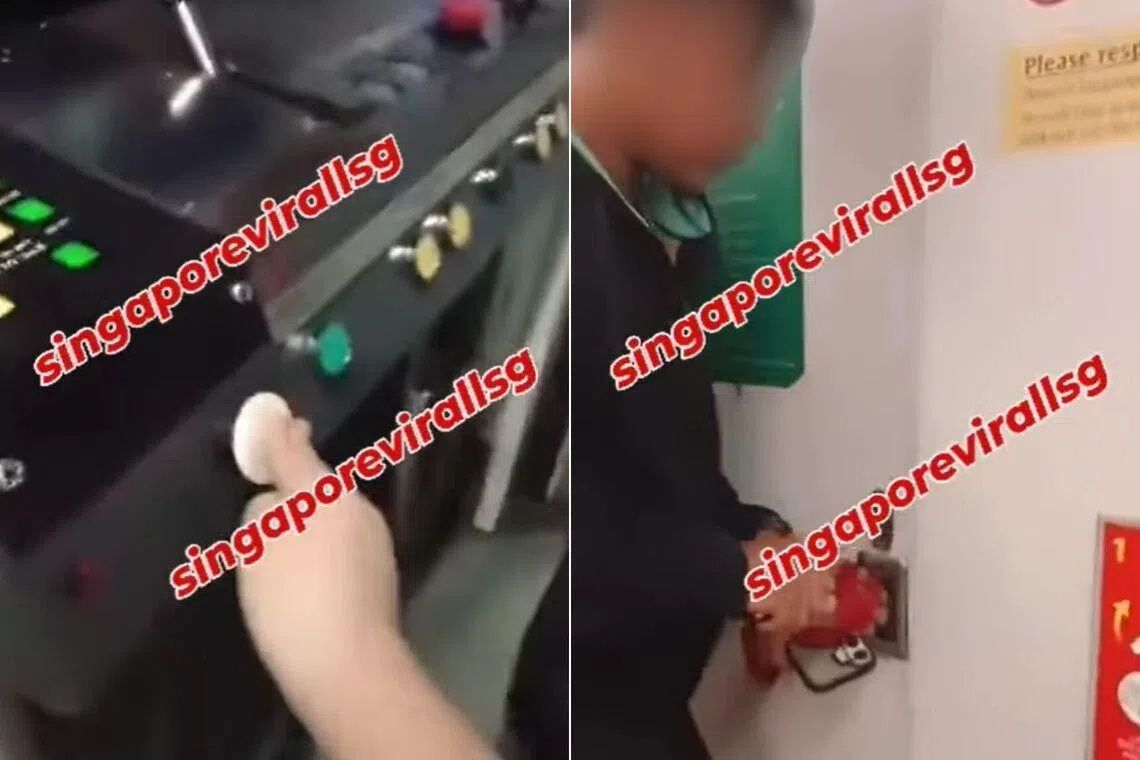
Singapore authorities have issued conditional warnings to two boys, aged 11 and 12, following an incident in February where they broke into the restricted back cabin of a train operating on the North-South Line. The incident, which occurred on 21 February, has only recently gained widespread attention after video footage circulated across social media platforms, drawing significant public scrutiny to the case and raising concerns about security protocols on the city-state's rail network.
Footage of the breach, initially posted on the singaporevirallsg Instagram account, shows the pair forcefully prying open the partition door separating the driver's cabin from the passenger area using a tool. Once inside the restricted space, the boys are seen repeatedly pressing what appears to be a control button, resulting in the train's horn being activated. By 30 June, the video had accumulated more than 281,000 views, nearly 140 comments, and been shared over 200 times, demonstrating the rapid amplification of the footage through digital platforms and the public interest in the incident.
SMRT Trains president Lam Sheau Kai confirmed the incident's authenticity in a statement released on 30 June, providing details about the operational response triggered by the unauthorised intrusion. The moment the boys activated the on-board alarm system, the train captain in the front cabin immediately alerted SMRT's Operations Control Centre, the centralised facility responsible for overseeing all daily train movements across the North-South Line and the broader rail system. This swift notification process exemplifies the communication protocols designed to respond to potential security threats aboard trains.
Staff stationed at the subsequent station were promptly notified to conduct an investigation as the train pulled in. The two boys disembarked at this next stop, and their actions throughout the incident were captured on the train's closed-circuit television system, providing authorities with comprehensive visual documentation of the breach. A police report was formally lodged on the same day, initiating an official inquiry into the matter that would ultimately result in the conditional warning decision.
The police confirmed they had received the report on 21 February and subsequently conducted a thorough investigation. Following consultations with the Attorney-General's Chambers, authorities determined that conditional warnings under the Rapid Transit System Regulations were the appropriate response to the incident. This decision reflects a deliberate prosecutorial approach that considered the age of the offenders, the nature of their actions, and the broader circumstances surrounding the breach, rather than pursuing formal criminal charges.
The conditional warning mechanism serves as a middle ground in Singapore's justice system, particularly for young offenders, allowing authorities to address misconduct while avoiding the more severe consequences of formal prosecution. The involvement of the Attorney-General's Chambers in the decision-making process underscores the significance placed on such incidents, even when alternative outcomes to prosecution are selected. This prosecutorial discretion, while occasionally subject to public debate, reflects legal considerations that may not be immediately apparent to observers who view only the dramatic video evidence.
The incident has prompted SMRT leadership to reiterate the organisation's commitment to rail security and the critical importance of restricted area access controls. Lam emphasised that unauthorised entry into cabin spaces represents a substantial threat to both passenger safety and operational reliability. Such breaches can disrupt the carefully coordinated systems that manage train movements, potentially endangering not only the individuals involved but also the thousands of commuters relying on the North-South Line daily. The reckless activation of train controls could theoretically compromise emergency systems or trigger unintended operational consequences.
This incident reflects broader challenges facing public transportation systems across Southeast Asia, where youthful curiosity and the appeal of restricted spaces can sometimes override safety considerations. The viral nature of the video highlights how incidents that might once have remained local news stories can rapidly achieve region-wide attention through social media amplification, potentially inspiring copycat behaviour or creating perceptions of security vulnerabilities that exceed the actual risk. Such digital virality can place additional pressure on transport operators to visibly strengthen their security protocols and communication strategies.
For Malaysian readers, the Singapore incident offers instructive parallels with the Klang Valley's MRT and LRT systems, which face comparable security challenges at significantly larger scale. Transport operators across the region have increasingly invested in CCTV systems, staff training, and emergency response procedures to prevent unauthorised cabin access. The decision to issue warnings rather than prosecute in the Singapore case may also resonate with discussions in Malaysia about age-appropriate responses to juvenile offences, balancing accountability with rehabilitation potential.
The enforcement action taken by Singapore authorities demonstrates the region's approach to securing critical infrastructure from unauthorised access, particularly involving minors. As Southeast Asian cities continue expanding their rapid transit networks, maintaining rigorous security standards while remaining accessible to the general public presents an ongoing operational challenge. The incident underscores that effective safety management requires multiple layers—technological systems like CCTV, human vigilance from operational staff, clear protocols for incident response, and appropriate legal frameworks that can adapt to different circumstances and age groups involved in violations.

