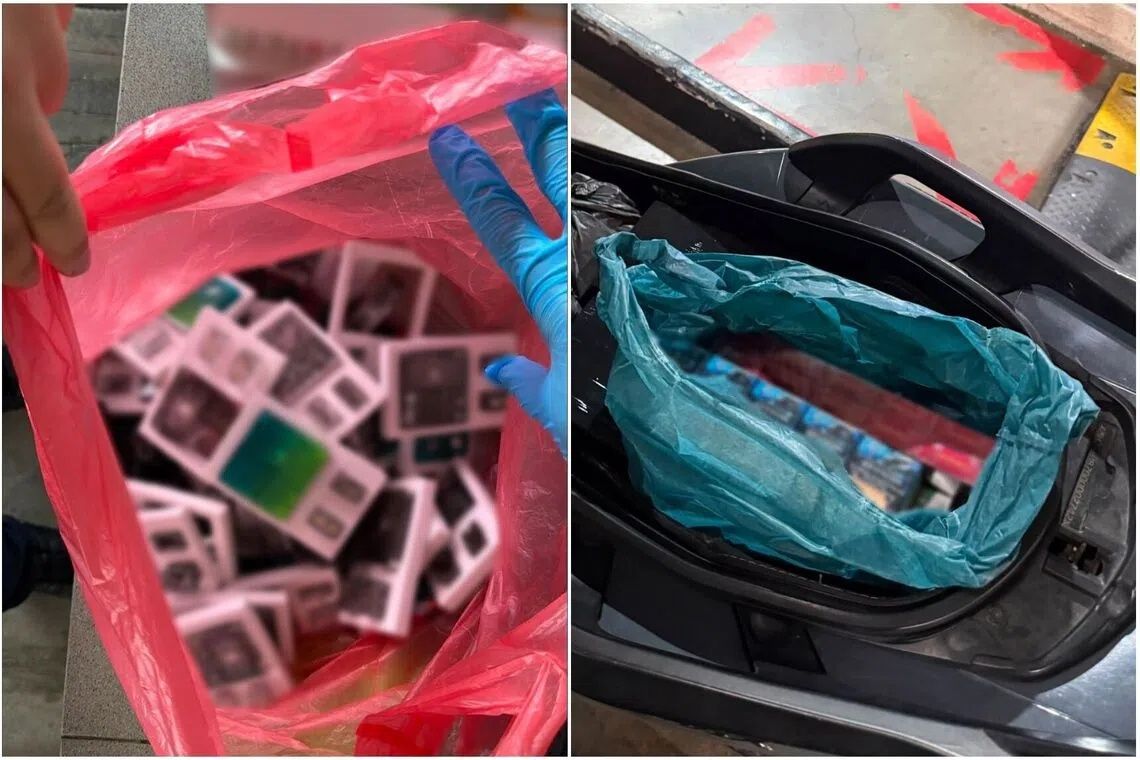
A 46-year-old Malaysian national and a 51-year-old Singaporean resident face serious criminal charges after being apprehended at Woodlands Checkpoint for attempting to smuggle contraband tobacco and vaping products into Singapore. The Immigration and Checkpoints Authority announced the arrests on Thursday, revealing that officers had intercepted the men during separate enforcement operations at the major border crossing on August 3 and 4. The busts highlight persistent challenges Singapore authorities face in combating transnational smuggling operations, particularly those exploiting the porous motorcyclist traffic flow across the Malaysia-Singapore causeway.
In the first incident on August 3, ICA officers conducting enhanced inspections of a Malaysia-registered motorcycle discovered an elaborate concealment scheme hidden within the vehicle's storage compartment. Officers uncovered more than 30 packets of cigarettes bearing no Singapore duty markings, alongside over 60 vaping devices and related accessory components. The scale of the seizure suggests this was not a casual cross-border procurement but rather part of a coordinated smuggling operation, as the variety and quantity of items point toward commercial intent rather than personal consumption. The strategic choice of motorcycle travel reflects common smuggling tactics designed to evade the more rigorous vehicle inspections applied to cars and commercial trucks.
The following day's intercept proved equally significant. Inspectors flagged a Singapore-registered motorcycle for detailed examination, uncovering 25 cartons and 30 packets of duty-unpaid cigarettes secreted beneath the seat and within the storage compartment, accompanied by more than 60 vapes. The discovery of contraband in a locally-registered vehicle indicates the smuggling problem extends beyond cross-border trafficking to include resident participation in illicit supply chains. The consistent pattern of concealment—utilising motorcycle storage compartments and under-seat spaces—demonstrates an established modus operandi likely replicated across numerous smuggling attempts that escape detection.
Following standard procedure, the suspects and all seized materials were transferred to Singapore Customs and the Health Sciences Authority for comprehensive investigation. This handover initiates a thorough forensic examination designed to trace the supply chain, identify additional network members, and determine whether these represent isolated incidents or components of larger smuggling networks. Investigators will likely examine financial transactions, communication records, and storage locations to establish the full scope of any organised operations. The involvement of customs authorities proves particularly significant given Singapore's aggressive stance on duty evasion, which constitutes a substantial revenue crime affecting the nation's fiscal base.
Penalties for duty-unpaid cigarette offences in Singapore carry considerable weight, reflecting the government's zero-tolerance approach. Those convicted of purchasing, selling, transporting, delivering, storing, or possessing contraband tobacco face fines reaching 40 times the evaded duties and taxes, coupled with imprisonment stretching to six years or both sanctions combined. Additionally, any vehicle implicated in such offences becomes subject to forfeiture, effectively confiscating the motorcycle or car involved. This vehicle seizure provision creates significant financial disincentives for both owners and users, as losing a motorcycle represents a major economic penalty beyond legal consequences. The escalating penalty structure signals Singapore's determination to impose costs on smugglers exceeding potential profits from illicit sales.
Vaping products occupy a unique legal status in Singapore, classified entirely outside permitted consumption. The island-state has implemented one of the world's most stringent vaping prohibitions, reflecting concerns about youth uptake and public health implications. Individuals caught using vapes face maximum fines of $10,000, while retailers and distributors confront penalties of up to $200,000 and six years' incarceration. Persons engaging in vape smuggling specifically incur even steeper penalties—maximum fines of $300,000 and up to nine years' imprisonment. These graduated penalty structures create disproportionate consequences for smuggling activities versus casual possession, acknowledging the supply-side role as more culpable than demand-side behaviour. The nine-year maximum for vape smuggling exceeds penalties for many property crimes, underscoring official prioritisation of preventing vaping product importation.
Foreigners apprehended for vape-related offences face additional immigration consequences that complement criminal sanctions. Individuals caught more than once with vaping products face cancellation of their entry permits and issuance of permanent re-entry bans. This combination of criminal liability and immigration consequences creates particularly severe outcomes for foreign nationals, as permanent bans effectively sever residence and employment in Singapore. For Malaysian workers and visitors, such bans represent professional disaster, as many rely on Singapore employment and access. This immigration enforcement mechanism thus extends deterrent effects beyond the immediate violator to broader migrant communities aware of these consequences.
The Woodlands Checkpoint sits at the strategic nexus of Singapore-Malaysia traffic, processing thousands of vehicles daily across the causeway. Its prominence makes it simultaneously one of Singapore's most important border control points and potentially vulnerable to systematic smuggling attempts exploiting high-volume operations. Authorities maintain continuous intelligence networks identifying emerging smuggling patterns, trends in contraband product composition, and organisational structures coordinating illegal imports. The August arrests align with broader regional trends as Southeast Asian governments confront rising duty-unpaid cigarette trafficking and expanding vape smuggling driven by substantial price differentials between jurisdictions. Malaysia's significantly lower tobacco taxation and permissive vaping regulations compared to Singapore create economic incentives motivating cross-border supply flows.
These cases reflect deeper supply-chain economics wherein organised groups exploit regulatory arbitrage between neighbouring markets. Singapore's exceptionally high cigarette taxation, designed to discourage consumption and support public health objectives, generates duty-unpaid cigarettes selling at substantial discounts compared to legitimately taxed products. Concurrently, Singapore's comprehensive vaping ban eliminates legitimate supply while maintaining consumer demand among a portion of the population, creating black markets that smugglers systematically service. By contrast, Malaysia permits vaping product sales and maintains significantly lower cigarette duties, rendering the country an efficient procurement point for smuggled goods destined for Singapore consumers.
The upstream investigation phases will determine whether additional participants operated distribution networks within Singapore, receiving contraband shipments and distributing products through retail or personal networks. Authorities typically pursue supply chains backwards and forwards simultaneously, identifying both procurement coordinators and end-market distributors. The presence of a Singapore-registered motorcycle in the August 4 arrest particularly suggests established local distribution infrastructure, as resident participation typically indicates established demand and delivery mechanisms. Intelligence generated from these prosecutions frequently enables subsequent enforcement operations targeting related networks uncovered during investigation phases.
These enforcement operations underscore Singapore's sustained commitment to border security and duty collection, deploying technological and personnel resources to intercept contraband flows at ports of entry. The checkpoint's effectiveness depends on maintaining sufficient inspection capacity while processing legitimate cross-border traffic expeditiously. Singapore customs and immigration authorities continually adjust inspection protocols based on emerging threat assessments and patterns identified through enforcement data. These arrests will likely inform refinements to motorcycle inspection procedures, given their apparent emergence as preferred smuggling conveyances compared to other vehicle categories.

