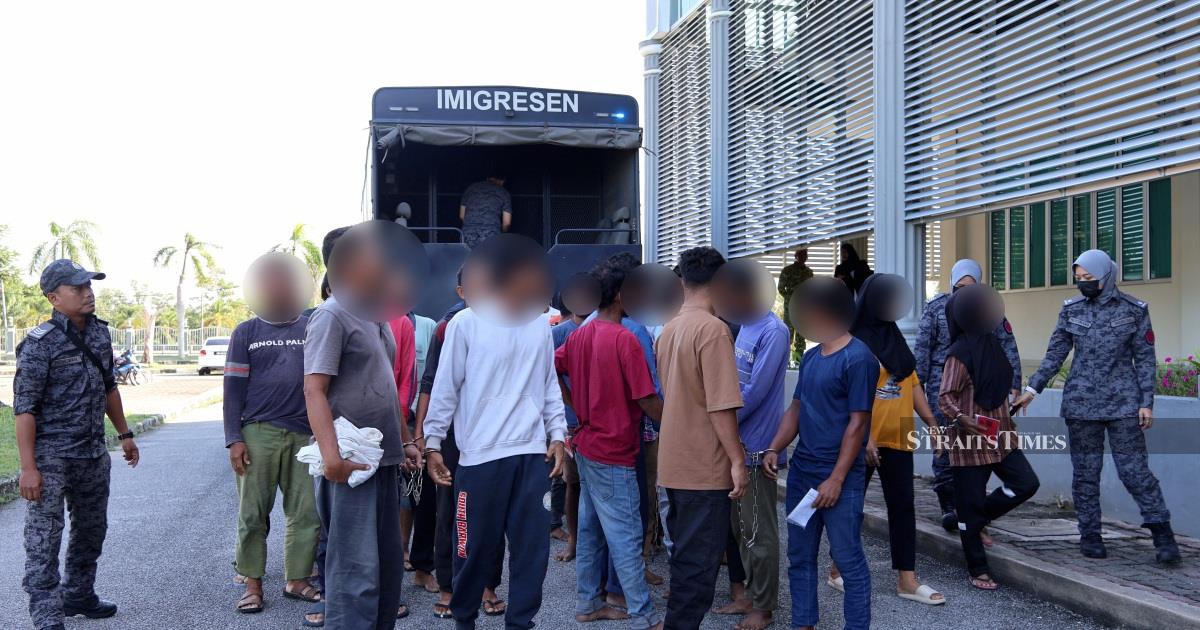
The Sessions Court in Pasir Mas has handed down financial penalties to 29 undocumented migrants following their guilty pleas to multiple immigration offences, marking a continuation of border enforcement efforts in Kelantan. The fines, ranging from RM1,000 to RM10,000 per individual, were delivered after the migrants acknowledged their culpability in proceedings that underscore Malaysia's ongoing immigration compliance operations.
The charges levelled against the group encompassed three distinct immigration violations: illegal entry into Malaysian territory, overstaying beyond authorised periods, and misuse of travel or entry permits. Each offender was convicted on at least one count, though court proceedings revealed that several individuals faced multiple charges simultaneously. This layered pattern of violations suggests coordinated unlawful movement rather than isolated administrative oversights, pointing to structural weaknesses in border management and documentation controls that persist across northern Malaysia.
Pasir Mas, situated in Kelantan's northernmost region bordering Thailand, remains a critical focal point for migration enforcement in Malaysia. The border district experiences consistent irregular movement from neighbouring Thailand, driven by economic disparities and the relative permeability of established crossing points. Local enforcement agencies have intensified operations in recent years, reflecting both federal directives prioritising immigration compliance and practical awareness that the porous northern frontier requires sustained attention to maintain security and public order.
The sentencing structure reflected graduated culpability, with the highest fines imposed on those demonstrating more egregious violations or longer periods of unauthorised residence. Malaysia's immigration legal framework permits courts discretion in penalty levels, enabling proportionate responses to individual circumstances whilst maintaining deterrent effect. For undocumented migrants in precarious economic situations, fines at the upper end represent extraordinary burdens, often forcing dependence on community networks or employer exploitation to raise payment funds—a dynamic that inadvertently perpetuates cycles of vulnerability and irregular employment.
This court action aligns with broader Southeast Asian patterns where countries confronting substantial migrant populations employ judicial penalties alongside administrative detention and deportation. Thailand, Indonesia, and Singapore have similarly expanded enforcement mechanisms, though approaches vary significantly in severity and consistency. Malaysia's relatively moderate fine structure contrasts with harsher criminal custodial sentences in some neighbouring jurisdictions, yet remains substantial enough to deter casual visa overstays.
The guilty pleas indicate either pragmatic case acknowledgment or potential cooperation with prosecutors, streamlining court processes and reducing litigation costs. In immigration cases, early admissions often reflect counsel advice that defending documentation violations proves futile when physical evidence and official records are conclusive. This efficiency gains system resources for addressing more complex cases, though it also raises concerns about whether all defendants received adequate legal representation capable of examining procedural compliance or identifying potential defences.
For Malaysia, immigration enforcement effectiveness depends partially on consistent judicial response. When courts impose meaningful financial consequences, detention becomes complementary rather than primary punishment, reducing overcrowding in immigration detention facilities—a persistent problem within the system. However, enforcement visibility in Kelantan and other border states remains episodic, with high-profile court actions occasionally punctuating extended periods of limited visible enforcement, potentially undermining deterrent messaging.
The undocumented migrants subject to these fines likely originate from Myanmar, Bangladesh, Cambodia, or Indonesia—nations sending the largest irregular migrant flows into Malaysia. Many enter seeking employment opportunities offering earnings substantially exceeding home-country wages, despite legal risks and exploitation vulnerabilities. The Pasir Mas court outcome reflects the enforcement side of this economically driven migration equation, demonstrating that crossing borders clandestinely carries financial penalties potentially equalling several months' wages for migrants in origin economies.
Overseas observer communities tracking Malaysia's immigration policies will note this enforcement action as evidence of continued border management activity, though comprehensive data on total undocumented migrant apprehensions and prosecutions across Malaysia remains limited. Transparency regarding court outcomes, detention centre populations, and deportation statistics remains inconsistent, complicating objective assessment of enforcement trends. NGOs and international organisations periodically highlight concerns about migrant detention conditions and deportation procedures, suggesting systemic challenges beyond the judicial sentencing phase.
Looking forward, Malaysia faces sustained pressure to balance security and labour market realities alongside humanitarian obligations. Border enforcement in Kelantan will likely continue as a visible policy priority, with court proceedings demonstrating governmental commitment to compliance frameworks. However, addressing root causes—including coordinated regional migration governance, legal labour pathways for lower-skilled work, and employer accountability for hiring undocumented workers—remains underdeveloped across Southeast Asia, potentially limiting the deterrent impact of judicial penalties alone.

