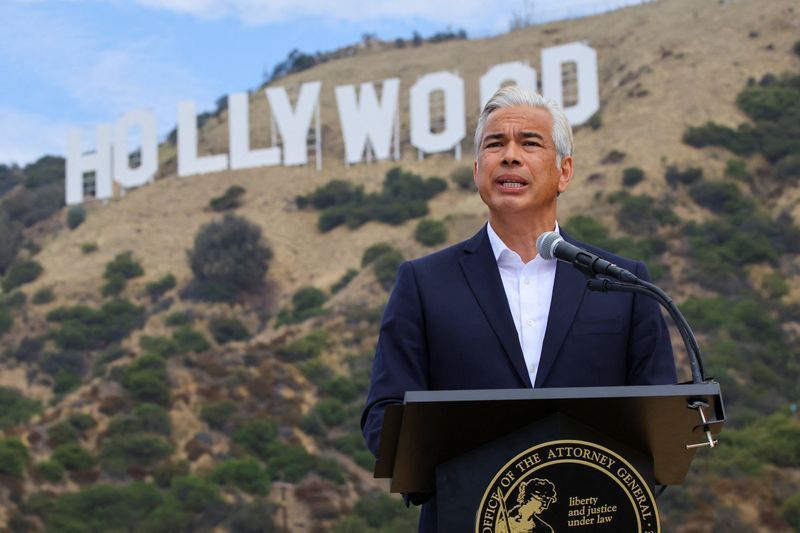
A coalition of twelve American states, led by California, has escalated its challenge to one of the entertainment industry's most consequential proposed mergers in recent years. The group filed suit in Oakland federal court to block Paramount's $110 billion acquisition of Warner Bros. Discovery, contending that the transaction would concentrate too much market power in a single entertainment conglomerate and ultimately harm consumers, workers, and small businesses across the United States. The lawsuit represents a significant legal hurdle for Paramount CEO David Ellison's vision of creating a formidable competitor to Netflix and Disney by merging two major content and distribution powerhouses.
The states' core argument centres on market concentration in the entertainment sector. According to the legal filing, the combined entity would command approximately 27 percent of the U.S. film distribution market, 30 percent of blockbuster film releases, and 27 percent of the basic cable channel landscape. The coalition contends that such concentration would enable the merged company to exercise extraordinary leverage over theaters, pay-television distributors, and ultimately consumers. For every dollar generated through theatrical releases and basic cable channels nationally, the states argue, the combined company would retain more than a quarter—a proportion they characterize as reflective of monopolistic market control. The lawsuit specifically warns that reduced competition between these two major studios would lead to higher prices for moviegoers and cable subscribers while potentially limiting the quantity and quality of entertainment offerings available to American households.
The timing of this state-level action underscores the increasingly politicized nature of American antitrust enforcement. All the attorneys general involved in filing Monday's lawsuit represent states controlled by the Democratic Party, a reality that critics have highlighted. Meanwhile, the U.S. Department of Justice approved the deal last month, a decision that has drawn scrutiny regarding the influence of political connections. Paramount CEO David Ellison's father, billionaire Oracle co-founder Larry Ellison, maintains substantial ties with Republican President Donald Trump. Some observers have suggested that these relationships may have facilitated federal regulatory approval, while Democratic state officials argue that the Trump administration has adopted an overly permissive approach toward major corporate combinations. California Attorney General Rob Bonta characterized the Trump administration's recent antitrust record as evidence of a "pro-rigged economy" stance, pointing to multiple settlements involving the Department of Justice that he and his allies view as insufficiently protective of competition.
The participating states—Arizona, Colorado, Connecticut, Massachusetts, Minnesota, Nevada, New Jersey, New Mexico, New York, Washington, and Oregon—represent a substantial geographic swath of American population and economic activity. Oregon Attorney General Dan Rayfield articulated the coalition's rationale by emphasizing protection for families, small businesses, and local film industry workers. The lawsuit highlights that Hollywood workers, including writers, actors, and crew members, have voiced serious concerns about employment prospects following the merger. Theater owners have similarly opposed the transaction, fearing it would result in fewer theatrical releases and diminished bargaining power when negotiating terms with distributors. These coalitional concerns extend beyond abstract economic theory to tangible impacts on livelihoods and regional economies that depend on entertainment production and distribution.
Paramount has mounted a vigorous defence against the allegations, characterizing the lawsuit as a misrepresentation of current competitive conditions in the entertainment industry and an improper application of settled antitrust doctrine. The company argues that the $110 billion acquisition would actually enhance efficiency and increase output rather than diminish it. Under Ellison's leadership, Paramount has committed to cutting $6 billion in redundant costs—encompassing infrastructure, marketing, and corporate personnel—while pledging to release 30 films annually from the combined studios. Company executives contend that such efficiency gains and expanded production capacity would benefit consumers through more diverse content offerings and ultimately strengthen the combined entity's ability to compete with streaming giants Netflix and Disney. However, the states dismiss such production commitments as unenforceable and insufficient to offset the inherent dangers of reduced competition in pricing and service quality.
The legal challenge carries profound implications for how the entertainment industry will be structured during the next decade. Stock markets initially responded positively to news of the lawsuit, with Paramount shares rising 2.9 percent and Warner Bros. shares climbing 2.6 percent—suggesting investor confidence that the companies will ultimately prevail or reach some accommodation. However, analysts have identified this state-level action as potentially the most serious obstacle yet to deal completion. The litigation itself promises to be protracted; a Reuters analysis of comparable federal merger cases indicates that judicial determinations typically require approximately eight months from filing to resolution. Every month of delay exacts substantial financial costs on Paramount, which has committed to paying Warner Bros. Discovery shareholders roughly $650 million in quarterly fees if the transaction fails to close before October. Prolonged uncertainty regarding deal completion could force renegotiation of financing arrangements, depress the company's stock valuation, and theoretically render the entire transaction economically unfeasible.
The politicization of antitrust enforcement has intensified considerably during recent years, with both major American political parties weaponizing competition law to advance their respective policy agendas. Democrats have increasingly employed antitrust as a mechanism to address concerns about corporate consolidation and rising costs of living that resonate with their electoral constituencies. Conversely, some Republican attorneys general have joined with Democratic counterparts on specific antitrust matters—notably the challenge to Live Nation's market dominance and Nexstar's acquisition of rival broadcaster Tegna—suggesting that certain competition issues transcend strict partisan divisions. California Attorney General Bonta explicitly invited Republican attorneys general to join the Paramount case, suggesting that the matter remains genuinely bipartisan despite the current litigants' shared Democratic affiliation. The failure of Republican officials to participate, however, reflects the broader reality that antitrust enforcement has become intertwined with partisan electoral strategy and ideological commitment to divergent economic philosophies.
For Malaysian and Southeast Asian observers, this American legal drama carries instructive implications about how sophisticated economies regulate media consolidation and market power. The Malaysian regulatory environment differs substantially from the American system, yet questions about appropriate levels of concentration in broadcasting, film distribution, and entertainment content production transcend national borders. As streaming services and multinational entertainment corporations extend their reach into Southeast Asian markets, governments throughout the region must consider whether current antitrust and competition frameworks adequately protect consumer interests and local media industries. The Paramount-Warner Bros. case illustrates how market concentration in entertainment can raise prices, reduce consumer choice, and threaten employment in creative industries—concerns equally relevant to developing Asian economies seeking to protect both consumers and domestic creative talent from domination by foreign megacorporations.
The fundamental tension that this litigation exposes concerns the proper balance between operational efficiency and competitive dynamism. Paramount argues, with considerable credibility, that merging overlapping operations would generate cost savings benefiting consumers through more diverse content. The states counter that such efficiency gains cannot be trusted when the consolidated entity lacks meaningful competitors constraining its pricing and quality decisions. This debate reflects a broader philosophical disagreement about whether antitrust law should focus narrowly on preventing outright consumer harm through price increases or should instead maintain multiple competitors as a structural safeguard against potential future abuse. The judicial outcome will substantially influence how American regulators approach comparable media mergers for years to come, potentially affecting the competitive landscape that streaming services and traditional broadcasters inhabit as they compete for global audiences including those in Southeast Asia.
Looking forward, the states have explicitly requested that Paramount delay closing the transaction until legal proceedings conclude, threatening to seek injunctive relief preventing completion if the company proceeds without judicial blessing. This stance creates meaningful leverage in potential settlement negotiations, though neither party has publicly indicated willingness to compromise. The stakes extend beyond Paramount and Warner Bros. to encompass the future structure of American entertainment distribution at a moment when traditional broadcast television confronts existential challenges from streaming platforms. Whether courts will ultimately credit the states' arguments about market concentration or defer to the federal government's approval and Paramount's efficiency rationale remains genuinely uncertain. What is clear is that this litigation will consume months of corporate resources, generate substantial legal fees, and introduce material uncertainty into the deal's completion timeline—outcomes that may ultimately achieve the states' practical objective of preventing the merger, regardless of judicial determination on the merits.

