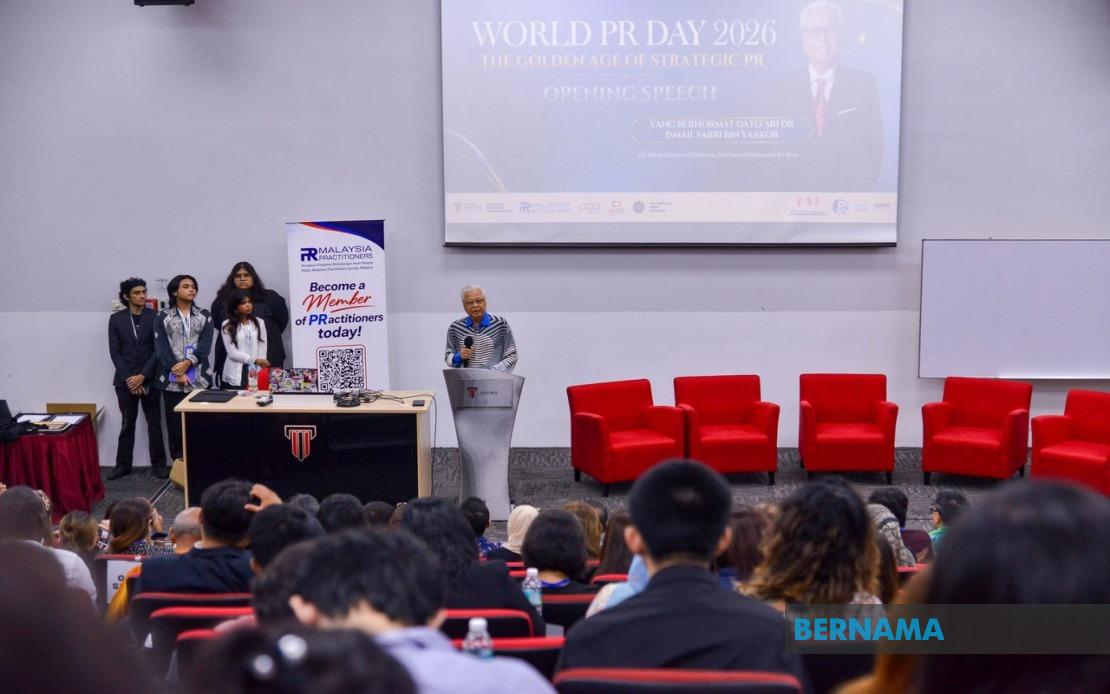
Former Prime Minister Datuk Seri Dr Ismail Sabri Yaakob has positioned integrity-driven communication as the cornerstone of building organisational trust in an increasingly digital and interconnected world. Speaking at the launch of World PR Day 2026 at Taylor's University in Subang Jaya on July 16, he argued that contemporary challenges extend far beyond traditional economic rivalry, encompassing the critical capacity to forge genuine trust through transparent and principled messaging. His remarks underscore a fundamental shift in how leaders and institutions must operate in the 21st century, where reputation and authenticity have become more valuable than ever before.
The paradigm Ismail Sabri outlined represents a significant departure from previous eras of competition. While the 20th century was dominated by organisations vying for economic supremacy through tangible goods and services, the current landscape has transformed into what he characterised as a "trust competition." In this new arena, an organisation's value is no longer determined solely by financial performance or operational metrics. Instead, success increasingly hinges on the institution's demonstrated ability to communicate credibly during both prosperous times and periods of crisis. This conceptual framework has profound implications for Malaysian businesses, government agencies, and civil society organisations grappling with reputation management in an age of rapid information dissemination and heightened public scrutiny.
Ismail Sabri's analysis of modern trust dynamics reflects the reality that digital connectivity has fundamentally altered public expectations regarding transparency and authenticity. When information travels instantaneously across social media platforms and traditional news channels simultaneously, organisations can no longer compartmentalise their messaging or control narratives through selective disclosure. The public now demands consistency between stated values and demonstrated actions, and any perceived disconnect triggers swift reputational damage. For Malaysian institutions and regional businesses, this reality necessitates a comprehensive overhaul of communication strategies to ensure they are built on genuine commitment to integrity rather than sophisticated public relations tactics alone.
Drawing on his firsthand experience navigating the COVID-19 pandemic as Prime Minister, Ismail Sabri highlighted how communication emerged as a decisive variable in policy implementation and public compliance. During that unprecedented health crisis, he found himself engaging with media outlets almost daily to explain evolving standard operating procedures and pandemic responses. This constant communication served a dual purpose: providing the public with clear, accurate information to minimise confusion while simultaneously building confidence in government decision-making. The experience crystallised his understanding that effective communication transcends mere announcement of policies; it functions as a critical instrument for cultivating public confidence and social cohesion during periods of uncertainty and rapid institutional change.
The role of public relations practitioners has evolved dramatically, according to Ismail Sabri's assessment, transforming from their traditional function as information distributors into strategic architects of organisational narratives. This evolution reflects the complexity of modern stakeholder management, where multiple constituencies—customers, employees, investors, regulators, and the broader public—simultaneously evaluate institutional credibility through multiple information channels. PR professionals must now possess sophisticated understanding of organisational strategy, reputational risks, and stakeholder psychology, positioning themselves as counsel to senior leadership rather than merely executing communication plans. For Malaysian PR firms and communications departments, this elevation of the function demands investment in talent development and strategic thinking capabilities.
Artificial intelligence represents both opportunity and peril in the communications landscape that Ismail Sabri addressed. On one hand, AI technologies enable PR practitioners and communications teams to analyse public sentiment, track narrative shifts, and respond to emerging reputational threats with unprecedented speed and sophistication. Real-time sentiment analysis powered by machine learning can identify concerns among key stakeholder groups before they escalate into full-scale controversies. However, Ismail Sabri cautioned that technology adoption must remain anchored to human values and ethical principles. The instrumental power of AI cannot justify its deployment for purposes that undermine honesty or manipulate public perception, a warning particularly relevant as Malaysian organisations increasingly integrate advanced analytics into their communications operations.
The proliferation of sophisticated disinformation presents an existential challenge to the integrity-based communication framework Ismail Sabri advocated. Deepfake technology, manipulated content, and algorithmically amplified misinformation have created an information environment where distinguishing fact from fabrication requires sustained effort from both communicators and audiences. This challenge extends beyond the private sector into governance, where false narratives about policy decisions or government actions can rapidly undermine public confidence and social stability. Southeast Asian nations, including Malaysia, have experienced first-hand the destabilising effects of coordinated disinformation campaigns, making the development of robust communications strategies that inoculate against false narratives increasingly urgent.
Ismail Sabri explicitly endorsed the government's initiative to develop an AI Governance Bill, positioning regulatory frameworks as essential safeguards against technology-enabled misconduct and ethical violations. Such legislation would establish clear standards for artificial intelligence applications in communications, particularly regarding the creation and spread of deepfakes and manipulated content. For Malaysian stakeholders, the development of robust governance frameworks represents a crucial counterbalance to technological capabilities that could otherwise be weaponised against institutional and social interests. The Bill's emphasis on digital ethics acknowledges that technological power divorced from ethical constraint poses genuine risks to information integrity and public trust.
The convergence of rapid technological change, information abundance, and intensified public scrutiny creates an operating environment fundamentally different from that of previous decades. Malaysian organisations operating across sectors must acknowledge that compliance with legal requirements and delivery of promised services represent necessary but insufficient conditions for earning public trust. Instead, stakeholders now evaluate institutions through multiple lenses, including alignment of espoused values with demonstrated actions, transparency in crisis communication, and consistency across all stakeholder interactions. This expanded understanding of trust-building requires comprehensive institutional change rather than superficial communications adjustments.
For Malaysian business leaders, government officials, and civil society organisations, Ismail Sabri's framework suggests that communication strategy should be integrated with organisational values and operational practices from the outset, rather than deployed as a remedial tool when reputational challenges emerge. Authenticity cannot be manufactured through messaging; it emerges from genuine commitment to principles that are then transparently communicated to stakeholders. As digital connectivity continues to accelerate and information flows become increasingly complex, the organisations that will thrive are those that treat integrity not as a communications tactic but as a foundational operational principle. This shift from communications-as-tactic to communications-as-authentic-expression represents perhaps the most significant imperative for Malaysian and regional institutions navigating the trust economy of the 21st century.

