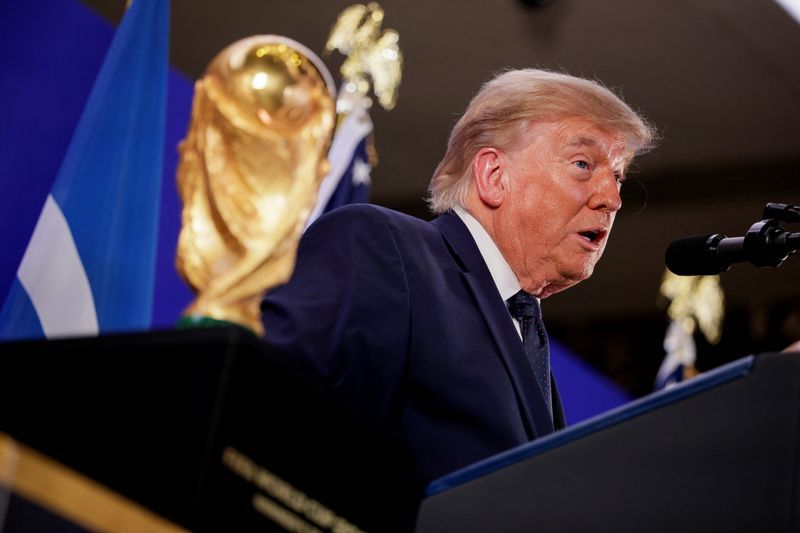
United States President Donald Trump will feature prominently at Sunday's World Cup final between Argentina and Spain at New York/New Jersey Stadium, where he is scheduled to sit alongside FIFA President Gianni Infantino and present the trophy to the winning nation. The appearance marks another high-profile moment for Trump in a tournament that has become unexpectedly entangled with American political divisions and international controversy, whilst simultaneously advancing his vision for a future World Cup hosted entirely by the United States.
Trump's central role in the competition intensified this week when he publicly confirmed his involvement in requesting that Infantino review the red card given to American striker Folarin Balogun. The disclosure triggered significant backlash across the global football community, with widespread concern that the American leader had inappropriately attempted to influence tournament proceedings and undermine the integrity of officiating decisions. FIFA swiftly issued denials that Trump's intervention played any role in the eventual suspension of Balogun's ban, yet the episode revealed the extraordinary access and influence the sitting president now enjoys within world football's governing body.
The relationship between Trump and Infantino has flourished remarkably in recent months, with the FIFA chief publicly expressing his gratitude to the American president at a reception held inside Trump Tower in Manhattan on Friday. Speaking before approximately 300 guests including Brazilian football legend Ronaldo and various FIFA dignitaries, Infantino credited Trump's administration as instrumental to the tournament's unprecedented commercial success and record-breaking attendance figures across North America. Trump reciprocated the praise, noting with characteristic bravado that the United States had unexpectedly proven itself a genuinely football-loving nation, a transformation he attributed directly to his own leadership.
The warming of ties between Trump and FIFA represents a striking reversal from concerns that had plagued the tournament's early planning stages. When Trump was elected to his second term, major American cities faced pointed questions about their capacity to welcome international supporters given the president's well-documented immigration restrictions and travel bans affecting several predominantly Muslim nations. The anxieties proved sufficiently acute that football authorities and urban planners debated extensively how to reassure visiting fans and teams about their safety and welcome. Trump subsequently heightened tensions by threatening to relocate matches away from cities governed by Democrats, a threat FIFA firmly rebuffed by asserting that any such decisions lay entirely within the federation's prerogative rather than the American president's.
Trump's enthusiastic embrace of World Cup pageantry forms part of a broader pattern of seeking out high-visibility sports platforms to maintain public prominence as his approval ratings show signs of stagnation during his second presidential term. The strategy proved particularly effective at the Ryder Cup held on Long Island, where Trump was greeted with sustained cheers from enthusiastic American spectators. Yet his appearances have not universally garnered affection. He was subjected to loud booing during Game 3 of the NBA Finals last month, whilst his attendance at last year's US Open men's tennis final caused considerable disruption when presidential security protocols kept fans outside the stadium well after play commenced.
Fox Sports faces distinctive editorial challenges in managing Trump's presence at the final, given that American coverage relies on a world feed over which the network exercises minimal control. The broadcaster cannot determine whether camera operators will cut to Trump during match action, nor can it anticipate timing of any such shots. Play-by-play announcer John Strong acknowledged frankly that Trump's polarising status creates a no-win scenario for broadcasters, noting that portions of the audience will welcome his attendance whilst others find his televised presence objectionable. The technical reality that networks cannot control the feed from FIFA's production team means that decisions about how frequently to show Trump remain entirely outside American editorial oversight.
Trump's stated ambition to host a future World Cup reflects his long-standing interest in securing international sporting events for American soil. He has frequently highlighted that FIFA awarded the 2026 tournament to a three-nation partnership comprising Canada, Mexico and the United States during his first presidency in 2018, positioning this decision as a personal accomplishment worthy of repeated mention. However, Trump's Friday comments suggesting that America should host the 2038 World Cup independently, explicitly excluding both neighbouring countries, carry unmistakable political undertones reflecting his broader nationalist and protectionist policy orientation.
The logistics of hosting another World Cup present genuine complexities that extend beyond Trump's rhetorical ambitions. American stadium infrastructure, player participation costs, and the sprawling geographic distances involved in hosting matches across multiple time zones have historically made independent American hosting more challenging than the multi-nation model FIFA has increasingly favoured. Nevertheless, Trump's demonstrated ability to build rapport with Infantino and FIFA leadership suggests his positioning for future tournaments should not be dismissed as purely theatrical. The president's willingness to court FIFA through high-profile appearances, lavish hospitality, and public praise has created political capital that could prove consequential in federation voting procedures determining future host nations.
For Malaysian and Southeast Asian observers, Trump's activities at the World Cup illustrate broader patterns whereby political leadership increasingly seeks to instrumentalise major sporting events for domestic political messaging and international positioning. The controversy surrounding Balogun's red card and Trump's intervention demonstrates the vulnerability of sporting institutions to political pressure when powerful actors demonstrate willingness to challenge their independence. Additionally, Trump's proposed exclusion of Canada and Mexico from the 2038 hosting arrangement reflects nationalist impulses that could have regional implications should similar protectionist thinking gain traction in other wealthy nations' approaches to international sporting governance. The episode underscores that global football, despite its ostensible political neutrality, remains deeply susceptible to the influence of governmental power and the ambitions of political leaders seeking to harness sport's considerable cultural authority.
Trump's presentation of the trophy on Sunday will serve as the visual culmination of a World Cup characterised by unprecedented economic success, record attendances, and unusual political entanglement. His appearance will instantaneously become subject to intense media scrutiny, with every camera angle and viewer reaction analysed for its political significance. Whether American networks choose to show him extensively, capture his reactions to goals, or focus primarily on players and action remains genuinely unknowable in advance. This uncertainty itself reflects the broader reality that Trump has fundamentally altered the World Cup's character, transforming it from an event primarily about football into an occasion equally defined by the complex intersection of sports, politics, nationalism and global diplomacy.

