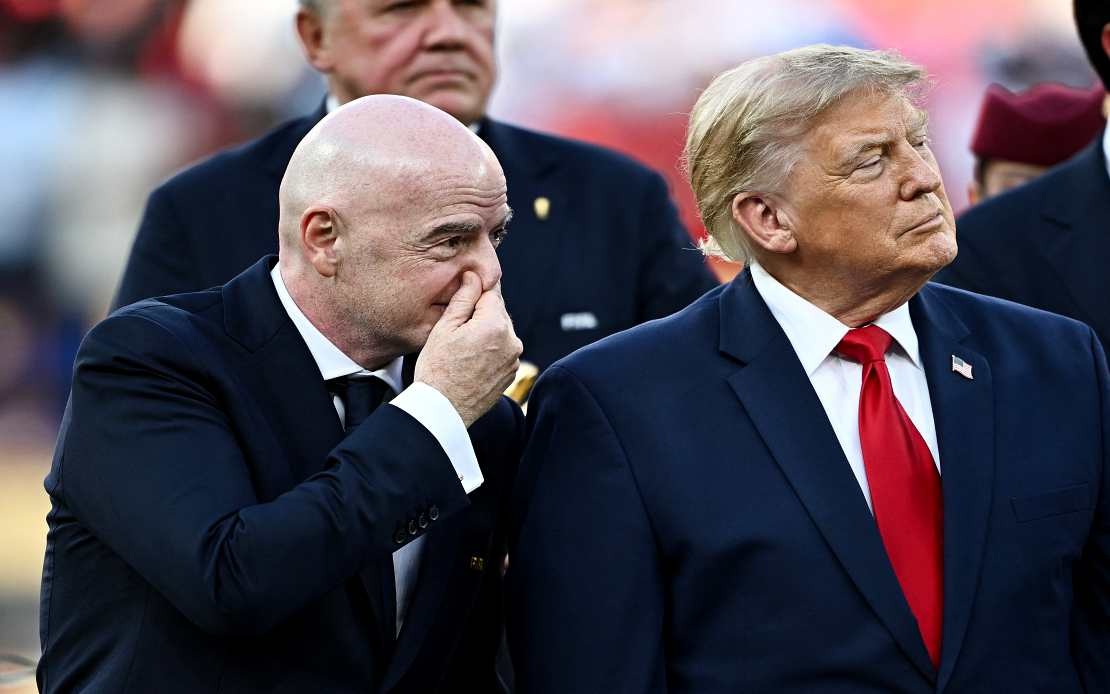
United States President Donald Trump has stepped into a high-profile dispute within international football governance, publicly endorsing FIFA President Gianni Infantino even as three major continental confederations demand independent scrutiny of his leadership. The intervention underscores the geopolitical dimensions of football administration and raises questions about whether external political pressure could influence the sport's institutional dynamics, particularly relevant as Southeast Asia positions itself as an increasingly important market for global football.
Trump's defence came in response to speculation about Infantino's possible departure from the FIFA presidency. Writing on Truth Social, the American leader characterised Infantino as a visionary executive responsible for what he claimed was the most commercially successful World Cup in history—four times larger than previous tournaments by his reckoning. This assertion reflects the 2022 Qatar World Cup's record-breaking financial performance, which generated unprecedented broadcasting revenues and sponsorship values.
The political backing proves timely, as Infantino faces mounting institutional pressure from the sport's power brokers. The Union of European Football Associations, the Asian Football Confederation, and the Confederation of North, Central American and Caribbean Football jointly published a letter condemning aspects of Infantino's stewardship. Their primary grievance concerns a controversial scheme to privatise a portion of FIFA's lucrative commercial portfolio, a proposal that threatened established revenue-sharing arrangements and governance structures that have evolved over decades.
At the heart of the controversy lies an ambitious financial restructuring announced in July. FIFA proposed raising $4.2 billion by selling approximately 20 percent equity stakes in a newly created entity that would assume control over the federation's media and commercial rights. This entity would manage rights across multiple World Cup cycles, fundamentally altering how football's most valuable tournaments are monetised. The proposal would have transformed FIFA's commercial operations from a confederation-controlled function into a hybrid public-private structure, introducing private capital into the sport's governance architecture.
Reports indicated that Joshua Kushner's foundation—brother of Trump's son-in-law Jared Kushner—stood positioned to acquire substantial shares in this new vehicle. The potential involvement of the Kushner family network raised additional concerns among confederation leaders about conflict of interest and the concentration of commercial control. This connection between American political circles and football administration illustrates how globalised sports governance has become intertwined with international political and business networks.
Infantino convened an emergency meeting with FIFA's executive leadership in early August to address escalating concerns. While the gathering ostensibly resulted in expressions of confidence in the president's continued tenure, Infantino acknowledged operational missteps regarding the FIFA Forward Enterprise commercial project. The acknowledgement represented a tactical concession, signalling willingness to adjust course while defending the broader vision of financial expansion and commercial modernisation.
European football's institutional response proved more confrontational. UEFA announced that all its member federations would boycott FIFA competitions until the commercial privatisation proposal was entirely abandoned. This constituted extraordinary pressure—threatening the participation of Europe's richest and most influential football associations from FIFA tournaments. For context, European confederations generate enormous broadcast rights revenues and command substantial voting power within FIFA's governance structures. Their unified stance demonstrated serious fractures within football's international hierarchy.
Confronted with this coordinated opposition spanning three continents, FIFA backed down. Infantino announced the abandonment of the commercial rights sales proposal, effectively surrendering the financial restructuring plan that had triggered the institutional crisis. The reversal represented a significant defeat for Infantino's modernisation agenda and validated the confederations' assertion that such consequential governance changes require broader consensus rather than unilateral executive action.
Trump's public endorsement arrived as Infantino absorbed these setbacks, appearing designed to reinforce the FIFA president's standing and counter narratives of institutional weakness. By framing Infantino as indispensable to football's future success, Trump offered political and reputational ballast precisely when confederations were demanding accountability. The American president's intervention suggests that despite football's relative autonomy as a global institution, major political figures maintain strategic interest in its leadership composition and policy directions.
For Malaysian and Southeast Asian observers, this episode illuminates several governance challenges facing regional and global sports organisations. The FIFA controversy demonstrates how commercial pressures, private equity involvement, and governance conflicts can destabilise even well-established institutions. It highlights the tension between modernisation imperatives and institutional legitimacy—between pursuing innovative financial structures and maintaining stakeholder confidence through inclusive decision-making processes.
The Asian Football Confederation's participation in the critical letter signals that Asian football interests aligned with UEFA's concerns about privatisation and commercial control. This coordination suggests emerging patterns of North-South and East-West alignment within sports governance, where developing football nations increasingly leverage collective action against structural changes perceived as favouring established commercial interests. The AFC's role demonstrates that Asian confederations need not defer to European institutional dominance when fundamental governance principles are at stake.
As Infantino consolidates his position following the commercial rights defeat, fundamental questions persist about FIFA's modernisation trajectory and governance legitimacy. The episode revealed both the limits of executive authority within football's federal structure and the capacity for coalition-building to constrain unilateral decision-making. For Southeast Asia's growing football stakeholders, the incident provides instructive lessons about institutional accountability, the perils of closed-door decision-making, and the necessity of preserving representative governance even amid pressures for rapid commercial evolution.

