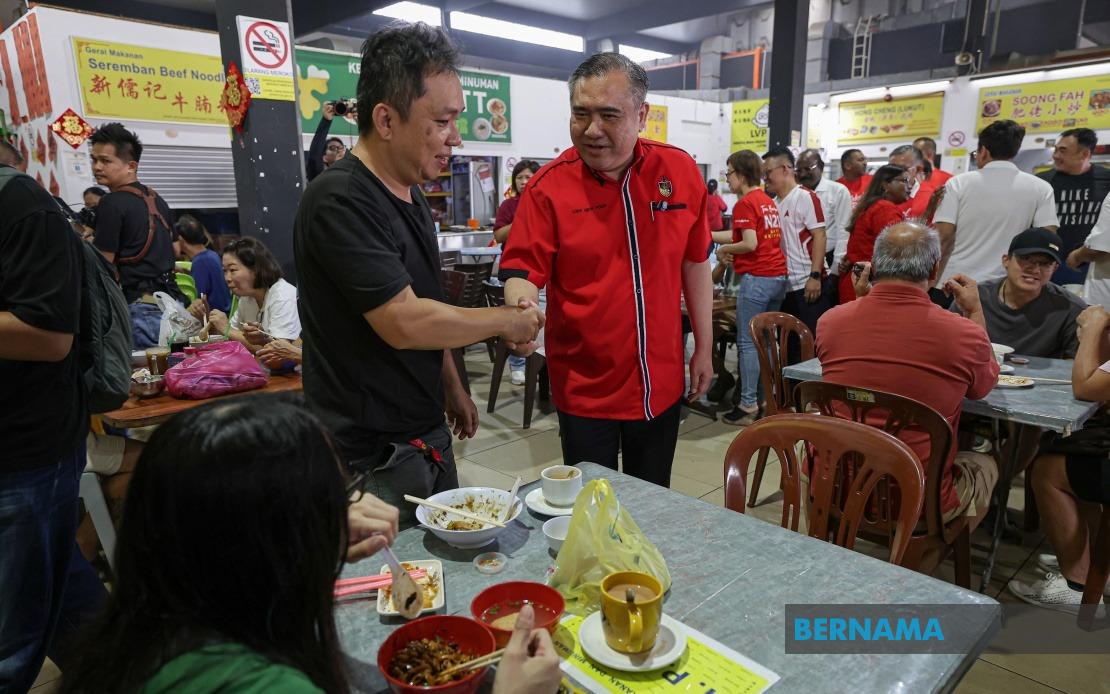
Transport Minister Anthony Loke has issued an uncompromising directive requiring all participants in the 16th Negeri Sembilan state election campaign to maintain rigorous compliance with traffic laws and road safety standards. Speaking in Seremban on July 19, Loke emphasised that no exceptions would be tolerated, framing safety protocols as fundamental requirements rather than optional guidelines for political candidates and their supporters.
The DAP secretary-general underscored the imperative of maintaining an orderly and secure campaign environment, stressing that preventing accidents must remain the paramount concern throughout the electoral period. His remarks came following a walkabout with Pakatan Harapan candidates including Ho Weng Wah, Lee Kai Yet, Siau Meow Kong, Nicole Tan, S. Mugunthan, and Chew Seh Yong at Pasar Besar Seremban, where he reinforced the party's commitment to exemplary conduct during the campaign trail.
Loke has personally instructed DAP campaign teams to wear protective helmets whenever riding motorcycles, establishing this as a non-negotiable minimum standard for party members. He illustrated his commitment through concrete action during the nomination day process, when he led a convoy from Pekan Titi to Kuala Klawang and explicitly declared that participation required helmet compliance. This zero-tolerance stance demonstrates how seriously the transport ministry is treating safety during what is typically a high-intensity campaign period characterised by frequent candidate movements and large supporter gatherings.
Beyond helmet requirements, Loke specifically cautioned all candidates and supporters against the dangerous practice of riding on vehicle tailgates—a common sight during Malaysian political campaigns where enthusiastic supporters cling to moving four-wheel-drive vehicles. He characterised this behaviour as reckless and incompatible with responsible campaign conduct, calling on all political parties and their leaders to prioritise safety over visual spectacle or symbolic displays of support.
The transport minister framed traffic compliance as a matter of principle that transcends partisan boundaries. While acknowledging that every political party naturally aspires to electoral victory, he argued that winning cannot justify flouting fundamental traffic regulations or endangering lives. This philosophy reflects a broader shift in Malaysian political discourse toward more professional and safety-conscious campaign practices, though enforcement mechanisms remain challenging given the decentralised nature of campaign operations.
The Negeri Sembilan state election represents a significant electoral contest, with the state assembly having been dissolved on June 5 following political developments in the state. The Election Commission has scheduled polling day for August 1, with early voting permitted on July 28. This timeline provides a focused campaign window during which heightened traffic volumes, candidate movements, and supporter activities typically concentrate in state constituencies.
Approximately 889,490 registered voters are eligible to participate in this state election, comprising 867,151 ordinary voters alongside 16,884 military personnel and their spouses, and 5,455 police officers voting early. This substantial electorate means considerable voter engagement activity across Negeri Sembilan's constituencies, with candidates conducting numerous campaign events, roadshows, and grassroots meetings that inevitably increase traffic movement and accident risk.
Loke's intervention in what might typically be considered a state-level matter reflects the transport ministry's jurisdiction over road safety policy and its legitimate interest in preventing campaign-related accidents. Malaysia has historically struggled with road safety metrics, and election periods traditionally witness elevated accident rates due to intensive campaign activities. The transport minister's proactive stance represents an attempt to break this problematic pattern through early, clear messaging to all political participants.
The directive carries particular significance because it comes from a senior minister who also serves as Seremban Member of Parliament, giving his message enhanced authority and demonstrating alignment between transport policy and electoral practice. As Seremban is one of the constituencies contested in this election, Loke's personal involvement signals that traffic compliance expectations apply equally to his own campaign activities and those of rival candidates.
For Malaysian voters and observers, this emphasis on traffic safety during elections offers a hopeful indicator that political competition need not compromise public safety. Campaign culture in Southeast Asia often normalises risky behaviours, but Loke's intervention suggests an emerging willingness among senior political figures to model responsible conduct. Whether this translates into sustained behavioural change across all campaign participants remains to be seen, but the symbolic importance of a transport minister actively enforcing safety standards during elections cannot be overstated in a region where such campaigns frequently generate traffic chaos.

