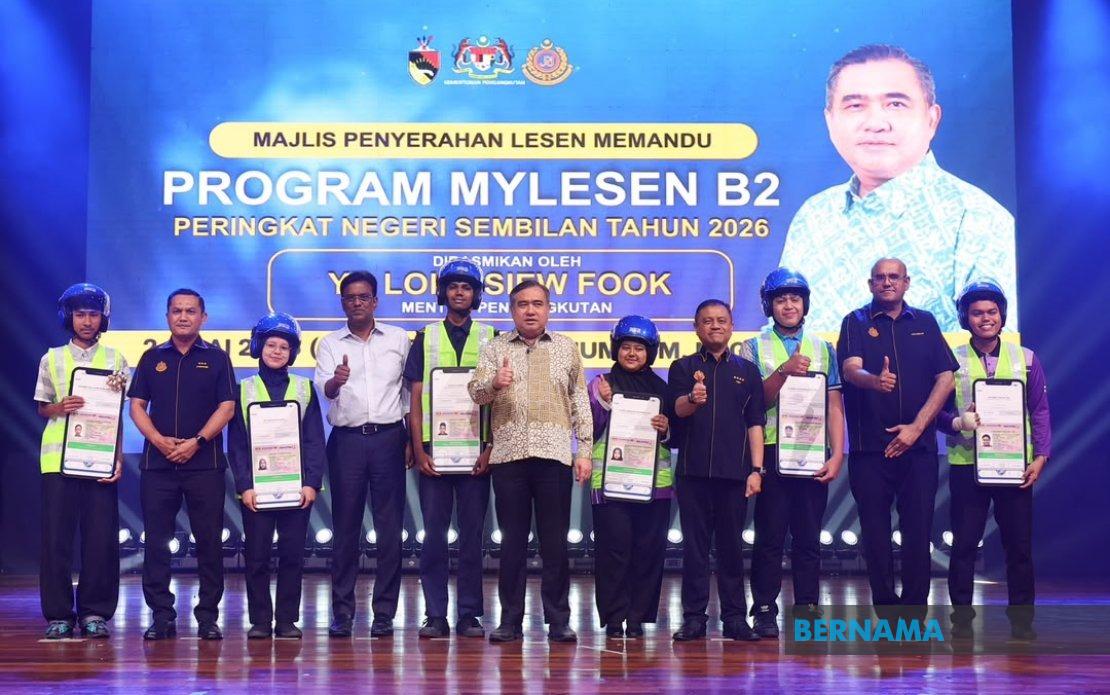
Transport Minister Anthony Loke delivered a pointed message to Malaysia's young motorcycle riders during a licence distribution ceremony in Seremban, cautioning that a motorcycle licence represents an obligation to ride responsibly within the law, not an entitlement to engage in reckless behaviour. Speaking at the Negeri Sembilan MyLesen B2 Programme presentation, Loke emphasised the gravity of road safety, particularly for a demographic that has consistently featured prominently in national accident statistics.
The statistics paint a sobering picture of road safety in Malaysia. Motorcyclists and pillion riders account for approximately 60 per cent of all road fatality cases recorded each year, with the overwhelming majority of these victims falling below the age of 30. This demographic concentration highlights a critical vulnerability among young riders, many of whom may lack the experience and judgment necessary to navigate Malaysia's increasingly congested roads. The concentration of fatalities among younger road users has become a persistent challenge for transport authorities, driving policy interventions such as the MyLesen B2 Programme itself.
The MyLesen B2 initiative represents a significant shift in how Malaysia approaches motorcycle licensing and rider development. Since its inception in 2023, the programme has extended formal licensing access to more than 100,000 recipients across the country, fundamentally democratising motorcycle ownership and legal riding opportunities. In Negeri Sembilan specifically, the government has nearly tripled participation this year, expanding the quota from 1,000 to 2,300 participants, demonstrating scaling commitment across regional boundaries. As of the Seremban event, almost 1,900 participants had successfully completed training and obtained their Probationary Driving Licence after passing competency assessments, indicating robust programme throughput.
Beyond the immediate licensing function, the MyLesen B2 Programme carries broader socioeconomic implications for Malaysian youth. By providing cost-free access to motorcycle licences, the government removes a significant financial barrier to legal mobility, enabling participants to access employment opportunities that require independent transportation, pursue educational pathways in distant locations, and improve their economic circumstances. For rural and semi-urban communities where public transport remains patchy, motorcycle mobility represents a practical gateway to opportunity. The programme thus functions simultaneously as a safety initiative, a social equity measure, and an economic enabler.
Loke's remarks specifically targeted the dangerous practice of illegal racing, which has become an increasingly visible problem on Malaysian roads, particularly during weekend hours. He framed weekend leisure time not as an opportunity for speed testing or street racing but as an occasion for safe, lawful travel. The minister's implicit message—that young riders face particular temptation to engage in illegal activities—reflects a reality that transport authorities have grappled with for years. Illegal racing operations typically involve young, newly-licensed riders who misinterpret their newfound mobility as permission for dangerous experimentation.
Underscoring this warning, Loke announced that Parliament has passed the Road Transport (Amendment) Bill 2026, introducing substantially harsher penalties for illegal racing and speed testing across all vehicle categories. This legislative escalation represents a marked hardening of enforcement philosophy. Previously, illegal racing violations resulted primarily in fines; the amended legislation now introduces imprisonment as a potential consequence, elevating the offence to serious status within transport law. For young riders already operating within the MyLesen B2 framework, this legal development carries immediate relevance and consequence.
The transport minister's emphasis on proper safety equipment complemented his broader safety messaging. He specifically urged all licence holders to adopt SIRIM-certified helmets—Malaysia's national standardisation body's approved safety products—both for themselves and for pillion riders. This attention to personal protective equipment reflects evidence-based injury prevention: properly certified helmets demonstrably reduce head trauma severity in accident scenarios. Positioning helmet compliance alongside legal compliance signals that safe riding involves multiple interconnected practices rather than single interventions.
The official delegation present at the Seremban event underscored the governmental weight behind the initiative. Transport Ministry Secretary-General Datuk Seri Jana Santhiran Muniyan, Road Transport Department Director-General Datuk Aedy Fadly Ramli, and JPJ Deputy Director-General Datuk Jazmanie Shafawi, alongside Negeri Sembilan's JPJ director Jasyindar Singh Sihdu, all participated in the licence presentations. This high-level attendance signals that the MyLesen B2 Programme enjoys sustained commitment across transport bureaucracy and that road safety messaging receives priority attention at ministerial levels.
For Malaysian youth and their families, the MyLesen B2 Programme represents both opportunity and obligation. The free licencing removes financial obstacles to legal mobility, yet simultaneously imposes heightened expectations regarding responsible riding behaviour. Transport authorities have invested in training, testing, and distribution infrastructure; riders now face corresponding expectations to justify that investment through lawful, careful conduct. The convergence of expanded legal access with stiffer penalties for illegal behaviour reflects a sophisticated policy approach: maximum opportunity coupled with maximum accountability.
The timing of Loke's remarks—coinciding with the parliamentary passage of amended road transport legislation—suggests a coordinated communication strategy. By combining promotional messaging around the MyLesen B2 Programme with warning about legal consequences for road violations, the Transport Ministry aims to shape behaviour among newly-licensed riders at a formative moment. Young riders receiving their licences during this period will simultaneously understand the privilege being granted and the serious consequences awaiting those who abuse that privilege.
Looking forward, the success of Malaysia's road safety agenda depends substantially on whether young MyLesen B2 participants internalise Loke's safety messaging and perceive the legal amendments as credible deterrents rather than theoretical threats. Transport safety ultimately rests on individual rider choices made moment by moment on Malaysian roads. A teenager deciding whether to engage in weekend racing, whether to wear a proper helmet, whether to ride within speed limits—these individual choices, multiplied across tens of thousands of newly-licensed riders, will determine whether the MyLesen B2 Programme succeeds in its dual mission of expanding opportunity while reducing the devastating toll that motorcycle accidents currently exact on young Malaysians.

