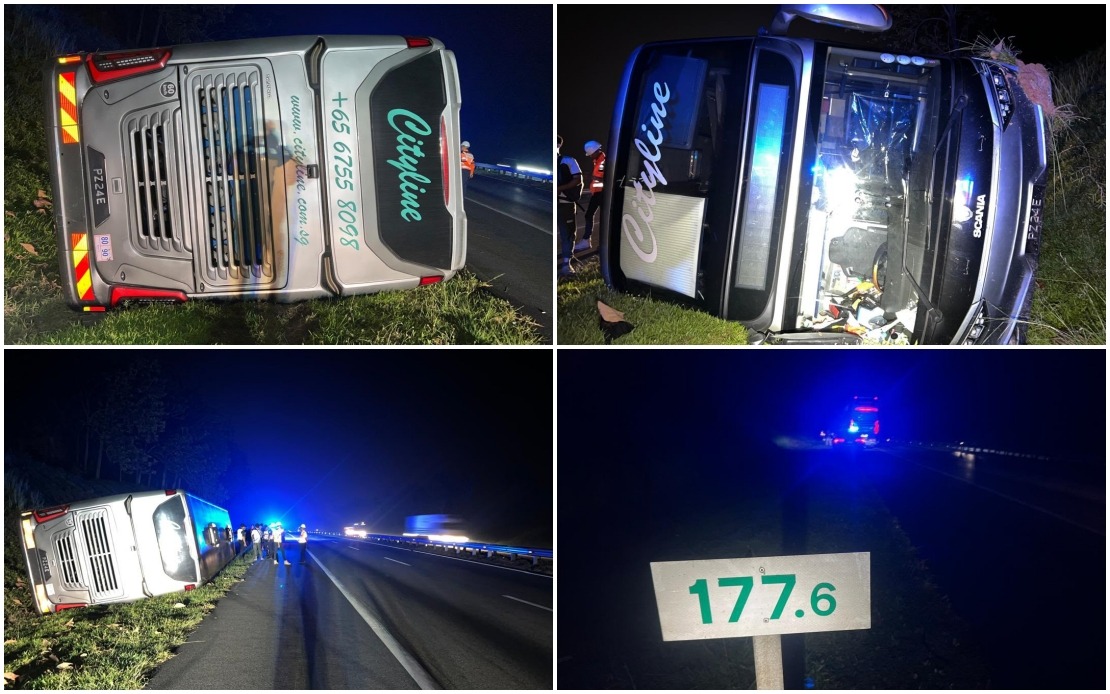
A tour bus carrying passengers between Singapore and Kuala Lumpur overturned along the northbound stretch of the North-South Expressway in Jasin on Monday morning, sending three people to hospital with injuries to their heads and lower limbs. The accident unfolded at Kilometre 177.6 around 5 am, when the bus encountered unexpected traffic congestion and veered sharply to the left before flipping, according to initial police investigations.
Among those hurt was a 59-year-old Malaysian tour guide who was supervising the group, alongside a 62-year-old Singaporean passenger and a 42-year-old British national, according to Jasin district police chief Supt Lee Robert. All three were transported to Jasin Hospital where they received treatment for their injuries. The accident involved 12 occupants in total, comprising the driver, tour guide, and ten passengers from various nationalities.
The sequence of events leading to the crash reveals a common highway hazard that catches drivers off guard. As the bus approached Kilometre 177.6 heading north, a heavy goods vehicle ahead had significantly reduced speed, forcing the bus driver to take evasive action. Rather than managing the deceleration smoothly, the driver steered sharply to the left side of the expressway in an attempt to avoid a rear-end collision. The manoeuvre, however, caused the bus to lose stability and overturn, with the vehicle ending up off the roadway.
This incident highlights ongoing safety concerns on Malaysia's major expressway corridors, particularly regarding heavy vehicle congestion and sudden traffic changes during early morning hours when visibility and driver alertness may be compromised. The North-South Expressway, spanning over 880 kilometres, remains one of Southeast Asia's busiest commercial and passenger routes, connecting Malaysia's northern and southern regions while serving as a key transit corridor for travellers moving between Malaysia and Singapore.
Tour operators running services along this route typically carry mixed groups of international tourists, making safety protocols and driver training especially critical. The presence of British and Singaporean nationals among the injured underscores the international significance of this transport corridor and the diverse passenger base relying on Malaysian highways for cross-border travel. Many such tour groups operate overnight or early morning schedules to optimise travel time, potentially placing additional fatigue demands on drivers navigating extended journeys.
Supt Lee Robert's statement emphasises that the accident was neither a case of excessive speed nor mechanical failure, but rather a reactive driving decision made under pressure to prevent a collision with the preceding vehicle. This classification matters for insurance purposes, liability determination, and ongoing investigations into whether the bus driver followed proper protocols for emergency manoeuvres on expressways. The circumstances also raise questions about whether adequate spacing was maintained between the vehicles involved and whether speed differentials were communicated effectively through brake lights or warning systems.
The injuries sustained by the three passengers, while not reported as life-threatening, nonetheless required hospital assessment and treatment, suggesting moderate impact forces from the rollover. Head and leg injuries from vehicle overturns frequently indicate that occupants were thrown or pressed against interior structures during the accident, pointing to the critical importance of seatbelt usage and proper seating positions while travelling on expressways. Tour operators operating international routes face regulatory obligations regarding passenger safety briefings and equipment standards that merit scrutiny in such incidents.
This accident joins a pattern of transportation incidents on Malaysia's expressway system that continue to claim injuries and fatalities despite ongoing safety campaigns and infrastructure improvements. Early morning departures, common among tour operators seeking to maximise daytime travel, coincide with periods when some drivers may experience fatigue or reduced cognitive performance. The concentration of heavy vehicles during these hours compounds risks, creating conditions where sudden decelerations can trigger cascading incidents affecting lighter vehicles like buses.
The involvement of three international passengers also carries implications for medical coordination, family notification protocols, and potential diplomatic considerations if injuries had been more severe. Tourist safety on Malaysian roadways remains a matter of concern for the tourism industry and government authorities seeking to maintain Malaysia's reputation as a safe destination for international visitors. Incidents such as this one garner attention from tour operator associations and safety regulators across Southeast Asia, influencing route planning and vehicle allocation decisions.
Looking forward, the investigation by Jasin district police will likely examine driver qualifications, vehicle maintenance records, speed data from black box systems if present, and whether the preceding lorry driver failed to signal intent adequately. These findings typically inform transport ministry guidelines and expressway operator policies governing heavy vehicle operations and passenger vehicle response protocols. For regional tour operators and transport companies, such incidents serve as reminders of the volatility inherent in highway travel and the necessity of continuous driver training on evasive manoeuvres and vehicle dynamics.

