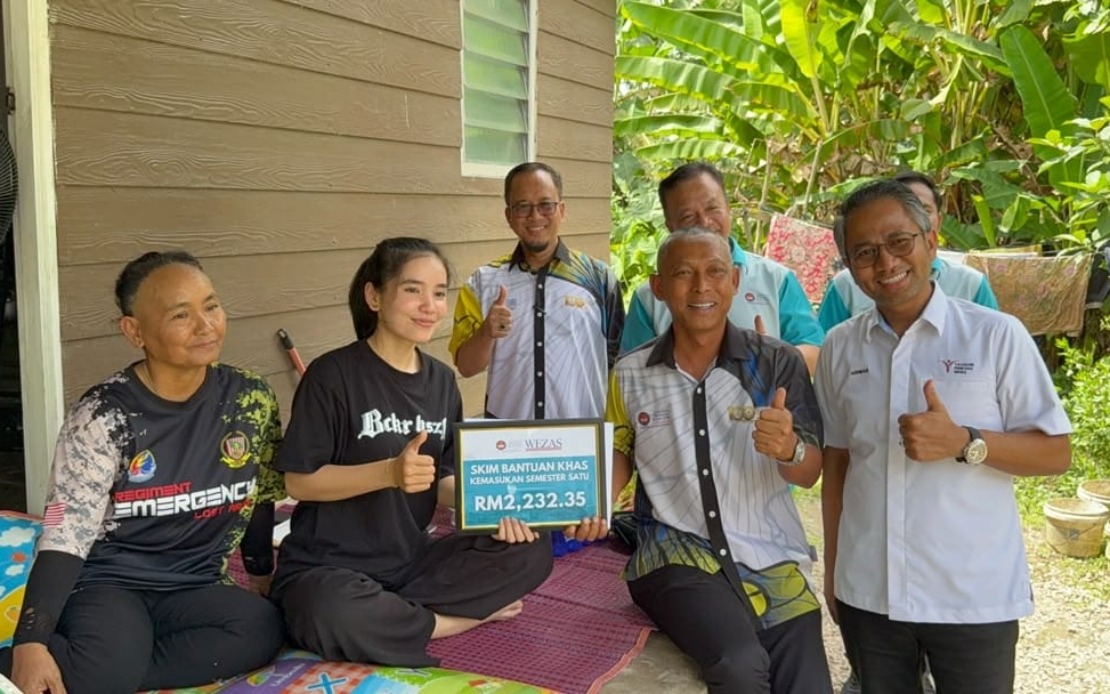
Three deserving students have overcome significant financial hurdles to pursue their university education, receiving crucial support from Universiti Pendidikan Sultan Idris (UPSI), the Higher Education Ministry (MOHE), and associated charitable bodies. The success stories highlight how collaborative efforts between educational institutions and government agencies can transform the educational trajectories of economically disadvantaged but academically gifted individuals seeking entry into Malaysia's higher education system.
Lovely Sabana Augustine, an accomplished STPM graduate, will enrol at UPSI's Faculty of Human Sciences beginning the 2026/2027 academic session. Her case gained significant traction on social media after she publicly appealed for assistance with registration fees and essential study materials. The youngest of four siblings, Sabana lives with her mother Mek Kenui in Tumpat, Kelantan, where household income remains constrained at approximately RM800 monthly from her mother's work as a school cleaner. Her father, a former military serviceman, passed away in 2017, removing a critical income source from the family structure. Despite these considerable hardships, her academic excellence earned her recognition as an STPM outstanding achiever, demonstrating that socioeconomic circumstances need not dictate intellectual potential or university admission outcomes.
Alongside Sabana, two other prospective students—Siti Nurdianis Nordin and Muhamad Ilias Danish—similarly navigated financial instability to reach their university threshold. Siti Nurdianis will study at the Faculty of Management and Economics, while Muhamad Ilias will join the Faculty of Languages and Communication. Siti Nurdianis comes from a household relying on inconsistent daily wage income, creating perpetual uncertainty about educational funding capacity. Muhamad Ilias faced an even more acute challenge following the death of his father, the household's primary earner. He now shares responsibility for supporting his mother and siblings, illustrating how family bereavement can rapidly transform a student's economic standing and educational accessibility.
The assistance package, totalling RM1,500 per student, emerged through a structured collaboration between multiple stakeholders in Malaysia's educational support ecosystem. UPSI's Centre for Waqf, Endowment, Zakat, Khairat, and Sadaqah (WEZAS) contributed RM500 per student, leveraging Islamic charitable principles to address educational disadvantage. The remaining RM1,000 came from Yayasan Perkasa Siswa (YPS), a foundation explicitly focused on student welfare within Malaysia's university system. This dual-source approach reflects growing recognition that educational support requires multiple institutional actors working in concert rather than isolated government intervention.
Hirman Awang, director of the Department of Higher Education's Student Affairs Division, positioned the initiative within MOHE's broader policy framework regarding accessibility and equity in higher education. His statement emphasised that the ministry views financial constraints as an illegitimate barrier preventing talented individuals from advancing academically. YPS's contribution of RM1,000 per recipient addresses foundational expenses—registration fees, accommodation deposits, study materials—that often consume months of a low-income family's earnings. By removing these immediate friction points, the assistance programme reduces the likelihood that capable students abandon university plans due to cashflow crises occurring before they even enrol.
Prof Dr Norkhalid Salimin, UPSI's deputy vice-chancellor for Student Affairs and Alumni, articulated the university's philosophical approach to student support as fundamentally proactive rather than reactive. UPSI's Student Affairs and Alumni Department (JHEPA) and WEZAS explicitly monitor incoming student cohorts for individuals signalling financial distress, rather than waiting for students to reach crisis point before offering help. This early-intervention model recognises that many disadvantaged students suffer from information asymmetry and uncertainty about available support mechanisms. By reaching out directly to prospective enrollees facing documented hardship, the university signals institutional commitment to removing psychological and practical barriers to help-seeking.
The collaboration between UPSI, YPS, and JPT represents a strategic realignment of how Malaysia's higher education sector addresses equity challenges. Rather than treating student financial need as an individual or family responsibility, the framework constructs support as an institutional priority requiring coordinated engagement across multiple levels—the university itself, foundation bodies with specialised student welfare mandates, and government departments responsible for higher education policy. This structural approach suggests a maturing understanding that access to university education in Malaysia increasingly depends on whether institutions actively identify and support vulnerable cohorts rather than assuming that admission automatically solves equity problems.
The broader context reveals persistent economic inequality within Malaysia's pre-university cohort. STPM excellence like Lovely Sabana's achievement does not guarantee family affluence; indeed, outstanding academic performance occasionally correlates with students from lower-income backgrounds who leverage education as upward mobility mechanism. The visibility of Sabana's social media appeal and its subsequent institutional response raises important questions about whether similar students without social media access or digital literacy face hidden barriers that institutional systems fail to detect. The RM1,500 assistance package, while transformative for immediate registration needs, likely represents the lower bound of first-year expenses, suggesting that these students may encounter renewed financial pressure as their studies progress.
Implementation of this assistance programme occurred strategically ahead of UPSI's September 13 registration deadline, compressed within a timeframe that required rapid institutional coordination. The ability to mobilise RM1,500 per student quickly indicates that UPSI and its partner organisations maintain readily available emergency funding mechanisms rather than relying on lengthy bureaucratic approval processes. This operational efficiency contrasts sharply with many government assistance programmes requiring extensive documentation and extended processing periods that can inadvertently exclude those most in need due to navigational complexity. The programme's design suggests lessons applicable across Malaysia's university system regarding how to distribute student support with maximum speed and minimum administrative burden.
Looking forward, the experience of Sabana, Siti Nurdianis, and Muhamad Ilias highlights both the success and limitations of current student support infrastructure. Their receipt of assistance validates the existence of well-intentioned institutional mechanisms; however, their circumstances also underscore that STPM excellence emerges despite profound economic disadvantage, suggesting that many equally capable students may never reach university-entrance academic levels due to resource constraints operating at secondary education stages. Malaysia's commitment to removing financial barriers at the university threshold requires complementary investments in identifying and supporting talented students from disadvantaged backgrounds much earlier in their educational journeys, ensuring that talent identification itself does not depend on family resources or geographic proximity to urban educational opportunities.

