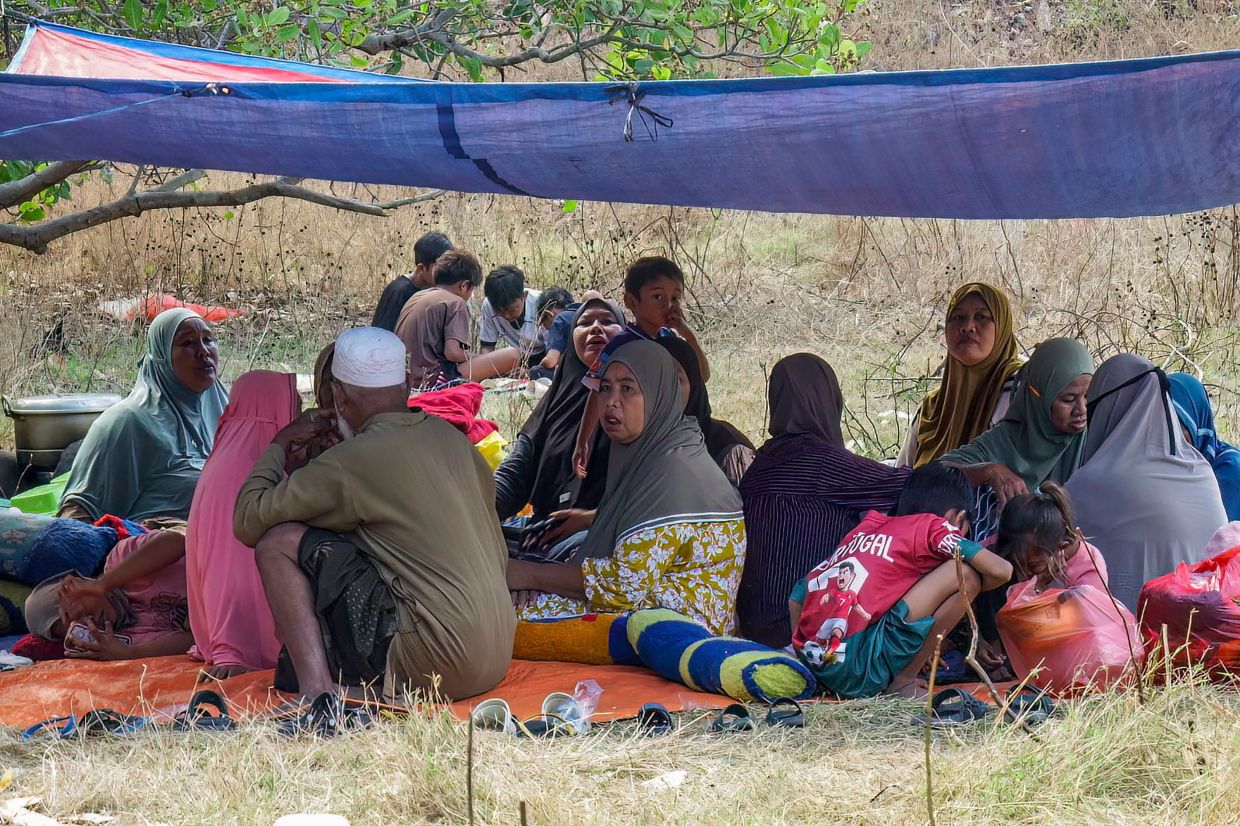
On Sunday, thousands of displaced residents on Indonesia's Flores island remained stranded in makeshift shelters following a devastating 7.7-magnitude earthquake that claimed 48 lives and left at least 101 others injured the previous morning. The disaster has pushed the island's disaster response systems to the brink, with survivors camping on hillsides and awaiting basic supplies as a prolonged series of aftershocks—341 recorded in the hours immediately following the main tremor—continued to shake the region and heighten public anxiety about structural collapses.
The early Saturday earthquake triggered mass panic among residents, with approximately 5,000 people abandoning their homes in fear as the ground buckled beneath them. Many sought refuge on higher ground, a survival instinct informed by memories of the island's traumatic seismic history. The decision to flee proved prescient when coastal populations observed the sea receding in what could have been a prelude to tsunami inundation. Though authorities subsequently lifted the tsunami warning after waves of up to 1.6 metres were recorded in certain coastal zones, the psychological toll of the evacuation compounded the physical devastation already visible across Flores's landscape.
For survivors such as Umri, a 55-year-old resident of Nangahale village on Flores's north coast, the aftermath has been one of profound deprivation. Huddled with others on a hilltop for over a full day, Umri articulated the immediate humanitarian crisis facing the island: the population desperately requires food, drinking water, medications, and basic necessities such as diapers for infants and children. These are not abstract needs but the foundation of survival in a region where normal supply chains have been severed and infrastructure has been compromised by the seismic event.
The psychological scars compound the material crisis. Nurhidayati, also 55, spent her night sleeping on a mat atop the same refuge hill, her anxiety amplified by traumatic memories of the catastrophic 1992 earthquake that devastated Flores with a comparable 7.7-magnitude force. That earlier disaster triggered a tsunami that claimed approximately 2,500 lives, leaving an indelible mark on the collective memory of Flores residents. Nurhidayati's reluctance to return home reflects not merely concern about additional tremors but deep-rooted trauma from an event that reshaped her understanding of natural hazards and vulnerability. She expressed hope that the government would mobilise resources quickly enough to provide essential supplies and psychological reassurance to terrified populations.
The destruction catalogued by disaster officials underscores the scale of infrastructure damage requiring urgent intervention. The National Disaster Management Agency (BNPB) confirmed that at least 914 houses sustained severe structural damage, with hundreds of additional dwellings experiencing lesser but still significant harm. Beyond residential structures, the earthquake ravaged critical public facilities: 93 educational institutions, 36 health facilities, and 38 government offices sustained damage, fragmenting the institutional capacity needed for coordinated disaster response. The loss of electrical and telecommunications infrastructure in certain areas has further complicated efforts to assess needs and coordinate relief operations, creating communication blackouts that impede situational awareness among distant authorities.
The epicentre of the shallow-focus earthquake lay just offshore from Flores's northern coast, concentrating seismic energy precisely where densely populated settlements clustered. Fortunately for the island's relatively sparse architectural environment, Flores contains few high-rise buildings that might have collapsed wholesale, though the concentration of vulnerable structures—predominantly concrete or wood-frame houses designed without sophisticated earthquake engineering—meant that even moderate ground motion translated into widespread destruction. Search and rescue officials, working from Sunday onward, reported no confirmed instances of people buried under rubble or unaccounted for, suggesting that the rapid evacuation and relatively low building density prevented even more catastrophic loss of life.
The Indonesian government and international community mobilised quickly to address the humanitarian emergency. Authorities dispatched 50,000 aid packages weighing a combined 275 tonnes to affected areas, attempting to provision the displaced population with survival necessities. The East Nusa Tenggara provincial administration, which encompasses Flores, initiated formal procedures to establish emergency response status for the subsequent 14 days, institutionalising the crisis response framework and potentially releasing additional budgetary and operational resources. European Union Commission President Ursula von der Leyen announced the European bloc's readiness to deploy its Copernicus Earth observation satellite constellation to support Indonesian search and rescue operations, an offer reflecting international recognition of both the disaster's severity and the value of advanced remote sensing technology for identifying survivors and assessing damage patterns.
Flores's vulnerability to seismic events reflects Indonesia's fundamental geographical predicament: the archipelago straddles the Pacific Ring of Fire, a vast arc of intense seismic activity encompassing Japan, Southeast Asia, and the Pacific basin. The tectonic mechanics driving this region's earthquake frequency stem from the complex interaction of multiple continental and oceanic plates colliding, subducting, and grinding against one another. This geological reality means that catastrophic earthquakes represent not exceptional occurrences but recurring natural phenomena to which Indonesian populations must perpetually adapt. The 2004 Indian Ocean earthquake, which registered 9.1 magnitude and triggered a tsunami killing approximately 220,000 people across the region—with Indonesia alone accounting for roughly 170,000 deaths—remains seared into regional consciousness as evidence of the immense destructive potential residing beneath tropical seas.
For Malaysia and other neighbouring Southeast Asian nations, the Flores disaster carries important implications regarding disaster preparedness and regional mutual aid frameworks. Although Malaysia occupies a relatively more seismically stable location than Indonesia's archipelagic context, the frequency of Indonesian earthquake events underscores the necessity for all regional governments to maintain robust early warning systems, emergency response protocols, and cross-border coordination mechanisms. The interconnected nature of Asian supply chains and the movement of goods and people across maritime boundaries mean that significant natural disasters in one nation inevitably ripple through regional economies and populations. Malaysian humanitarian agencies and disaster response capabilities may be engaged in future Flores-scale emergencies, making knowledge transfer and operational coordination with Indonesian counterparts increasingly valuable.
The immediate priorities facing Indonesian authorities and humanitarian organisations involve scaling emergency shelter provision, establishing functioning water and sanitation systems, restoring medical services to treat the injured, and preventing disease outbreaks in crowded evacuation zones. The prospect of prolonged aftershock sequences—already numbering in the hundreds—poses ongoing dangers to partially damaged structures and complicates the timeline for residents returning home. Psychological support for traumatised populations will require as much attention as physical reconstruction, particularly for survivors whose prior earthquake experiences have left lasting emotional scars. The test of Indonesia's institutional capacity and international partnership systems will ultimately be measured in how rapidly normalcy can be restored to Flores and whether lessons from this disaster translate into enhanced preparedness for the next inevitable seismic event in this tectonically restless region.

