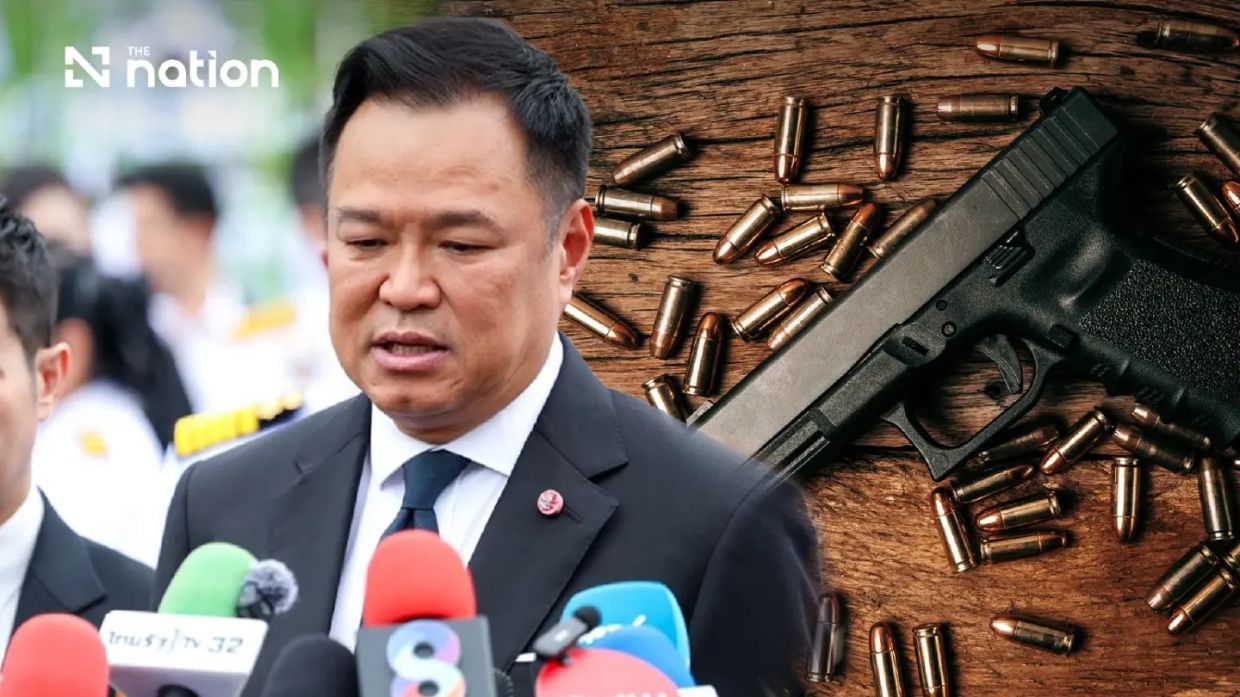
Thailand's Prime Minister Anutin Charnvirakul has announced a comprehensive push for stricter firearms legislation following the shocking mass shooting at Debsirin Nonthaburi School. After visiting the scene and holding discussions with national police chief Pol Gen Kittharath Punpetch at Government House, Charnvirakul outlined an ambitious legislative agenda designed to tighten controls on gun ownership and use across the kingdom. Working alongside Deputy Prime Minister Pakorn Nilprapunt, the government has prioritised amending current laws to create a more robust framework for regulating firearms in Thai society.
Central to the government's strategy is an enforcement mechanism focused on checkpoint operations and systematic inspections in public spaces. Anutin made clear that any individual found carrying a firearm outside their residence without legitimate professional justification—whether in public areas or inside vehicles—will face serious criminal charges. This approach represents a hardline stance on gun possession, reflecting growing public alarm following the school tragedy. The emphasis on enforcement reflects recognition that legislative changes alone cannot succeed without rigorous implementation and monitoring by law enforcement agencies.
The Prime Minister firmly rejected suggestions that teachers should be permitted to carry weapons for defensive purposes, a proposal that has gained traction in some circles following the shooting. Anutin's position is unequivocal: teachers lack the formal authorisation status of law enforcement officers and cannot be expected to respond to armed threats in educational settings. This decision prioritises the safety culture within schools rather than militarising the educational environment. The government's stance aligns with concerns that arming educators could introduce additional risks to students and create liability issues for institutions.
Addressing the broader problem of illegal firearm circulation, the government is reviving an amnesty-style programme that would allow citizens to surrender unlawful or unauthorised weapons to state authorities without penalty. This initiative recognises that many weapons in private hands exist outside the legal framework, creating ongoing public safety risks. By offering a no-questions-asked surrender option, the government hopes to reduce the pool of unregistered firearms while establishing a baseline for future enforcement efforts. Citizens can deliver weapons to the Department of Provincial Administration, district offices, or police stations, where proper documentation will be recorded.
However, Anutin made abundantly clear that the amnesty programme does not legitimise illegal firearm ownership. Any gun lacking proper registration status is inherently unlawful, and individuals caught possessing such weapons during his administration will face serious legal consequences. The Prime Minister stressed that surrendering illegal firearms is the only viable path for current owners, emphasising that the risks of retaining unregistered weapons far outweigh any perceived benefits. This hardline messaging is intended to encourage voluntary compliance while deterring continued illegal possession.
The government's approach to legal firearm ownership emphasises secure storage and parental responsibility. Guns kept in homes must be properly registered with authorities, stored securely to prevent unauthorised access, and kept away from children. Both the registered owner and any individual who uses a weapon in committing an offence will face legal liability, creating dual accountability mechanisms. This framework aims to reduce accidental or theft-related gun misuse while ensuring that responsibility for firearm safety extends beyond the immediate user to include the legal owner.
Regarding the circumstances surrounding the school shooting itself, Anutin urged restraint in public commentary pending completion of the police investigation. Reports suggesting that the student perpetrator had experienced bullying prompted the Prime Minister to caution against premature speculation or theories that might heighten public anxiety without factual foundation. He emphasised that investigative agencies must be allowed to establish the actual facts before broader policy discussions about school safety and bullying prevention proceed. This stance reflects concern that unverified claims could either misdirect policy responses or create widespread fear in educational communities.
The government's long-term security strategy extends beyond firearms regulation alone. Anutin announced that multiple agencies beyond the Department of Provincial Administration have received direct orders to conduct comprehensive inspections aimed at suppressing unlawful activities more broadly. Police and other authorised officers will intensify their enforcement operations, suggesting a coordinated, multi-agency approach to public safety. This comprehensive strategy acknowledges that addressing violent crime requires sustained effort across various government departments and enforcement bodies working in concert.
For Malaysia and other Southeast Asian nations grappling with similar public safety challenges, Thailand's legislative response offers both lessons and cautionary notes. The emphasis on strict enforcement, secured storage requirements, and dual liability reflects best practices in firearm regulation. However, the effectiveness of such measures ultimately depends on implementation capacity and sustained political will. The incident underscores the vulnerability of schools even in developed regional economies and the importance of evidence-based responses rather than reactive policymaking. Malaysian policymakers observing Thailand's approach may find relevant insights for their own firearms management and school safety frameworks, though local context and existing legislative structures will determine which elements prove most applicable.

