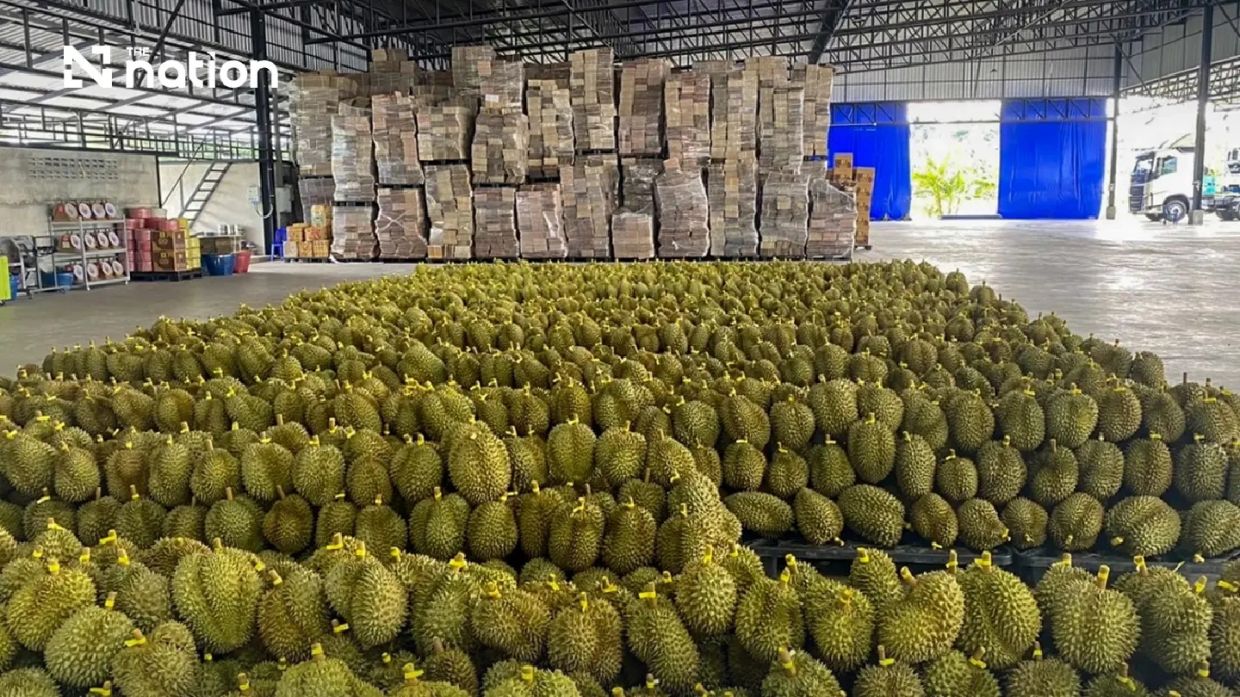
Thailand has achieved a watershed moment in its agricultural trade with China, with fresh durian exports to the world's largest consumer surpassing THB100 billion during the first six months of 2026. The shipment volume reached 872,237 tonnes distributed across 53,665 containers, marking the first occasion that first-half exports have breached the three-figure billion-baht threshold. Officials are projecting that the sector will sustain momentum to deliver a full-year export value of THB150 billion, cementing Thailand's status as the globe's foremost supplier of premium fresh durians.
The surge in export performance cannot be attributed to simple price increases or volume expansion alone. Rather, it reflects a fundamental restructuring of how Thailand manages quality and regulatory oversight throughout its durian supply chain. Agriculture and Cooperatives Minister Suriya Jungrungreangkit, who has been in his post for fewer than 90 days, has championed a wholesale transformation away from reactive, case-by-case problem-solving towards a holistic, system-wide framework that emphasises prevention and transparency. This strategic pivot has resonated powerfully with Chinese authorities and importers, who have historically expressed concerns about product integrity.
The cornerstone of Thailand's renewed approach centres on a set of rigorous standards termed the "Four Nos": absolutely no immature durian, no insect infestations, no misrepresentation of geographical origin, and no traces of Basic Yellow 2—a problematic dye substance. Beyond these categorical prohibitions, the authorities have layered in additional safeguards including a four-stage PLUS screening mechanism designed to intercept plant pests, risk assessment protocols grounded in scientific evidence, and end-to-end traceability architecture that follows individual shipments from orchard to port. The electronic phytosanitary certificate system now underpins all transactions, creating a digital audit trail that accelerates clearance while furnishing regulators and buyers with comprehensive documentation.
The operational redesign has dramatically reduced bureaucratic friction that previously impeded Thailand's competitive position. By streamlining inspection procedures and freeing up regulatory resources for facilitative rather than purely compliance-focused activities, the government has cut processing delays that once jeopardised product freshness and market windows. Chinese importers report faster turnaround times and greater confidence in batch authentication, factors that directly translate into sustained commercial demand and premium pricing.
Thailand's historical struggles in this sector merit context for regional observers. Prior disruptions stemmed from sporadic detection of cadmium contamination, seed borer infestation, falsely labelled origins, and residues of Basic Yellow 2—each incident denting buyer confidence and occasionally triggering import suspensions. These quality lapses had hobbled Thailand's otherwise formidable competitive advantages: ideal climate conditions, extensive durian cultivation expertise, and a reputation for flavour and consistency. The current ministerial team recognised that ad-hoc firefighting would never suffice; instead, they invested in institutional capacity to prevent violations upstream rather than managing crises downstream.
Central to this transformation has been the coordination framework now binding together the Department of Agriculture, the National Bureau of Agricultural Commodity and Food Standards, the Department of Agricultural Extension, customs authorities, producing provinces, testing laboratories, commercial operators, farmers, and Chinese regulatory counterparts. This multi-stakeholder architecture ensures that quality standards permeate every layer of production and export, from smallholder orchards to multinational logistics firms. Rather than siloing responsibility, the system fosters information-sharing and collective accountability. Provincial producers understand precisely which practices invite rejection; packing houses know the testing protocols they must satisfy; laboratories operate standardised assays; and customs officials possess the technical knowledge to verify compliance swiftly.
For Malaysia and other Southeast Asian exporters, Thailand's experience offers instructive lessons about the mechanics of agricultural trade in an era of increasingly stringent buyer scrutiny. China's position as the dominant consumer of tropical fruits across the region means that satisfying its regulatory and quality expectations has become non-negotiable for any exporter seeking market access. Thailand's methodical overhaul—emphasising transparency, science-based risk management, and genuine institutional reform rather than mere cosmetic adjustments—demonstrates the commercial payoff of treating quality assurance as a strategic investment rather than a cost burden. Exporters that view compliance as an overhead to be minimised will inevitably lose ground to competitors committed to excellence.
Minister Suriya has articulated an ambitious vision extending well beyond durians. He frames the current success as a template for upgrading management across Thailand's entire agricultural export portfolio, from mangoes and pineapples to processed seafood and frozen vegetables. If the Thai model proves as effective with these commodities as it has with durians, it could reshape regional competitive dynamics and establish new benchmarks for quality governance. For downstream economies like Malaysia that also export to China, the pressure will mount to adopt similarly robust systems or risk market share erosion.
The financial dimensions underscore the stakes. At THB100 billion for six months and a projected THB150 billion annually, durian exports now constitute a major source of foreign exchange for Thailand and critical income for rural farming communities throughout the Northeast and South. The sector directly or indirectly employs tens of thousands, from plantation workers to logistics coordinators to quality inspectors. Protecting and expanding this revenue stream through superior management benefits not just agribusiness magnates but smallholder farmers whose livelihoods depend on consistent market access and fair prices.
Department of Agriculture Director-General Rapibhat Chandarasrivongs has articulated the bureaucratic philosophy underpinning these gains: the agency is repositioning itself as a "Smart Regulator" that leverages data, technology, and scientific reasoning to oversee compliance across sprawling supply networks. Rather than stationing inspectors at every checkpoint—an economically unfeasible approach—the system collects intelligence from production points, processing facilities, and laboratories, synthesising that information to issue digital certificates and flag anomalies. This approach reduces compliance burdens on operators and farmers whilst enhancing supervisory precision and responsiveness. It is a model increasingly adopted by advanced regulatory jurisdictions globally, and Thailand's successful implementation in the agricultural context suggests that comparable methodologies could be adapted to other sectors and emerging economies.
The symbolic importance of exceeding THB100 billion in first-half exports extends beyond mere accounting. It signals to trading partners that Thailand has moved beyond temporary fixes and established durable institutional capacity to guarantee product integrity. For buyers in China and throughout Asia, it reinforces that Thai durians represent not merely a commodity but a quality assurance proposition backed by verifiable systems and transparent governance. This reputational asset compounds over time, as repeated positive experiences with Thai suppliers cement loyalty and enable price premiums. Conversely, any lapses in the future would carry magnified reputational costs, creating strong incentives for ongoing vigilance and continuous improvement.

