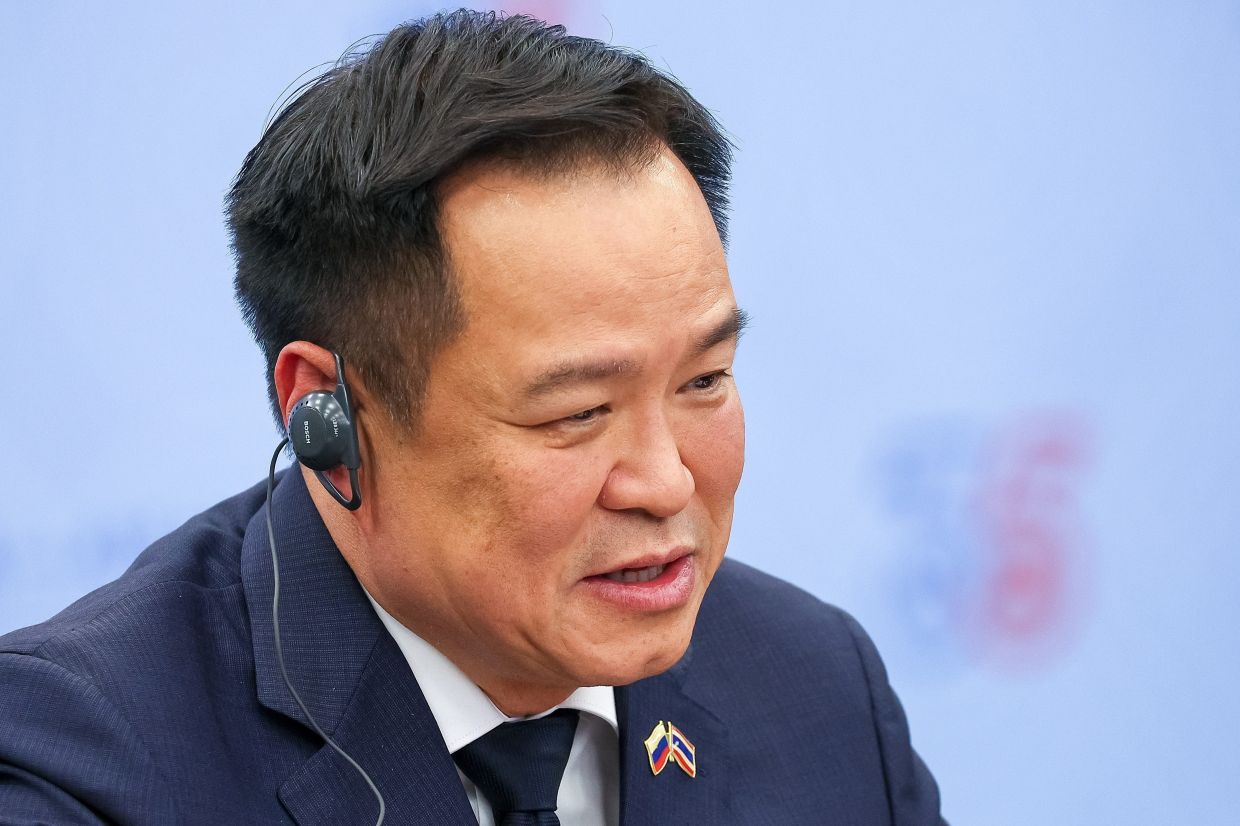
Thai Prime Minister Anutin Charnvirakul reached the hundred-day milestone of his tenure on June 27 having steered his government through immediate political and energy crises, yet analysts express concern that his administration shows little appetite for the systemic economic reforms the kingdom desperately requires. The 59-year-old leader took office on March 20 following his re-election victory, marking the second spell as premier after his initial appointment in September 2025 when the previous government collapsed. While political stability has been preserved and acute pressures managed, observers worry that routine administration is masking the absence of meaningful structural change needed to lift Thailand from regional underperformance.
Anutin's first hundred days proved immediately challenging when geopolitical turbulence erupted just weeks into his mandate. The February 28 US-Israel attacks on Iran disrupted global oil supplies and exposed how vulnerable Thailand remains to maritime disruptions beyond its control. As shipping through the Strait of Hormuz faced repeated interruptions, crude prices climbed above US$100 per barrel, triggering panic buying at petrol stations and threatening energy security across the kingdom. The crisis tested whether the new administration possessed the bureaucratic competence and political capital to navigate such external shocks without compromising the fragile consensus Anutin had just built through his election victory.
The government's response demonstrated tactical proficiency in managing the immediate fallout. Thai authorities activated the national Oil Fuel Fund to subsidise fuel prices, simultaneously providing relief to farmers and industrial operators through reduced borrowing costs. Coal-fired power plants were ramped up to full capacity while diversification efforts broadened import sources to include the United States, Malaysia and Brunei, moving beyond traditional suppliers. According to Mathis Lohatepanont, a political science doctoral candidate at the University of Michigan, these measures allowed the administration to "weather the initial storm" and prevent the destabilising unrest that might have threatened Anutin's fledgling tenure. The absence of mass street protests despite elevated energy costs suggested public tolerance for the government's crisis management.
Beyond energy diplomacy, Anutin moved swiftly to consolidate political support through nationalist posturing on Thailand's longstanding border dispute with Cambodia. This approach resonated with his Bhumjaithai Party's electoral coalition and aligned with the party's campaign messaging, which had positioned a hardline stance toward Phnom Penh as central to reclaiming Thai sovereignty. As premier, Anutin maintained the military's lead role in border security operations and followed through on campaign promises by unilaterally terminating the 2001 bilateral maritime boundary agreement with Cambodia. By elevating the dispute to United Nations arbitration, the government signalled unwillingness to compromise on territorial matters, a position that satisfied nationalist sentiment within the electorate and reinforced Anutin's credibility with core supporters.
The administration also delivered on a flagship welfare initiative that generated immediate political dividends among ordinary Thais. The "Thais Help Thais Plus" scheme, launched on June 1, allows approximately 30 million citizens aged eighteen and above to purchase selected goods from participating merchants at just forty percent of retail price, with the government absorbing the remaining cost. Allocating 176 billion baht (US$5.27 billion) to the programme, Anutin fulfilled a campaign pledge that addressed the cost-of-living pressures afflicting middle and working-class households. The subsidy mechanism proved popular precisely because it delivered tangible, immediate relief without requiring structural economic transformation. Chulalongkorn University political scientist Puangthong Pawakapan cautioned, however, that while the scheme eases household budgets temporarily, it "does absolutely nothing to solve the underlying economic crisis" gripping Thailand.
This distinction between symptom relief and cure diagnosis illuminates the larger critique levelled against Anutin's first hundred days. Analysts broadly acknowledge his success in preventing political collapse and navigating the energy shock that could have destabilised a less competent administration. Yet they observe virtually no evidence that the government is grappling with the structural weaknesses that have strangled Thai economic performance across successive administrations. Over the past five years, the kingdom has never achieved annual growth exceeding three percent, a trajectory worsened by the International Monetary Fund's projection of merely 1.5 percent expansion for the current year—the slowest pace in Southeast Asia. Vietnam is forecast to expand at 7.1 percent, Cambodia at four percent, and even conflict-ravaged Myanmar at three percent, underscoring Thailand's deepening competitive disadvantage within a dynamic region.
While Anutin has rhetorically endorsed ambitions to build new economic engines in digital technology, artificial intelligence and clean energy, scholars such as Stithorn Thananithichot from Chulalongkorn University's Political Science Faculty emphasise that no credible roadmap accompanies these aspirations. Administrative energy has been consumed by routine governance rather than catalysing the transformative initiatives necessary to break Thailand's growth stagnation. Equally troubling for long-term stability, the government confronts an ageing population and unsustainable household debt burdens—conditions that compound over time without policy intervention. The chronic absence of continuity through two decades of military coups and short-lived governments has allowed structural problems to accumulate rather than be systematically addressed, creating a backdrop of economic fragility that occasional subsidy schemes cannot remedy.
The most revealing indicator of Anutin's reform intentions comes from his handling of constitutional change, an issue on which Thai voters delivered an unambiguous mandate. In February 2026, nearly sixty percent of voters—approximately twenty million citizens—endorsed constitutional amendment in a referendum conducted alongside general elections. The 2017 Constitution, drafted under former Prime Minister Prayut Chan-o-cha's military junta administration that ruled from 2014 until 2023, is widely regarded by legal scholars and civil society as undemocratic. Yet despite overwhelming public support for constitutional revision, Anutin's government has permitted the issue to languish with negligible progress. Stithorn argues this stagnation reflects deliberate choice rather than temporal constraint: "A government that intended to reform would have signalled at least one substantive structural commitment at the outset; this one did not, and that absence is by design rather than a matter of time."
This analytical assessment gains weight when examining Anutin's ministerial appointments, which observers note have attracted scrutiny for failing to signal reform orientation. Rather than staffing the cabinet with transformative figures committed to systemic overhaul, the composition appears oriented toward maintaining existing power distributions and institutional arrangements. The combination of rhetorical support for modernisation coupled with bureaucratic continuity and the sidelining of constitutional reform suggests an administration comfortable managing Thailand's present configuration rather than fundamentally reshaping it. For a region where peer economies are expanding at multiples of Thailand's growth rate, such complacency carries longer-term consequences that extend far beyond Anutin's immediate political fortunes.
For Malaysian observers and Southeast Asian policymakers, Thailand's trajectory carries pertinent lessons. The kingdom's difficulty in maintaining policy continuity and translating electoral mandates into structural reform reflects broader regional vulnerabilities when political instability and institutional weakness combine. Thailand's experience demonstrates how successfully weathering acute crises—energy shocks, maritime tensions, household economic pressures—can mask the absence of progress on deeper transformations that determine generational competitiveness. As ASEAN nations compete for foreign investment and regional influence, Thailand's apparent satisfaction with crisis management over systemic reform may exact increasing costs. The kingdom's inability to translate popular electoral support for constitutional change into meaningful institutional adjustment suggests that political stability without reform momentum contains seeds of future instability.

