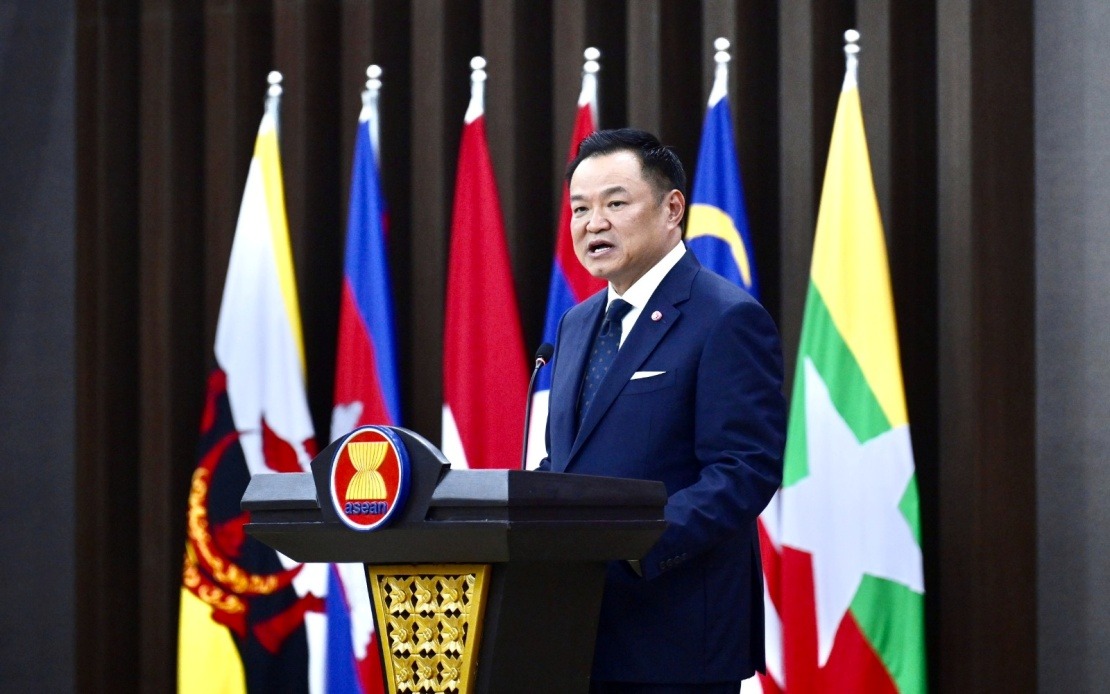
Thai Prime Minister Anutin Charnvirakul has called for the Association of Southeast Asian Nations to strengthen its internal cohesion and build greater resilience against mounting global uncertainties, presenting a three-pillar roadmap during his address at the ASEAN Secretariat in Jakarta. Speaking on Tuesday, the Thai leader emphasised that the regional organisation must simultaneously anchor its actions on delivering concrete improvements to the lives of its 650 million people, signalling a shift toward outcomes-based governance within the bloc.
At the heart of Anutin's message lies a conviction that contemporary challenges—spanning geopolitical tensions, economic volatility, technological disruption, and transnational security threats—demand collaborative regional responses rather than isolated national efforts. This framing reflects growing concerns among Southeast Asian capitals that the region risks fragmentation if individual nations pursue unilateral policies, particularly as great-power competition intensifies. For Malaysian policymakers and readers, the emphasis on regional solutions carries particular weight given Malaysia's own economic interdependencies and security concerns, which cannot be adequately addressed without coordinated ASEAN action.
The Prime Minister's call to apply ASEAN's foundational principles—consensus-building and non-interference in internal affairs—with "greater flexibility" represents a subtle but significant proposal to recalibrate how the bloc operates. Traditionally, these principles have been interpreted rigidly, sometimes paralyzing collective action when member states disagree. Anutin's suggestion indicates growing appetite within ASEAN leadership to develop more nimble decision-making mechanisms without abandoning the consensus-based approach that underpins regional stability. This could have implications for how ASEAN addresses pressing issues from Myanmar's political crisis to transnational crime networks.
Thailand's emphasis on supply chain strengthening and food and energy security resonates deeply across Southeast Asia, where economic resilience remains fragile. The region's heavy reliance on external supply chains, exposed during the pandemic and subsequent geopolitical disruptions, has prompted urgent reassessment of how ASEAN can reduce vulnerability. Anutin's advocacy for enhanced digital connectivity and youth skills development acknowledges that economic competitiveness in the coming decades will depend on technological adoption and human capital development—areas where significant disparities exist across the bloc.
The Thai Prime Minister's visit to Jakarta marks a notable shift in bilateral engagement between Bangkok and Jakarta, representing the first official visit by a Thai premier to Indonesia in 15 years. This resumption of high-level visits signals potential warming in relations between Southeast Asia's two largest economies, which have experienced periods of diplomatic coolness. For the broader region, improved Thai-Indonesian coordination matters significantly, as both nations wield substantial influence over ASEAN's strategic direction and can either facilitate or obstruct collective initiatives.
Anutin's measured approach to the Myanmar crisis, advocating for what he termed "calibrated re-engagement" while maintaining support for ASEAN's Five-Point Consensus, illustrates the delicate balancing act required within the bloc. The recent International Committee of the Red Cross visit to Aung San Suu Kyi, which Thailand highlighted as a positive development, provides a modest diplomatic opening that allows ASEAN members to pursue dialogue without appearing to legitimise the military coup. This gradualist approach appeals to nations reluctant to impose stronger punitive measures against the junta, while still maintaining pressure for eventual democratic restoration.
Thailand's reaffirmed commitment to peaceful resolution of disputes with Cambodia through international law mechanisms reflects broader regional efforts to manage bilateral tensions without escalation. As ASEAN approaches its 60th anniversary in 2027, these bilateral success stories become crucial evidence that the organisation remains capable of facilitating dialogue and preventing conflicts from destabilising the entire region. The emphasis on rebuilding mutual trust between Bangkok and Phnom Penh signals that even historically contentious relationships can be therapeutically addressed through sustained engagement.
The positioning of this address ahead of ASEAN's diamond jubilee suggests Thailand intends to shape the organisation's strategic agenda in coming years. With Anutin having assumed office as Thailand's 32nd Prime Minister in September 2025, his Jakarta visit demonstrates a pivot toward active regional diplomacy—a contrast to periods when Thai governments have been preoccupied with domestic political challenges. This renewed engagement from Bangkok could provide impetus for ASEAN to tackle long-deferred institutional reforms and enhance its operational effectiveness.
Anutin's insistence that ASEAN must act proactively rather than reactively to emerging crises challenges the organisation's historical tendency to address problems only after they have escalated. This preventive approach, if adopted across ASEAN, could reshape how the bloc handles early warning signs of economic instability, disease outbreaks, or security threats. For Malaysia, which often plays bridging roles within ASEAN, such institutional evolution could enhance the region's capacity to address shared concerns more effectively and maintain the stability upon which Southeast Asian prosperity depends.
The emphasis on measuring ASEAN's success through tangible improvements in citizens' lives—stronger economic opportunities, enhanced security, and reduced transnational crime—represents a significant reorientation toward addressing public concerns. Ordinary Southeast Asians often perceive ASEAN as a distant, elite diplomatic arrangement rather than an institution delivering concrete benefits. By pivoting toward demonstrable outcomes, the Thai government signals that ASEAN must evolve beyond ceremonial summitry and become a mechanism for solving the practical problems affecting regional populations. This people-centred approach, if genuinely implemented, could reinvigorate public support for regional integration across Southeast Asia.

