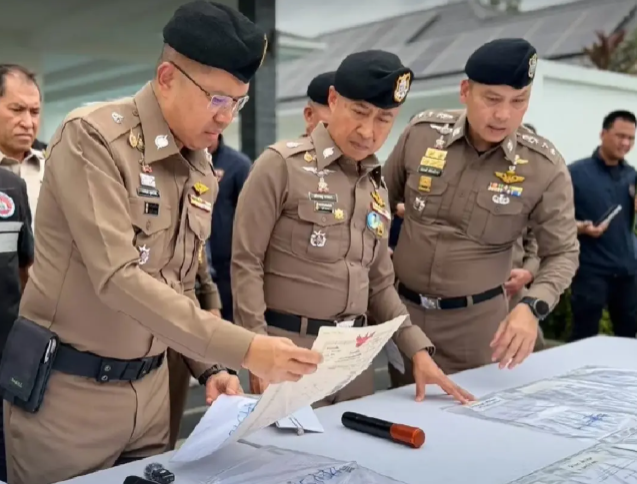
Thai police have arrested 13 foreign nationals in coordinated raids across Hua Hin, intensifying a nationwide campaign against the use of nominee shareholders to circumvent restrictions on foreign property ownership in Thailand. The operation, carried out on Monday in Prachuap Khiri Khan province, represents the sixth major phase of an investigation that has now expanded across popular tourist destinations and coastal resorts throughout the kingdom.
The sweeping enforcement action targeted 15 locations centred on a modern residential development in Thap Tai subdistrict, with over 200 police officers and government officials participating in the operation. Among those detained were three British nationals, four Chinese citizens, and individual nationals from Italy, France, the Netherlands, Austria, the Philippines and the United States. Authorities had secured arrest warrants for 45 foreigners prior to the raids, while a further 39 Thai nationals were summoned for questioning. The detainees remain under investigation, though none have yet faced formal charges in court.
The properties at the centre of the investigation are luxurious pool villas and detached houses commanding prices between 10 and 20 million baht each, representing a significant real estate market segment in Thailand's premium beachfront zones. Police identified six companies operating within the development that were allegedly structured to exploit nominee arrangements, with investigators uncovering financial and corporate documentation suggesting the use of Thai shareholders merely as fronts for foreign beneficiaries who maintained actual control. The broader investigation encompasses 33 separate companies suspected of holding land ostensibly on behalf of Thai nationals but in reality benefiting foreign owners, with the total property portfolio under scrutiny valued at approximately 300 million baht.
The emerging pattern uncovered during interrogations reveals a sophisticated advisory ecosystem built around foreign buyers seeking to circumvent Thailand's constitutional and statutory prohibitions on direct property ownership by non-nationals. Investigators found that multiple foreign purchasers had been directed by law and accounting firms to establish Thai-registered companies, with the understanding that this corporate structure would provide legal cover for their property acquisitions. These foreign nationals reportedly believed their arrangements complied with Thai law, unaware or dismissive of the legal complications inherent in such schemes. The targeted law and accounting firms involved have not been publicly identified, suggesting the investigation remains ongoing in relation to these professional service providers.
When Thai nominee shareholders were questioned, a consistent narrative emerged that proved crucial to building the investigation's case. These Thai nationals claimed to have agreed to hold share certificates for foreign counterparts without ever paying for the shares or exercising any meaningful governance role within the companies. They reported having no access to financial statements, investment documentation, or operational records pertaining to their nominal shareholdings. This deliberate informational compartmentalisation strongly indicates that the companies were essentially shell structures designed to conceal beneficial foreign ownership while maintaining the technical appearance of Thai control required by law. Police seized extensive documentation during the raids, including company registration papers, accounting records, computers, mobile devices and digital data that forensic teams will examine to reconstruct financial flows and identify additional networks operating in Thailand and potentially overseas.
The economic implications of these arrangements are substantial for Thailand's real estate market and tourism sector. The investigation reflects broader concerns among Thai authorities about the emergence of shadow networks designed to circumvent constitutional restrictions on foreign landownership. Thailand's constitutional framework and Land Code fundamentally prohibit non-nationals from owning freehold land, a policy intended to preserve national sovereignty over agricultural and urban territories. However, the sophisticated corporate and financial engineering uncovered in Hua Hin demonstrates how determined foreign investors and accommodating professional advisors have developed workarounds that effectively nullify these protections.
The crackdown began in the southern islands and has progressively moved northward and eastward, creating a geographical map of hotspots where nominee schemes have flourished. The initial phase examined nominee companies and associated law and accounting networks on Koh Phangan in Surat Thani, establishing the investigative template now being applied nationwide. Phase 3 expanded operations to the Andaman coast provinces of Phuket, Phang Nga and Krabi, where authorities examined 89 land parcels and buildings valued at over 1.05 billion baht. Phase 4 subsequently shifted to Chonburi province, while Phase 5 targeted 31 companies and 29 land plots worth approximately 633 million baht in Chiang Mai. Across the five completed phases, investigators examined 233 separate parcels of land and buildings encompassing more than 160 rai or 25.6 hectares, with an estimated combined valuation of 2.539 billion baht. These figures underscore the scale of the phenomenon Thai authorities are attempting to address.
The operation has already yielded substantial legal consequences. Courts have approved 133 arrest warrants arising from the five earlier phases, while 20 cases have progressed to conviction, indicating that Thai prosecutors are successfully building criminal cases and achieving outcomes in the judicial system. However, the number of convictions relative to arrests and warrants suggests that the legal processes remain in relatively early stages, with many cases still winding through the Thai criminal justice system. The Royal Thai Police have signalled their intention to continue these investigations systematically across remaining tourist destinations, acknowledging that the problem extends beyond the coastal resort zones already targeted.
A significant dimension of the inquiry involves corruption within the Thai state apparatus. Investigators are examining whether government officials at national or provincial level knowingly facilitated, overlooked or actively assisted in the creation and maintenance of these nominee structures. This reflects broader concerns about institutional capture within real estate and local government administration, where potential conflicts of interest or financial incentives could compromise official oversight. The inclusion of corruption investigations within the scope of the nominee crackdown indicates that Thai authorities recognise the schemes could not have flourished without at least tacit official acquiescence or active cooperation at certain junctures.
For foreign nationals and legitimate international investors in Thailand, the crackdown carries important implications for due diligence and compliance with Thai law. The authorities have explicitly distinguished between unlawful nominee schemes and legitimate foreign investment conducted in accordance with Thai regulations, signalling that properly structured investments will not face enforcement action. Malaysian and other Southeast Asian investors and property buyers should carefully distinguish between legal mechanisms for foreign participation in Thai real estate and the illegal nominee arrangements the police are targeting. Condominium ownership remains available to qualified foreign buyers through properly registered legal ownership arrangements, whereas the schemes under investigation fundamentally misrepresent beneficial ownership through falsified corporate structures.
The Royal Thai Police have invited public reporting of suspected illegal foreign business activity through formal channels including local police stations and a dedicated national hotline at 1599, available around the clock. This invitation to citizen participation suggests authorities view the phenomenon as sufficiently widespread that comprehensive detection requires public assistance beyond official investigation capacity. The campaign's continuation and expansion across additional provinces indicates the government's determination to assert control over foreign ownership patterns and ensure compliance with constitutional property restrictions. For regional investors and the broader business community across Southeast Asia, the campaign underscores the importance of engaging qualified Thai legal counsel experienced in foreign investment compliance before acquiring property or establishing business operations in Thailand.

