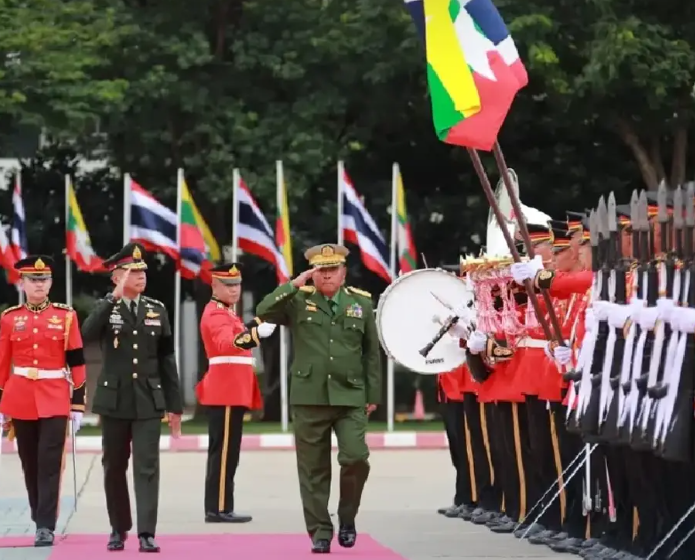
Thailand's military establishment has extended a diplomatic overture to Myanmar's armed forces leadership, with General Ukris Boontanondha hosting his counterpart Ye Win Oo at a Bangkok hotel on Thursday in what signals a broader regional realignment toward the coup-staging military regime. The visit represents Ye Win Oo's first foreign engagement since assuming command of Myanmar's armed forces, underscoring the junta's coordinated effort to rehabilitate its international standing following five years of near-total isolation triggered by the 2021 overthrow of Aung San Suu Kyi's democratically elected government.
Myanmar's military apparatus has orchestrated what it portrays as a transition to normalcy, having orchestrated elections at the beginning of 2026 under heavily restricted conditions that permitted the military to retain substantive power while repackaging its authority under civilian-led institutions. The elections allowed General Min Aung Hlaing, who orchestrated the original putsch and commanded the armed forces throughout the ensuing instability, to assume the presidency while transferring formal military command to Ye Win Oo, a loyalist with deep connections to the regime's security apparatus dating back to his tenure as a spymaster for the former junta administration.
The bilateral engagement between Thai and Myanmar military commanders is designed ostensibly to address shared challenges along their 2,400-kilometre border, a frontier that has become a flashpoint of instability as Myanmar's internal armed conflict spills across territorial boundaries. The ongoing civil war, which has claimed an estimated 100,000 lives across Myanmar, has created humanitarian pressures and security concerns for neighbouring countries including Thailand, compelling regional powers to prioritise practical cooperation over ideological stances regarding the legitimacy of Myanmar's current government structure.
Thailand's diplomatic posture toward Myanmar represents a pragmatic calculus that prioritises border management and regional stability over adherence to international human rights norms. Thai Foreign Minister Sihasak Phuangketkeow articulated this position explicitly, arguing that engagement with Myanmar's military leadership reflects geopolitical necessity rather than endorsement of its governance model. This month, Thai Prime Minister Anutin Charnvirakul extended full diplomatic honours to Min Aung Hlaing during a Bangkok state visit, signalling Thailand's willingness to treat Myanmar's restructured military-led government as a legitimate regional interlocutor despite the circumstances of its consolidation of power.
The international community remains fractured over the appropriate response to Myanmar's election-managed transition. Democracy advocates and human rights monitoring organisations have consistently characterised the 2026 electoral process as a theatrical exercise designed to confer legitimacy upon military authoritarianism whilst systematically excluding competing political voices. Aung San Suu Kyi, whose party dominated the 2015 elections that preceded the coup, remains incarcerated and sidelined from political participation, whilst the regime has pursued punitive action against civil society activists and dissenting voices through prosecution and imprisonment.
Yet neighbouring states sharing immediate geographic and economic ties with Myanmar have moved to treat the elections as a sufficient basis for normalising relations. This approach reflects a fundamental divergence between Southeast Asian nations prioritising strategic neighbourhood management and Western democracies emphasising governance standards and human rights compliance. Thailand's decision to host both Min Aung Hlaing and subsequently Ye Win Oo represents a decisive pivot within the Association of Southeast Asian Nations toward pragmatism over principle regarding Myanmar's political trajectory.
Ye Win Oo's appointment to military command has attracted significant international opprobrium, with the United States and allied governments imposing sanctions against him in connection with the coup and subsequent military operations. His background as a security apparatus insider with documented involvement in intelligence operations for the junta underscores the continuity between Myanmar's pre-coup and post-coup military establishments, suggesting that ostensible institutional reforms mask substantive patterns of military dominance and institutional consolidation of armed forces authority.
Recent United Nations investigative findings have documented that Myanmar's military operations have intensified rather than moderated following the elections, with escalating aerial bombardment of civilian concentrations and documented patterns of arbitrary detention, systematic torture, and sexual violence deployed as instruments of state power. The UN's Independent Investigative Mechanism released detailed documentation of these allegations, providing systematic evidence that Myanmar's military campaign against its internal adversaries continues to generate severe humanitarian consequences and documented abuses that would qualify as potential violations of international humanitarian law.
Myanmar's government has categorically rejected these allegations, characterising UN findings as politicised and unsubstantiated assessments misrepresenting the security forces' operations. The regime's defiant posture toward international human rights monitoring mechanisms reflects its confidence that regional diplomatic engagement, particularly from Southeast Asian neighbours, will proceed irrespective of documentation from international bodies. This calculation appears validated by Thailand's willingness to proceed with high-level military engagements despite the contemporaneous release of updated UN reports documenting alleged abuses.
The decision by Thailand to embrace Myanmar's restructured military leadership has provoked sharp criticism from human rights advocacy networks. The Special Advisory Council for Myanmar declared this week that Thailand's diplomatic engagement effectively constitutes an endorsement of military authoritarianism, suggesting that regional powers are sacrificing credibility on human rights principles in pursuit of stability objectives. This critique highlights the fundamental tension between Southeast Asian statecraft emphasising non-interference and border pragmatism, and international norms increasingly requiring accountability for documented allegations of systematic abuse and rights violations.
The broader pattern emerging from these diplomatic engagements suggests a regional consensus among Southeast Asian governments that Myanmar's elections, whatever their democratic legitimacy, constitute a sufficiently legitimate basis for international recognition and normalised state-to-state relations. This approach effectively grants Myanmar's military establishment a pathway toward rehabilitation despite the absence of meaningful democratic transition, competitive political participation, or substantive constraints on military authority. The implications for Myanmar's trajectory toward or away from democratic governance remain deeply uncertain, but the regional diplomatic realignment clearly favours accommodation with the existing military-led structure over isolation and conditionality.

