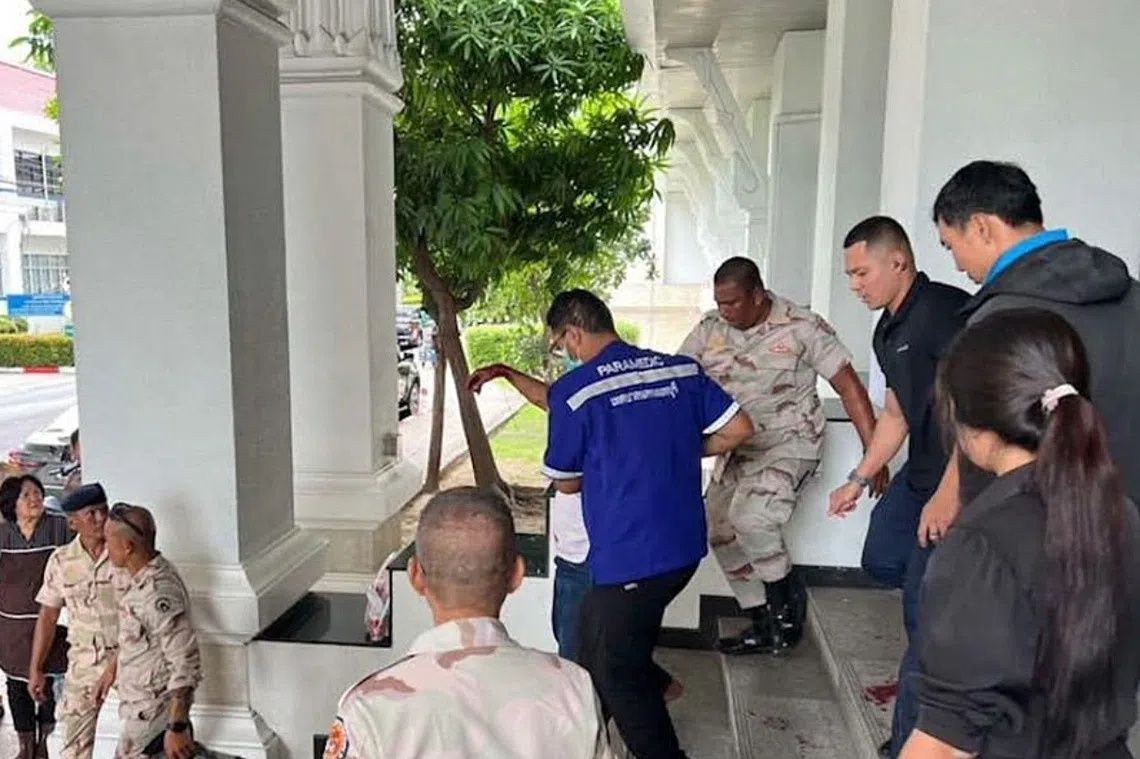
Thailand's security apparatus faces mounting scrutiny following a shooting at a provincial government building on Monday, the second major firearms incident to strike the Southeast Asian nation within days and reigniting urgent calls for stricter gun legislation. According to Major General Dejrapee Kongdee, the provincial police commander, a suspected gunman—identified as a former lawmaker—opened fire at the facility on Bangkok's outskirts, targeting a senior provincial official and his driver. Both victims sustained injuries and were transported to hospital for medical care, though neither wound proved fatal.
The arrest of the alleged shooter marked the conclusion of a rapidly escalating crisis at the provincial office, though authorities have provided limited details about the motive behind the attack or the circumstances that led to the confrontation. The incident, occurring just 72 hours after one of Thailand's most devastating mass casualty events, has deepened public anxiety about firearm proliferation and the capacity of existing regulations to prevent armed violence. The timing compounds national distress as officials and lawmakers struggle to respond coherently to what appears to be an emerging public safety emergency.
Friday's school shooting represents a watershed moment for Thailand's gun policy debate. A 14-year-old student opened fire at Debsirin Nonthaburi School in the same province, first killing his grandparents before proceeding to methodically attack classmates and staff throughout the campus. The rampage claimed nine lives and wounded more than twenty others before the teenager turned the weapon on himself. This constitutes Thailand's deadliest mass shooting incident since 2020, and the tragedy has resonated across Southeast Asia as a stark reminder of how quickly firearm access can translate into catastrophic loss of life within educational institutions.
The psychological impact on Thailand's student population has been profound. On Monday, as schools reopened their doors following the weekend tragedy, administrators implemented enhanced security protocols designed to prevent unauthorized access to campuses. Many institutions deployed metal detectors at entrances and instituted additional screening procedures for visitors and staff. These visible security measures underscore the deep unease permeating Thai educational communities and reflect institutional responses to perceived vulnerability in the aftermath of the school massacre.
Prime Minister Anutin Charnvirakul has seized upon both incidents as justification for comprehensive firearms reform. In statements to media following Monday's provincial office shooting, the Prime Minister reiterated his administration's commitment to strengthening gun control legislation, signaling that his government views these events as politically urgent and demands swift legislative action. Whether such rhetoric translates into concrete policy changes remains uncertain, however, given Thailand's history of prolonged political transitions and the influence of gun ownership constituencies within Thai society.
Thailand's regulatory framework governing firearms has historically been comparatively permissive by regional standards, with civilian gun ownership relatively widespread among middle and upper-class Thais who cite personal security concerns and hunting interests. The nation's police and military maintain substantial arsenals, and institutional access to weapons creates potential pathways for diversion to civilian markets. Previous mass shooting incidents—including a 2020 attack that claimed 29 lives—have prompted temporary surges in gun control advocacy, yet substantive legislative reform has often stalled amid competing political priorities and lobbying pressure from gun rights constituencies.
The involvement of a former lawmaker in Monday's shooting adds a troubling political dimension to the crisis. While investigations remain ongoing, the shooter's prior role in government raises questions about how individuals with access to state institutions and networks might possess particular capabilities or motivations for violent action. This aspect of the incident may amplify political pressures on the current administration to demonstrate capacity for institutional reform and accountability across the governmental apparatus.
Regional security analysts have begun examining whether Thailand's recent violence represents isolated incidents or symptoms of broader social fragmentation. The school shooting's perpetrator was reportedly a student, suggesting that access to firearms among younger Thais may represent a particular vulnerability. The successive incidents within a 72-hour window have certainly concentrated media attention and public concern in ways that previous isolated shootings might not have achieved, potentially creating political space for legislative action that previously seemed unlikely.
For Malaysia and other Southeast Asian countries monitoring Thailand's response, the unfolding situation carries instructive implications. Malaysia maintains relatively strict firearms regulations compared to Thailand, yet concerns about armed violence persist across the region. The Thai government's handling of gun policy reform—whether it translates rhetoric into legislation or reverts to inaction once immediate political pressure subsides—will likely influence regional debates about optimal approaches to firearm regulation and public safety.
International observers have noted that Thailand's capacity to implement effective gun control hinges on several variables: sustained political will from senior leadership, institutional cooperation among law enforcement and regulatory agencies, public support for restrictions that might inconvenience legitimate gun owners, and resistance to lobbying pressure from commercial interests in Thailand's firearms sector. The coming weeks will prove critical in determining whether the tragic events of Friday and Monday catalyze genuine policy transformation or fade into Thailand's historical pattern of cyclical violence followed by temporary reform momentum that ultimately dissipates without legislative outcome.

