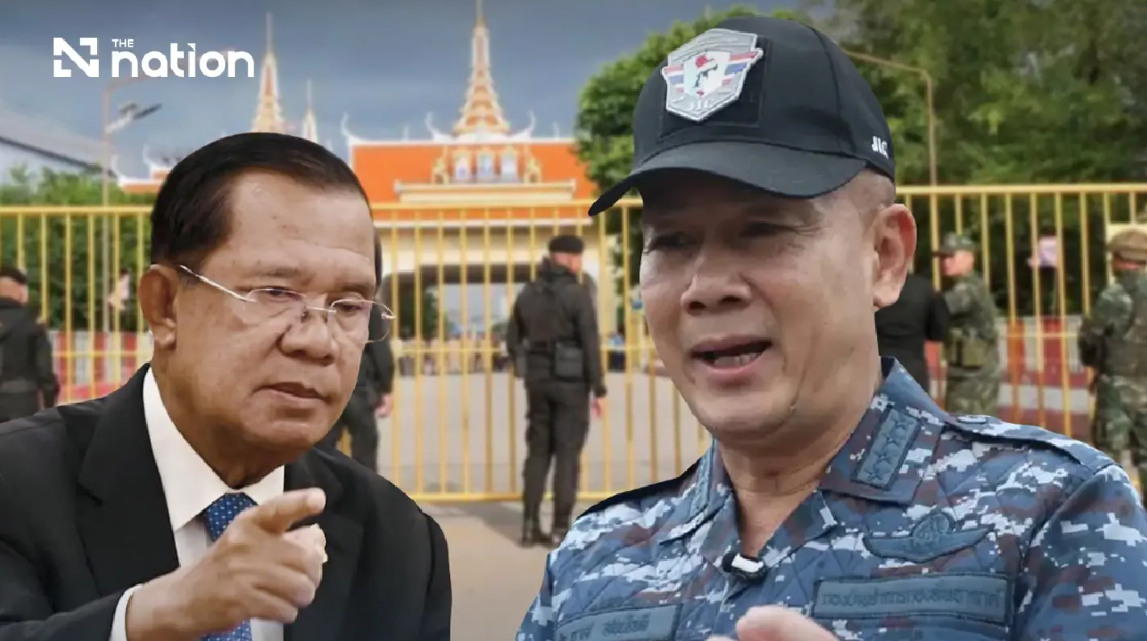
Thailand has pushed back sharply against allegations made by Cambodian Senate President Hun Sen that it has disguised military territorial expansion as an online crime enforcement operation. Air Chief Marshal Prapas Sonjaidee, who directs the Joint Information Centre monitoring the Thailand-Cambodia Situation, used a Friday statement to systematically dismantle what he characterised as unfounded accusations levelled at an international forum. His detailed rebuttal underscores the deepening diplomatic friction along one of Southeast Asia's most volatile borders, where scam operations, military positioning and competing territorial claims have created a combustible mix.
At the heart of the dispute lies a fundamental disagreement over how to interpret Thai military operations near the Cambodia border. Hun Sen has framed Thailand's actions as a deliberate conflation of two distinct issues: the legitimate fight against transnational cybercrime networks and what he views as territorial acquisition. Prapas rejected this characterisation entirely, arguing that conflating criminal activity with military occupation represents a category error that obscures rather than clarifies the actual sequence of events. He insisted that whether a specific location harbours scam operations and whether that same location is being used for military purposes represent entirely separate analytical questions that cannot be merged to construct a narrative of aggressive expansion.
The Thai official's argument hinges on establishing a clear evidentiary standard for discussions about military conflict. He contended that serious allegations raised on the international stage must be grounded in verifiable facts capable of independent examination rather than rhetorical framing. This position reflects Bangkok's broader frustration with what it sees as Cambodia's tendency to weaponise diplomatic forums to advance territorial claims without presenting comprehensive supporting documentation. The distinction Prapas drew between assessing actual site usage and determining military necessity reflects a legalistic approach designed to shift debate away from competing narratives toward measurable facts.
Crucially, Prapas reframed the entire conflict narrative by insisting that any honest account of the border clash must begin with the initial deployment of weapons rather than Thailand's response to hostile actions. According to Thai accounts, Cambodia initiated armed confrontation in ways that endangered Thai civilian populations, thereby necessitating a protective response. This sequencing question is not merely rhetorical but carries profound implications for how the international community evaluates responsibility and proportionality. By emphasising chronology, Prapas attempted to reclaim the narrative of victimisation for Thailand rather than accepting Cambodia's characterisation as the aggrieved party.
The positioning of military forces under the existing ceasefire agreement emerged as another critical flashpoint in Prapas's statement. He argued that both countries had agreed that troops would remain at positions established when the ceasefire took effect, maintain separation, avoid provocative actions and refrain from advancing toward one another. Under this framework, Thailand's maintenance of force positions does not constitute occupation but rather compliance with a bilateral agreement. Prapas contended that labelling agreed-upon troop positioning as occupation simultaneously violates the ceasefire agreement while redefining one of its core provisions. This logic, however, presumes that both sides share identical interpretations of where forces were positioned when the ceasefire commenced—a disputed proposition.
Regarding the question of border demarcation, Prapas emphasised that military deployments should not determine territorial boundaries. Instead, he advocated for established bilateral border mechanisms to address disagreements over where the actual frontier lies. This position reflects Thailand's preference for institutional processes over unilateral claims, yet it also acknowledges an underlying vulnerability: Cambodia disputes Thailand's interpretation of the border itself, making military positions inherently contestable. The Thai official's appeal to institutional mechanisms can only succeed if both parties accept their legitimacy and binding nature—conditions that remain uncertain given the broader climate of mutual accusation.
The humanitarian dimension of the conflict received substantial attention in Prapas's remarks. He strongly affirmed that civilian protection constitutes a non-negotiable principle that transcends national boundaries, arguing that Thai and Cambodian civilians possess equal claims to safety. This invocation of universalist humanitarian values attempted to reposition Thailand as the ethical defender of innocent lives rather than an aggressor. However, his insistence that any discussion of civilian harm must encompass damage on both sides, including weapon types, firing directions and temporal sequences, effectively raises the evidentiary bar for acknowledging casualties. This stance could be interpreted as either a commitment to comprehensive documentation or as an attempt to relativise harm by requiring symmetrical analysis.
Information warfare and disinformation emerged as a particularly fraught dimension of the dispute. Prapas acknowledged that these phenomena represent genuine 21st-century challenges but contended that the solution lies in transparency rather than counter-accusations. He argued that creating competing narratives of information manipulation simply perpetuates the cycle rather than breaking it. This position appears designed to appeal to international observers uncomfortable with both sides' handling of public communications. Yet it also contains an implicit assumption that making information public will lead to shared understanding—a presumption that may not hold given the parties' divergent interpretive frameworks and domestic political pressures.
The scam operations issue, which ostensibly triggered Thailand's initial enforcement operations, received comparatively brief treatment in Prapas's statement. He proposed bilateral cooperation against online criminal networks while keeping this issue entirely separate from border and military questions. This compartmentalisation attempts to depoliticise transnational crime by removing it from the broader territorial dispute. For Malaysia and other regional states, the proliferation of online scam operations originating from border areas represents a direct threat to citizens and economic security. Thailand's proposal for joint action could offer a constructive pathway for regional cooperation, though success would require Cambodia to accept that criminal enforcement and territorial disputes should operate on different tracks.
The Thai official concluded by articulating Thailand's stated objectives: preventing further conflict, protecting civilians and military personnel, suppressing criminal operations, and establishing conditions for meaningful negotiations. This framing positions Thailand as a reluctant, defensive actor constrained by security imperatives rather than an expansionist power. Whether this characterisation aligns with Cambodia's assessment remains disputed, but it provides insight into how Bangkok wishes to be perceived both regionally and internationally. For Malaysia's policymakers, Thailand's emphasis on distinguishing between legitimate security responses and territorial aggression carries implications for how regional disputes are evaluated and resolved.
The broader significance of this exchange extends beyond the bilateral Thailand-Cambodia relationship to encompass questions about how Southeast Asian states manage competing territorial claims, military operations and information narratives. Prapas's systematic rebuttal suggests that Bangkok intends to prosecute its position through detailed factual argumentation rather than matching Hun Sen's rhetorical claims. Whether this legalistic approach proves more effective than Cambodia's diplomatic offensive remains uncertain. What appears clear is that the border dispute will continue generating high-stakes diplomatic friction, with implications for regional stability and the credibility of bilateral agreements. Regional observers and neighbouring states like Malaysia face the complex challenge of assessing competing claims while maintaining balanced diplomatic relationships with both parties.

