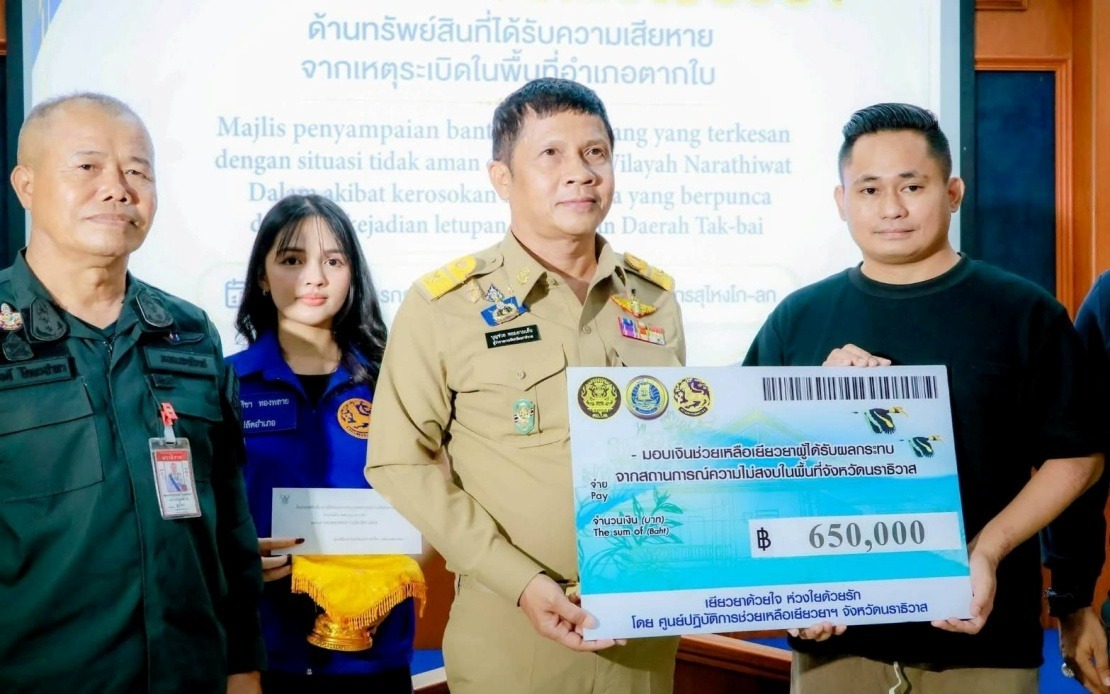
The Thai government has begun disbursing compensation to Malaysian citizens affected by a bomb blast in Tak Bai district, marking a significant response to cross-border security incidents in the volatile southern border region. On Friday, Narathiwat Governor Boonchuay Homyamyen formally presented 650,000 baht to Muhammad Yusri Udin, one of two Malaysians injured when an improvised explosive device detonated near the Sapom junction in the early morning hours of June 29. The compensation, equivalent to approximately RM80,000, represents the Thai government's acknowledgment of civilian harm resulting from security challenges in the region and underscores Bangkok's commitment to maintaining diplomatic relations with neighbouring Malaysia despite recurring cross-border incidents.
The bombing occurred at approximately 11.40 am local time when the hidden explosive device, planted in a roadside drain, detonated without warning. Alongside Muhammad Yusri, 38, another Malaysian national, Abdullah Syarapi Abd Rahman, 45, sustained injuries in the blast. Preliminary investigations determined that the two men were caught in the crossfire of regional security tensions rather than being deliberately targeted, suggesting they were casualties of circumstances rather than deliberate attack. The incident highlights the persistent dangers facing both residents and cross-border travellers in Thailand's southernmost provinces, where insurgency-related violence continues to create unpredictable security environments.
Investigative efforts by Thai security authorities have intensified following the explosion. A 40-year-old suspect was detained shortly after the incident, and security forces deployed comprehensive response measures including explosive ordnance disposal operations and forensic examinations at the blast site. These investigative protocols reflect Thailand's attempts to establish accountability and prevent future incidents, though the underlying drivers of violence in the region remain complex. The Thai government's willingness to prosecute suspects and conduct thorough investigations signals to Malaysian authorities and citizens that Bangkok takes cross-border security seriously and seeks to prevent escalation of tensions that could destabilize the bilateral relationship.
Governor Boonchuay's public statements during the compensation ceremony demonstrated Thailand's desire to reassure both Malaysian citizens and international tourists about safety conditions in southern Thailand. He emphasized that the Thai government "will not sit idly by" and reaffirmed commitment to strengthening security infrastructure across the region. This rhetorical positioning is crucial for Thailand's tourism industry, which relies heavily on regional travellers, including Malaysians who regularly visit Narathiwat and neighbouring provinces. A climate of insecurity and unaddressed cross-border incidents could deter Malaysian visitors, potentially impacting local economies dependent on tourism revenue.
The compensation mechanism itself derives from a dedicated Thai government fund designed specifically to assist victims of security-related incidents, encompassing both injury compensation and property damage claims. This institutionalized approach suggests Thailand recognizes that violence in the border region will likely continue, necessitating systematic victim support mechanisms. For Malaysian citizens travelling or working in southern Thailand, the existence of such compensation frameworks provides some reassurance, though it also underscores the reality that residual security risks remain inherent to the region.
The incident occurred against a backdrop of long-standing insurgency-related violence in Thailand's deep south, where separatist movements have conducted sporadic attacks on military installations, government facilities, and civilian infrastructure for decades. Rebel groups operating in the region have shown willingness to employ improvised explosives as a tactic, creating persistent hazards for civilian populations. Thai authorities have attributed the Tak Bai bombing to such rebel movements, though precise responsibility remains subject to ongoing investigation. The fact that Malaysian nationals were injured suggests that the security implications of southern Thailand's instability extend beyond Thai borders, affecting Malaysian communities and necessitating coordinated bilateral responses.
Malaysian-Thai cooperation on border security has historically been pragmatic, with both nations recognizing mutual interests in maintaining stability along their shared frontier. The compensation payment, facilitated through formal government channels at the Sungai Golok Customs Office, exemplifies this cooperative approach. By providing timely financial redress to injured Malaysian citizens, Thailand demonstrates responsiveness to cross-border concerns and seeks to prevent accumulation of grievances that could strain relations. For Malaysia, the swift processing of compensation claims validates diplomatic channels and encourages continued engagement with Thai counterparts on security matters.
The broader implications of this incident extend to regional security dynamics and travel safety considerations for Southeast Asian nationals throughout the region. Southern Thailand remains a destination for Malaysian business travellers, tourists, and workers despite security concerns, making incidents like the Tak Bai bombing consequential for bilateral relations and cross-border economic activity. The Thai government's response—swift compensation, public security commitments, and active investigation—sets expectations for how Bangkok will handle future cross-border incidents. Should such events recur without adequate Thai response, accumulating Malaysian grievances could create political pressure for Malaysian authorities to strengthen border controls or restrict travel advisories.
Looking forward, both nations face ongoing challenges in managing security risks in the border region while maintaining economic and social connections essential to regional stability. Thailand's security forces must balance counterinsurgency operations with civilian protection, a task complicated by the insurgency's dispersed nature and use of improvised weapons. Malaysia, meanwhile, must balance legitimate security concerns with economic interests tied to cross-border commerce and tourism. The compensation payment represents a positive diplomatic signal, yet sustained progress requires deeper cooperation on intelligence sharing, coordinated military operations, and shared commitment to addressing root causes of insurgency-related violence in Thailand's southernmost provinces.

