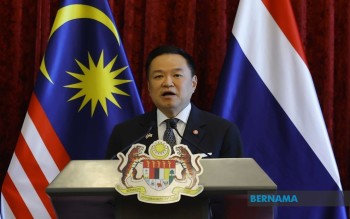
Thailand's Prime Minister Anutin Charnvirakul struck an upbeat note during his visit to Malaysia this week, expressing strong conviction that the two neighbouring economies can breach the US$30 billion bilateral trade ceiling by 2027. Speaking at a joint press conference with Prime Minister Datuk Seri Anwar Ibrahim following a memorandum of understanding exchange ceremony at Perdana Putra Complex in Putrajaya, Anutin underscored the robustness of the commercial relationship that has already pushed bilateral commerce to approximately US$28 billion annually.
The trajectory toward this ambitious trade target reflects the deepening economic integration between Southeast Asia's second and third largest economies. Malaysia currently occupies the position of Thailand's largest trading partner within ASEAN, a status that underscores the centrality of their commercial ties to both nations' regional strategies. The proximity of reaching the US$30 billion threshold suggests that structural barriers have largely been overcome and that both governments see genuine potential for accelerated growth in the coming years.
Anutin's remarks carried particular weight given his position as architect of Thailand's trade policy following his reappointment as prime minister in March 2026. This constituted his inaugural visit to Malaysia in that capacity, signalling Bangkok's intent to recalibrate and invigorate bilateral economic engagement at the highest political level. The timing and tone of his statements reflected a deliberate effort to use high-profile diplomatic visits as leverage for ambitious commercial goals, a strategy increasingly common among Southeast Asian leaders navigating complex global trade dynamics.
Central to the two leaders' vision is a commitment to leveraging complementary economic strengths rather than pursuing zero-sum competition. Anutin highlighted Thailand's determination to support efforts aimed at reshaping regional value chains and supply chains, recognising that Malaysia and Thailand possess distinct comparative advantages that, when properly aligned, can create mutual prosperity. This represents a shift from traditional bilateral trade focused on raw materials and finished goods toward more sophisticated integrated production ecosystems.
Both governments have identified three strategic pillars for future commercial development: food security, energy security, and the digital economy alongside high-tech manufacturing. These sectors transcend conventional trade categories and touch on fundamental issues of national resilience, particularly relevant in an era of geopolitical volatility and climate uncertainty. Thailand's emphasis on these areas reflects its vulnerability to agricultural price shocks and energy dependency, while Malaysia's focus aligns with its vision of becoming a high-income economy through technology adoption and innovation.
Anwar's commitment to marshalling Malaysia's institutional resources toward the trade target demonstrates political will at the ministerial level. By engaging both the Ministry of Foreign Affairs and the Ministry of Investment, Trade and Industry (MITI), Malaysia is institutionalising the pursuit of this objective, moving beyond rhetorical commitment to concrete implementation. This dual-ministry approach signals recognition that achieving ambitious trade targets requires both diplomatic facilitation and commercial incentive structures.
The bilateral meeting between the two leaders served as a stocktaking exercise on the broader Malaysia-Thailand relationship, extending beyond trade to encompass cooperation in multiple domains. Tourism featured prominently in Anwar's remarks, reflecting the substantial people-to-people connections and the economic significance of cross-border leisure travel. This integrated approach—viewing trade as part of a holistic relationship rather than an isolated economic metric—provides resilience should particular sectors encounter headwinds.
The joint trade committee mechanism referenced by Anutin offers the institutional framework for translating optimism into actionable plans. These committees typically oversee the negotiation of non-tariff barriers, coordinate regulatory frameworks, and identify emerging opportunities in nascent sectors. The promise to establish more ambitious targets following this initial achievement suggests both leaders recognise that trade partnerships require continuous recalibration to remain relevant and growth-oriented.
For Malaysian readers and regional observers, this diplomatic engagement carries implications beyond mere bilateral economics. The Malaysia-Thailand relationship constitutes a critical pillar of ASEAN cohesion and Southeast Asian stability. Strengthened commercial ties reduce incentives for political friction and create constituencies within both nations invested in peaceful relations. The emphasis on supply chain integration also positions the two countries as a unified bloc within broader Indo-Pacific economic architecture, potentially enhancing their collective bargaining power in multilateral forums.
Anutin's confidence in the achievability of the trade target reflects underlying economic fundamentals rather than mere aspiration. The proximity to US$30 billion—needing only marginal growth from the current US$28 billion baseline—suggests the target is realistic rather than aspirational. This contrasts with some regional trade projections that rely on speculative sectoral shifts or untested policy interventions. The incremental nature of the goal provides both governments with reasonable probability of success, lending credibility to their broader bilateral agenda.
Looking forward, the intersection of regional trade ambitions with global economic fragmentation presents both opportunities and challenges. As supply chains reorganise in response to geopolitical realignments, Malaysia and Thailand's geographical proximity and complementary industrial bases position them to capture flows redirected from East Asia or the West. However, realising this potential requires sustained policy coordination, investment in cross-border infrastructure, and protection of the commercial environment from political disruption—challenges that demand the kind of high-level political attention Anutin's visit exemplified.
The two prime ministers' emphasis on cooperation over competition also carries significance for the broader ASEAN project at a time when member states navigate competing great power interests. By demonstrating that bilateral relationships can flourish through pragmatic engagement focused on mutual economic benefit, Malaysia and Thailand provide a model of regional integration that proves economically productive and politically stabilising. This foundation suggests that reaching the US$30 billion target by 2027 remains well within reach, provided both governments maintain the policy discipline and institutional commitment evident in this week's engagements.

