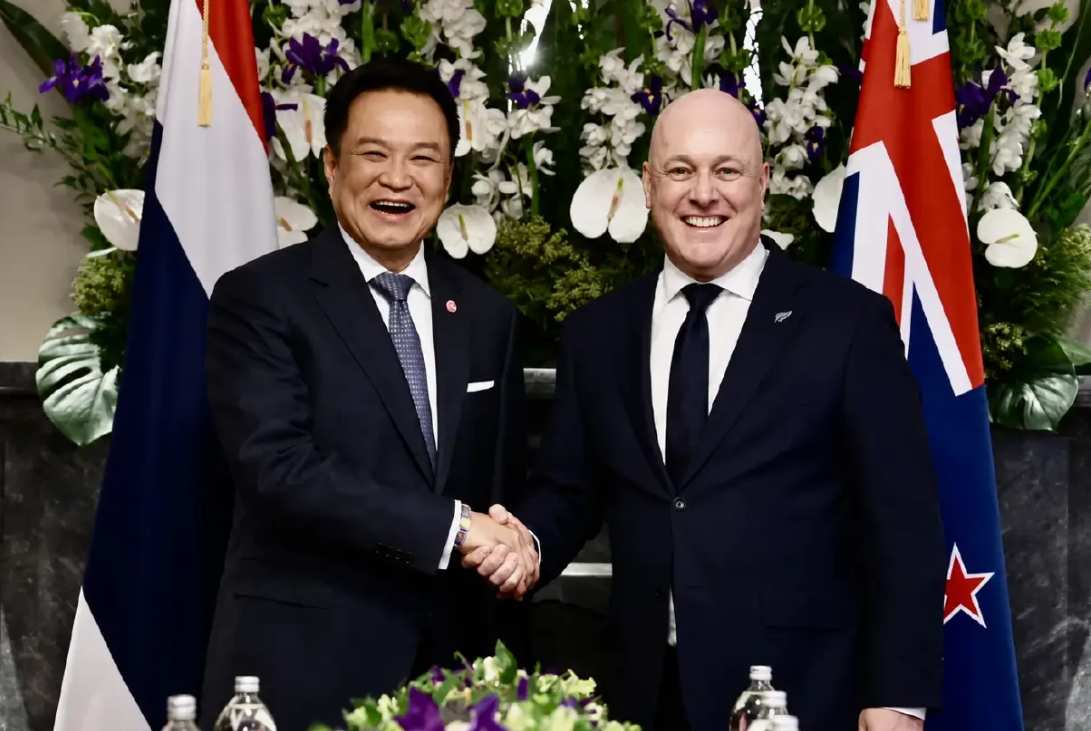
Thailand and New Zealand have formally elevated their diplomatic relationship to a strategic partnership, signalling a major shift in bilateral engagement that extends well into the coming decades. Following talks in Wellington on Friday, Prime Minister Anutin Charnvirakul and New Zealand Prime Minister Christopher Luxon signed a Joint Declaration on the Strategic Partnership, a move that coincides with celebrations marking 70 years of formal relations between Bangkok and Auckland. The elevation represents more than ceremonial significance; it commits both governments to an ambitious framework spanning the next five years and broader economic objectives stretching to 2045, when officials hope to see bilateral trade surge to US$7.5 billion, approximately 246 billion baht.
The timing of Anutin's visit to New Zealand underscores the importance both capitals place on the relationship during this anniversary year. The bilateral talks, conducted at Government House with senior ministers from each side participating, centred on four pillars designed to translate the strategic partnership into tangible benefits for citizens and businesses in both countries. These framework agreements, formalised through the Thailand–New Zealand Joint Plan of Action 2026–2030, provide the roadmap for deepening cooperation across political, economic, educational, cultural and multilateral dimensions. The comprehensiveness of the approach reflects recognition that modern strategic partnerships must address multifaceted challenges and opportunities beyond traditional trade and diplomatic channels.
Security cooperation forms the foundation of the partnership, with both nations committing to strengthen their coordinated response to transnational organised crime, the growing menace of online scams and human trafficking. For Thailand, which sits in Southeast Asia's Golden Triangle region and grapples with significant drug trafficking challenges, collaboration with a developed-nation law-enforcement apparatus like New Zealand's offers valuable expertise and intelligence-sharing capabilities. Similarly, New Zealand benefits from Thailand's strategic position within ASEAN and its experience managing complex transnational security issues. The agreement includes closer coordination and information-sharing between Thai and New Zealand police forces, establishing institutional mechanisms that should outlast individual government administrations and become embedded in operational procedures.
The economic dimension reflects the most concrete ambition, with the US$7.5 billion trade target representing a tripling of current bilateral commerce within the next two decades. This goal appears ambitious yet achievable given the complementary nature of the two economies. Thailand's agricultural, manufacturing and tourism sectors find natural counterparts in New Zealand's dairy, forestry, wine and agricultural technology industries. Both countries have committed to expanding investment opportunities and strengthening the existing Thailand–New Zealand Closer Economic Partnership, a framework designed to reduce trade barriers and create new business corridors. The emphasis on innovation, food security, energy transition, sustainable agriculture and environmental conservation reflects the shared priorities of middle-income and developed economies confronting climate change and resource scarcity.
Cultural and educational cooperation represents a critical mechanism for building people-to-people connections that sustain long-term partnerships. The governments plan to expand collaboration in education and skills development, creating pathways for student exchanges, academic partnerships and capacity-building initiatives. For Thai professionals and students seeking to upgrade qualifications in Western educational systems, New Zealand offers an accessible alternative to traditional destinations, particularly given geographical proximity to the Asia-Pacific region and New Zealand's reputation for high-quality tertiary education. These educational investments generate future cohorts of Thai and New Zealand citizens with direct experience in each other's societies, creating networks that endure across careers and decades.
The agreement between Education New Zealand and Thailand's Office of the Civil Service Commission holds particular significance for administrative capacity-building, suggesting that knowledge transfer will extend to government operations and institutional strengthening. A separate accord between the Royal Thai Police and New Zealand Police formalises what is likely already occurring informally, creating formal channels for training exchanges, best-practice sharing and joint operations planning. Additionally, a private-sector memorandum of understanding between Chata Instruments Company Limited and Aeroqual Limited signals confidence from the business communities in both countries that the strategic partnership will generate commercial opportunities.
Regional and multilateral cooperation constitutes the fourth pillar, positioning the Thailand–New Zealand partnership within broader Asia-Pacific institutional frameworks. Both nations committed to closer collaboration through Mekong cooperation mechanisms, ASEAN-led platforms, APEC and other international forums. This emphasis reflects New Zealand's strategy of maintaining active engagement in Asian regional institutions while Thailand seeks to leverage partnerships with developed nations to strengthen its role within ASEAN. The focus on multilateralism and rules-based international order carries particular weight given recent regional tensions and the evolving geopolitical environment in Southeast Asia.
A particularly significant outcome of the talks involves aviation connectivity. Thai Airways International intends to resume direct services between Bangkok and Auckland beginning in March 2027, with Anutin indicating he would push for an earlier restart if feasible. The restoration of direct flights carries implications extending well beyond airline operations. Historically, direct routes reduce travel friction and costs, thereby stimulating tourism flows, business travel and academic exchanges. For Thai nationals seeking employment or education in New Zealand and vice versa, direct connectivity eliminates lengthy stopovers and reduces overall journey costs. The timing of the route restoration aligns with the government's broader push to increase visitor arrivals and position Thailand as a regional aviation hub.
Anutin leveraged the Wellington visit to secure New Zealand's support for Thailand's bid to join the Organisation for Economic Co-operation and Development, with Prime Minister Luxon expressing full backing. OECD membership represents a major policy objective for Thailand's government, signalling the country's commitment to international economic standards, good governance and regulatory harmonisation. As a regional economic hub with significant influence within ASEAN, Thailand's OECD membership would represent a milestone for Southeast Asian development and could facilitate future bilateral collaboration on compliance frameworks and policy coordination.
The strategic partnership announcement carries clear signals about how mid-sized Asian economies and developed Pacific nations view contemporary international relationships. Rather than narrowly focused alliances, modern partnerships encompass security, trade, education, culture and multilateral coordination. For Malaysian readers and policymakers, the Thailand–New Zealand model offers instructive lessons about how regional partners can deepen engagement while respecting each nation's independent foreign policy trajectories. The emphasis on ASEAN-led mechanisms and Mekong cooperation frameworks reflects recognition that effective regional partnerships must operate within established multilateral structures rather than attempting to circumvent them.
Looking forward, the partnership's success will depend on translating ambitious targets into operational reality. The US$7.5 billion trade goal requires not merely political commitment but removal of specific trade barriers, investment facilitation and support for businesses identifying genuine commercial opportunities. Similarly, educational and cultural exchanges must become embedded in institutional programming rather than remaining aspirational statements. The framework's five-year action plan through 2030 provides checkpoints for assessing progress and recalibrating approaches as circumstances evolve. For the broader Southeast Asian region, a strengthened Thailand–New Zealand partnership contributes to the diversification of external relationships and reduces over-reliance on any single great power, ultimately enhancing stability and encouraging all partners to compete on the basis of legitimate value creation rather than coercive pressure.
Anutin's characterisation of the visit as the beginning of a new chapter resonates with the contemporary logic of flexible, issue-based partnerships that transcend traditional Cold War alliance patterns. As Thailand navigates complex regional dynamics and seeks to strengthen its position within ASEAN while maintaining meaningful engagement with developed democracies, the New Zealand partnership offers a template for balanced, multi-dimensional cooperation. The restoration of direct flights, the tripled trade ambition, and the comprehensive institutional arrangements all point toward a relationship increasingly woven into the daily operations and future planning of both societies. Whether this partnership ultimately achieves its ambitious goals will serve as a bellwether for how middle-power nations can successfully coordinate in the evolving geopolitical landscape of the Asia-Pacific region.

