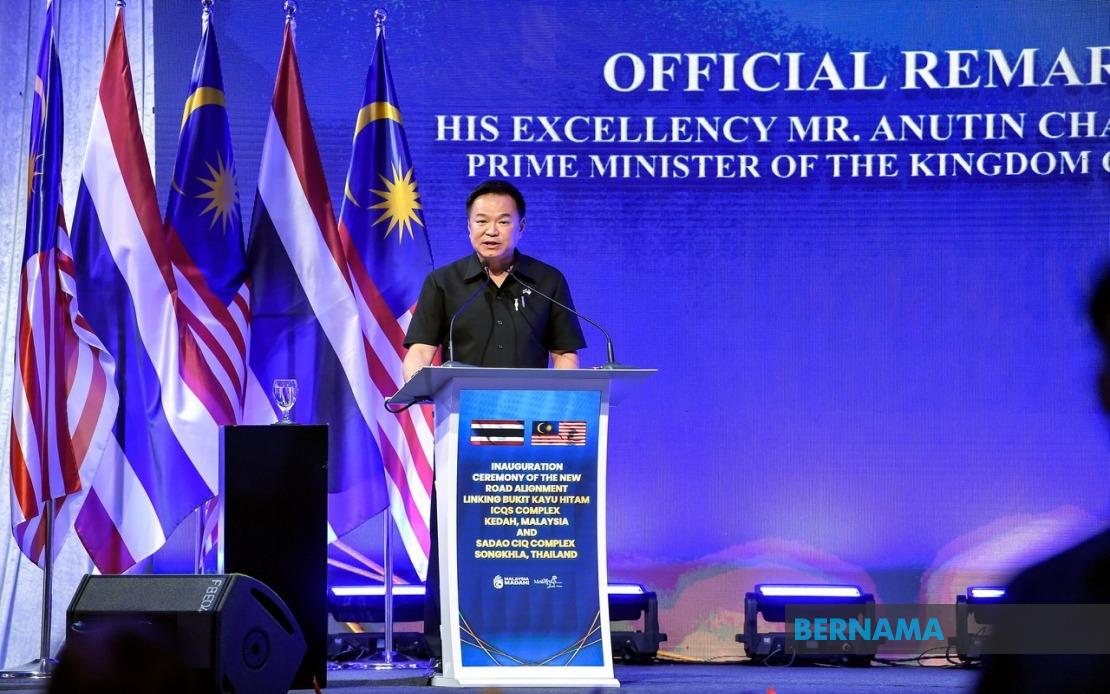
Thailand and Malaysia have taken a significant step toward realising ambitious regional connectivity goals with the joint inauguration of a new road alignment at one of Southeast Asia's busiest land borders. Thai Prime Minister Anutin Charnvirakul and Malaysian Prime Minister Datuk Seri Anwar Ibrahim officiated the ceremony at Bukit Kayu Hitam in Kedah on July 10, formally opening the improved link between Malaysia's Bukit Kayu Hitam Immigration, Customs, Quarantine and Security Complex and Thailand's Sadao Customs, Immigration and Quarantine Complex. The project represents the culmination of coordinated efforts between both governments to streamline cross-border movement and positions the corridor as a critical artery for goods and people destined for markets extending into China and beyond.
Anutin's remarks at the ceremony underscored Bangkok's determination to address what both nations recognise as critical infrastructure gaps constraining regional trade flows. He committed Thailand to systematically completing remaining missing transport links that currently fragment the supply chain between Malaysia's ports and markets in upper Thailand, China, and Russia. The Thai premier framed this initiative not merely as bilateral infrastructure development but as an essential component of Thailand's broader regional integration strategy. By eliminating bottlenecks and reducing transit times, the new road alignment promises to enhance the competitiveness of goods moving through both nations, particularly benefiting manufacturers and traders who depend on predictable, efficient cross-border logistics.
The Bukit Kayu Hitam-Sadao crossing represents one of Asia's most critical trade routes, handling enormous daily volumes of commercial and passenger traffic. The new road configuration is specifically designed to mitigate chronic congestion that has plagued the checkpoint and created delays affecting time-sensitive shipments. By providing an improved traffic flow pattern, the alignment reduces dwell times at the border, lowering operational costs for businesses and improving turnaround times for vehicles. For Malaysian traders and manufacturers, particularly those in Kedah and surrounding states, this improvement translates to faster access to Thai and Chinese markets, potentially enhancing the region's attractiveness to investors seeking efficient supply chain routes.
The bilateral initiative extends far beyond this single crossing. Both governments have identified three additional strategic corridor partnerships requiring development: the Songkhla-Kedah axis, the Satun-Perlis connection, and the Narathiwat-Kelantan link. This coordinated approach reflects a sophisticated understanding that southern Thailand and northern Malaysia comprise an economically integrated region whose potential remains substantially underutilised due to fragmented infrastructure. By treating these corridors as an interconnected system rather than isolated projects, Anutin and Anwar signal recognition that comprehensive connectivity yields exponentially greater economic benefits than piecemeal improvements.
Anutin's remarks particularly emphasised the bidirectional nature of the trade benefits, noting that improved linkages would enable Thai and Chinese goods to move through Malaysia toward Singapore and Indonesia with greater efficiency. This framing acknowledges Malaysia's geographic position as a natural transhipment hub for Southeast Asian trade and highlights how border infrastructure investment serves not only bilateral commerce but the entire region's supply chain architecture. For Malaysia, enhanced connectivity creates opportunities for port authorities, logistics operators, and service providers to capture value-added activities associated with increased cross-border flows.
The economic dimensions of improved connectivity extend beyond immediate trade volumes. Both prime ministers recognised that enhanced cross-border movement generates employment opportunities in border communities, which historically experience economic marginalisation relative to core urban centres. Infrastructure investment in these regions can catalyse local development through increased commerce, expansion of border service industries, and growth in tourism facilitated by smoother people movement. Anutin specifically referenced the government's commitment to improving living standards for populations inhabiting the shared border region, framing infrastructure development as integral to inclusive economic growth.
The timing of this initiative reflects broader geopolitical and economic realities shaping Southeast Asia's development trajectory. As global supply chains reconfigure and manufacturing hubs seek proximity to major markets, efficient regional transport corridors assume heightened strategic importance. Thailand and Malaysia's push to eliminate transport bottlenecks positions both nations to capture flows that might otherwise route through alternative corridors. For Malaysia particularly, strengthened linkages with Thailand open pathways to deeper integration with broader ASEAN infrastructure networks while reinforcing the country's role as a critical juncture in pan-Asian trade routes.
Both governments have committed to addressing broader procedural challenges affecting cross-border movement beyond physical infrastructure. Anutin highlighted ongoing discussions regarding border procedures and facilitation mechanisms intended to simplify documentation and reduce administrative delays. These softer infrastructure improvements, while less visible than road construction, often prove equally consequential in determining corridor efficiency. Harmonisation of quarantine procedures, mutual recognition of documentation standards, and streamlined customs processing can eliminate delays that new roads cannot address, suggesting that Bangkok and Kuala Lumpur are pursuing a holistic approach to corridor development.
The bilateral cooperation reflected in this project appears characteristic of a broader warming in Malaysia-Thailand relations under Anwar's administration. The ceremony included ceremonial elements emphasising personal rapport between the prime ministers, with Anwar welcoming Anutin at the border alongside his wife Datuk Seri Dr Wan Azizah Wan Ismail and Anutin accompanied by his wife Thananon Charnvirakul. These personal dimensions of diplomacy, while symbolic, often facilitate the sustained cooperation required for multi-year infrastructure projects whose benefits accumulate over extended timeframes. Anutin's two-day official visit provided opportunity for substantive discussions addressing outstanding bilateral issues while reinforcing momentum toward broader integration objectives.
The corridor initiative carries implications extending beyond conventional trade metrics. Improved connectivity between Malaysia's Kedah, Perlis, and Kelantan states and Thailand's southern provinces creates frameworks for enhanced cooperation on shared challenges including human trafficking, labour migration, and environmental protection. Regional development corridors typically generate informal networks of officials, business leaders, and civil society actors whose interactions over time build mutual understanding and facilitate collaboration on issues transcending traditional bilateral diplomacy. The transport linkage therefore functions as both practical infrastructure and institutional foundation for deeper integration.
Investment in border infrastructure simultaneously addresses structural vulnerabilities in Malaysia's northern states, which have historically experienced slower development relative to the more industrialised central and southern regions. Enhanced connectivity to Thailand provides alternative market access and potential attracts manufacturers seeking locations with favourable proximity to multiple demand centres. The initiative aligns with Malaysia's regional development policies emphasising balanced growth across geographic zones and represents recognition that state-level competitiveness increasingly depends on integration into seamless regional systems rather than reliance on domestic markets alone.
Looking forward, the success of the Bukit Kayu Hitam-Sadao project will likely establish a template for development of the additional three corridors identified by both governments. This sequential approach allows both nations to refine implementation processes, address technical challenges, and demonstrate concrete benefits that build political support for subsequent phases. The corridor initiative ultimately exemplifies how infrastructure investment, diplomacy, and economic policy can align to advance mutual prosperity, particularly among neighbouring nations sharing geographic proximity and complementary economic structures.

