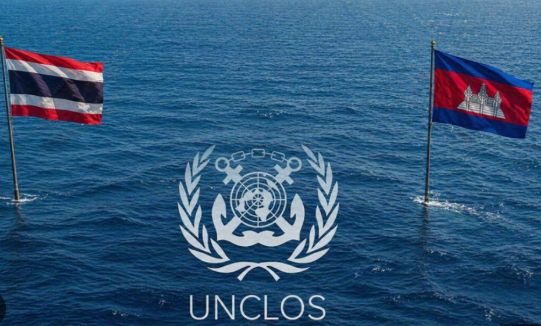
Thailand has formally accepted Cambodia's request to pursue compulsory conciliation under the 1982 United Nations Convention on the Law of the Sea over their long-standing maritime boundary dispute in the Gulf of Thailand. The Thai government submitted its official response to Cambodia on June 19, following Phnom Penh's notification transmitted on June 2. However, Bangkok has been careful to clarify that it views this process as a mechanism for generating recommendations rather than a binding resolution, and Thai officials have repeatedly stressed that any outcome cannot be imposed on either nation.
The decision to accept conciliation represents a formal diplomatic step, but one hedged with significant caveats. Thailand's Ministry of Foreign Affairs has appointed Deputy Prime Minister and Foreign Minister Sihasak Phuangketkeow as the country's Agent in the proceedings, with Songchai Chaipatiyut, currently ambassador to Kuwait and formerly a senior official at the Department of Treaties and Legal Affairs, serving as Deputy Agent. This selection signals the gravity with which Thailand regards the process, placing it in the hands of high-ranking officials, even as the government downplays its potential binding effects.
Thailand has named two conciliators to the panel: Judge Albert J Hoffmann of South Africa and Judge Rudiger Wolfrum of Germany, both described by Thai authorities as internationally recognised experts in maritime law. The four conciliators appointed jointly by Thailand and Cambodia will have 30 days from Thailand's formal response to elect a fifth conciliator who will chair the commission. The entire conciliation process is expected to conclude within approximately 12 months, unless both parties mutually agree to extend the timeline.
The conciliation framework operates differently from litigation or binding arbitration, a distinction Thai officials have emphasised at every opportunity. Rather than serving as advocates for either side, conciliators function as neutral experts tasked with comprehending the dispute's context, hearing both parties' positions, and facilitating identification of potential solutions acceptable to both nations. The commission's report will contain recommendations and conclusions, but these carry no legal weight under Unclos Annex V, which explicitly states that conciliation outcomes remain non-binding on the parties involved.
Thailand's approach reflects a deliberate strategy to use conciliation as a negotiating tool rather than as a dispute resolution mechanism with enforceable consequences. The Foreign Ministry has positioned the process as a framework intended to support bilateral negotiations rather than supplant them, with Bangkok maintaining that final settlement must emerge from direct talks between Bangkok and Phnom Penh. This stance becomes particularly significant given Thailand's termination in May of the 2001 memorandum of understanding with Cambodia, commonly referred to as MoU 44, which had governed the handling of overlapping maritime claims on the continental shelf.
The decision to terminate MoU 44 proved contentious, though Prime Minister Anutin Charnvirakul insisted it reflected not conflict with Cambodia but rather frustration with the lack of substantive progress over 25 years of cooperation under that framework. The Thai government characterised the termination as a recalibration of the bilateral cooperation mechanism rather than an abandonment of negotiations or diplomatic relations. Nevertheless, the timing of this move, followed by Cambodia's initiation of compulsory conciliation, underscores the tension between the two nations over how to resolve their overlapping maritime claims.
The underlying dispute concerns maritime boundary delineation in the Gulf of Thailand, an area believed to contain significant natural gas reserves and other hydrocarbon resources. This economic dimension has historically complicated negotiations, as the issue has intertwined questions of pure maritime delimitation with broader questions concerning joint development arrangements and equitable resource sharing. Thailand has sought to narrow the conciliation scope to maritime boundary delimitation alone, a position that diverges from Cambodia's apparent preference to address provisional arrangements for joint resource development and equitable sharing within the conciliation process.
This disagreement over the conciliation's proper scope reflects deeper divergences between the two governments regarding the dispute's fundamental character and resolution pathway. Cambodia, in initiating the compulsory conciliation process, signalled its desire for peaceful resolution through international legal mechanisms, positioning itself as the party committed to binding, rule-based settlement. Thailand's acceptance, coupled with its insistence on non-binding outcomes and continued bilateral negotiation, suggests Bangkok prefers maintaining flexibility and avoiding outcomes that might constrain its future positioning or require compromises on resource allocation.
The significance of this dispute extends beyond bilateral Thailand-Cambodia relations. For Malaysia and other Southeast Asian nations reliant on stable maritime arrangements and predictable resource governance in adjacent waters, the outcome carries important precedent implications. The dispute demonstrates how overlapping maritime claims and hydrocarbon interests can persist for decades without resolution, even when countries share strategic interests and cooperative frameworks. It also illustrates the complex interplay between international legal mechanisms like Unclos and the reality that states often prefer bilateral approaches that preserve negotiating flexibility over binding international adjudication.
Thailand's emphasis on the non-binding nature of conciliation reflects a broader reluctance among Southeast Asian states to accept outcomes from international dispute resolution that might constrain sovereignty or resource rights. By accepting conciliation while simultaneously stressing its advisory character, Thailand seeks to gain the legitimacy and information benefits of an international process without surrendering ultimate decision-making authority to external actors. This pragmatic approach, while potentially frustrating to Cambodia, aligns with how many regional governments navigate the tension between international legal commitments and nationalist concerns about sovereignty.
The conciliation process now enters its technical phase, with the selection of the fifth conciliator expected within the coming month. How effectively this mechanism facilitates eventual agreement depends substantially on whether both parties can narrow their disagreements regarding the process's proper scope and whether they can identify genuinely feasible compromises on maritime boundaries and resource development. Thailand's insistence that final agreement must emerge from bilateral negotiation essentially means the conciliation commission's recommendations will require subsequent negotiation for implementation, potentially extending the resolution timeline considerably beyond the anticipated 12-month conciliation period.
As the conciliation proceeds, Thailand continues invoking Unclos as a common reference point for maritime relations, a position that theoretically provides objective criteria for boundary delimitation while potentially limiting how far either party can deviate from internationally established maritime law principles. Whether this shared legal framework ultimately narrows the gap between Thailand and Cambodia's positions remains uncertain, but the conciliation process at minimum establishes a structured international venue in which both governments must articulate and defend their maritime claims under expert scrutiny. For regional observers, the proceedings offer insights into how maritime disputes in Southeast Asia's crowded waters might eventually be resolved, whether through binding international adjudication or through assisted bilateral negotiation.