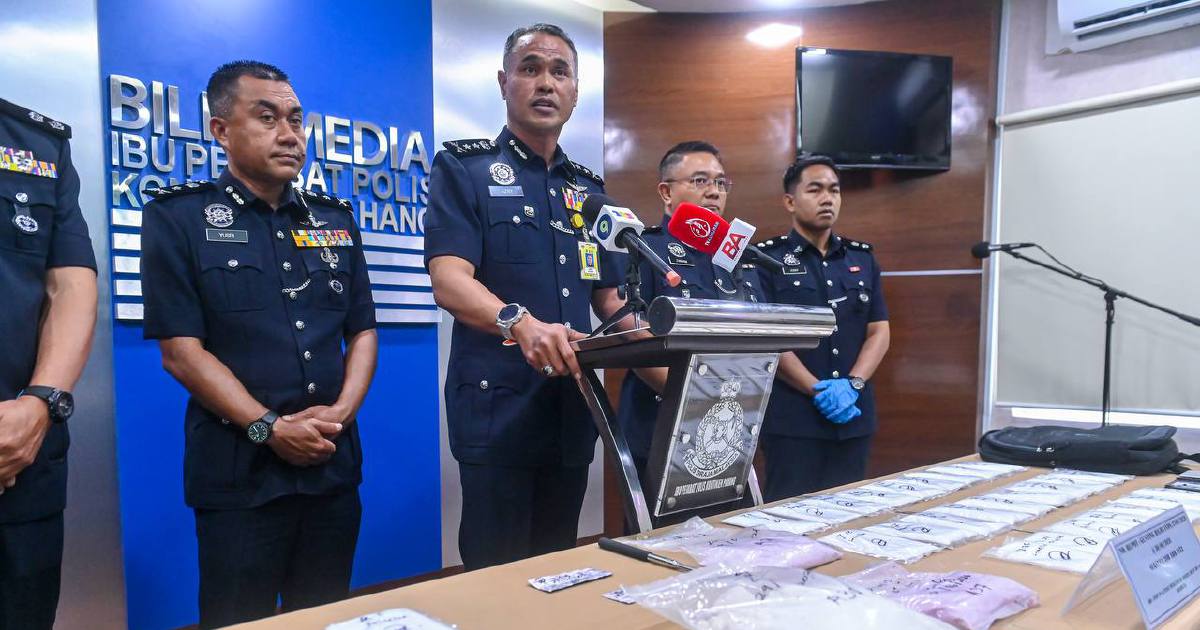
Drug enforcement officers in Pahang have arrested a Thai national and her Malaysian partner following a coordinated operation in the Genting Permai area of Bentong that resulted in the seizure of narcotics worth approximately RM728,000. The pair allegedly functioned as couriers for a larger drug trafficking network, moving controlled substances across the region during a three-month operational window before their detention.
The arrest represents a significant breakthrough in combating regional drug trafficking, which has become an increasingly complex challenge across Southeast Asia. The involvement of a foreign national in such operations underscores the cross-border dimensions of organised drug smuggling, where criminal networks frequently recruit couriers from neighbouring countries to distribute substances within Malaysia. The Bentong area, situated along important transportation corridors in Pahang, has emerged as a focal point for such activities due to its strategic geographic location and relative accessibility from multiple entry points.
Authorities have indicated that the couple's operation was not isolated but rather part of a coordinated supply chain managed by a larger syndicate. This hierarchical structure, with high-level organisers directing field-level couriers, is typical of contemporary drug trafficking organisations that compartmentalise operations to minimise exposure and maximise operational resilience. The three-month duration of documented activity suggests the network had already established itself within the region and possessed sufficient resources and logistics to maintain consistent distribution.
The RM728,000 valuation of seized drugs provides insight into the scale of operations and the profit margins driving such criminal enterprises. This figure likely represents a substantial stockpile rather than a single transaction, indicating that the couple managed considerable inventory for a regional market with significant demand. The seizure disrupts what appears to be an established distribution channel, potentially creating supply shortages for downstream dealers and creating cascading impacts through the trafficking network.
For Malaysia's law enforcement community, the arrest highlights both achievements in drug interdiction and the persistent challenge posed by transnational criminal syndicates. The capacity to detect and intercept operations of this magnitude demonstrates operational effectiveness, yet the continued existence of such networks suggests that supply remains robust despite regular enforcement actions. The involvement of foreign nationals also complicates jurisdictional considerations and international cooperation frameworks that govern drug trafficking investigations.
The Bentong incident carries particular significance for Pahang, where authorities have consistently reported elevated drug trafficking activity related to the state's position as a transit zone. Geographic factors, including proximity to Kuala Lumpur and connectivity to Kelantan and Terengganu, create natural advantages for distribution networks seeking to reach diverse consumer markets. The state's transportation infrastructure, while beneficial for legitimate commerce, simultaneously facilitates illicit movement of contraband.
Broader regional implications extend across Southeast Asia, where Malaysia functions simultaneously as a consumption market, transit point, and sometimes production location within larger trafficking ecosystems. The arrest of foreign nationals engaged in Malaysian drug operations reflects patterns observed throughout the region, where criminal organisations transcend national boundaries to exploit regulatory differences and enforcement gaps. Thailand, which has witnessed intensified domestic drug problems partly stemming from overflow from regional trafficking networks, faces interconnected challenges with Malaysia in managing these flows.
The investigation into this operation will likely extend beyond the arrested pair to identify supply sources, organisational leadership, and distribution networks downstream. Authorities typically prioritise dismantling infrastructure rather than simply removing individual operatives, recognising that removing couriers without addressing supply chains and market mechanisms produces temporary disruption rather than systemic degradation of criminal capacity. Interrogation and surveillance data may reveal additional subjects warranting investigation and additional seizure opportunities.
Community impact from such trafficking extends beyond direct drug consumption to encompass associated crime, violence, and social degradation. Bentong residents and surrounding communities experience consequences of trafficking activity including petty crime, gang violence, and neighbourhood instability. Successful enforcement actions therefore provide tangible benefits to public safety beyond headline drug quantities.
The case demonstrates that sustained investment in drug enforcement infrastructure, intelligence gathering, and inter-agency coordination yields measurable results despite entrenched trafficking challenges. The capacity to detect and neutralise operations of this magnitude requires sophisticated intelligence networks, trained personnel, and adequate resourcing. Maintaining such capability demands ongoing commitment and resource allocation even as criminal organisations continuously adapt methodologies and operational security protocols.
Moving forward, this arrest provides law enforcement with valuable intelligence regarding syndicate operations, courier recruitment patterns, distribution methodologies, and market structure. These insights enhance future interdiction capabilities and inform strategic drug policy development. For Malaysian authorities and regional partners through ASEAN frameworks, maintaining momentum against transnational trafficking requires continued cooperation, intelligence sharing, and coordinated enforcement initiatives that address the fundamental economics driving these criminal operations.

