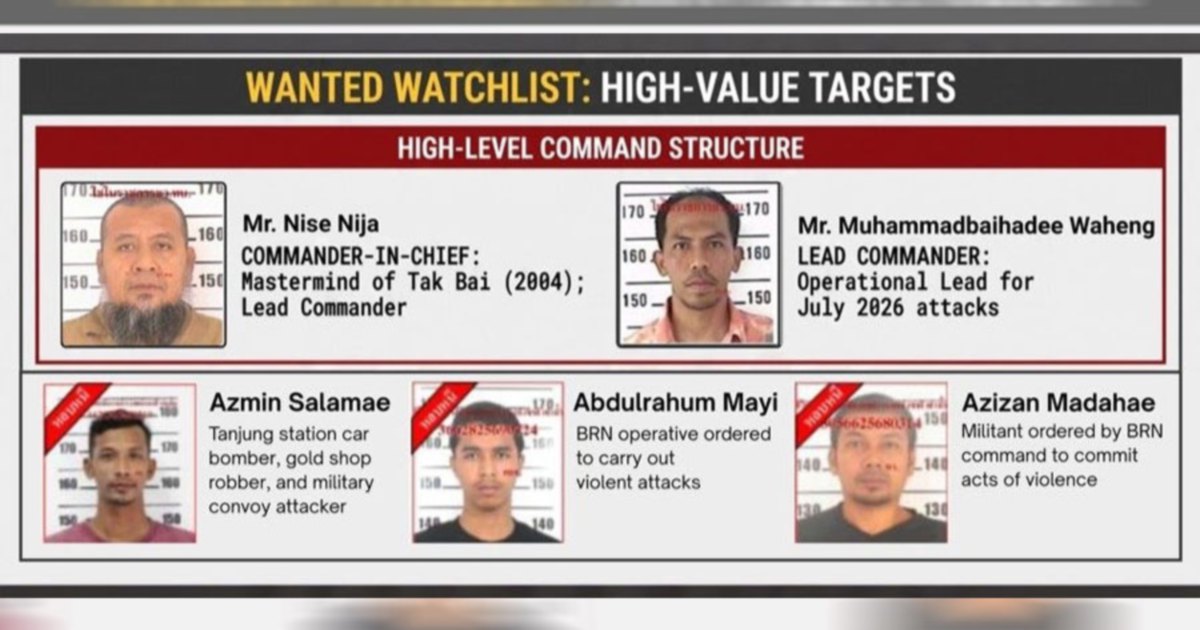
Thai law enforcement agencies have formally issued arrest warrants targeting five individuals suspected of carrying out a coordinated attack on a military security post in Narathiwat province during late July. The incident occurred at a checkpoint situated along Bukit Sami Municipal Road in the Tanjong Mas subdistrict of Ra-ngae district, marking another significant security flashpoint in the volatile southernmost Thai provinces that have long grappled with separatist violence.
The July 22 ambush represents a continuation of the simmering conflict that has characterized the Pattani, Yala, and Narathiwat border region for nearly two decades. This particular operation appears to have been coordinated with deliberate tactical planning, prompting Thai authorities to escalate their investigative efforts through the issuance of formal warrants. The decision to publicly name five specific suspects indicates that investigators have assembled sufficient preliminary evidence linking these individuals to the attack, though further corroboration of charges remains ongoing.
For Malaysian readers and regional security analysts, the incident underscores the persistent instability affecting Thailand's southern border regions, areas that directly influence cross-border security dynamics. The Narathiwat province shares significant maritime and terrestrial boundaries with Malaysia's Kelantan state, creating interconnected security challenges that require coordinated bilateral responses. Such attacks periodically spike during particular seasons or in response to military operations, though the underlying grievances fuelling the insurgency remain largely unresolved despite multiple peace initiatives.
The checkpoint location along Bukit Sami Municipal Road positions it within areas historically vulnerable to militant activity. Security installations throughout southern Thailand have become routine targets, reflecting the sophistication and commitment of armed groups operating in the region. The fact that this particular ambush resulted in fatalities distinguishes it among the numerous lower-profile incidents that occur with regularity but receive minimal international attention.
Investigators are likely examining several critical dimensions of the attack: the identity and operational affiliations of the suspects, their access to weapons and explosives, the intelligence gathering preceding the ambush, and connections to organized militant networks operating across the border. The issuance of multiple warrants suggests the involvement of several operational cells rather than isolated actors, implying organizational capacity that extends beyond opportunistic violence.
Thailand's security apparatus faces considerable challenges in apprehending suspects in these southern provinces, where rough terrain, sympathetic local populations, and porous borders complicate law enforcement operations. Previous security operations have demonstrated both the military's capacity for large-scale deployments and the insurgency's resilience in sustaining operations despite sustained counter-measures. The cycle of attack and response has become normalized in the region's security landscape.
From a Malaysian perspective, such incidents carry direct implications for border security and regional stability. The Malaysian government maintains heightened vigilance along its southern borders, recognizing that violence in neighboring Thai provinces occasionally spills across into Malaysian territory or involves networks with transnational dimensions. Cross-border smuggling, weapons trafficking, and militant movement represent persistent concerns for both nations' security agencies.
The investigation's progression will likely involve cooperation between Thai military and police agencies, with potential coordination with Malaysian counterparts through established bilateral mechanisms. Intelligence sharing regarding suspects' movements, financial networks, and international connections could prove instrumental in locating and apprehending the individuals named in the warrants. Such cooperation has historically produced results in disrupting militant cells operating across borders.
The broader context reveals that southern Thailand's insurgency, nominally representing Patani separatism though fragmented into numerous competing factions, has resisted conventional military and diplomatic solutions. The ambush represents one manifestation of violence that continues despite the Thai government's varied approaches combining military operations, development initiatives, and intermittent peace negotiations. The persistence of such attacks suggests fundamental grievances remain unaddressed.
Regional observers note that the complexity of southern Thailand's security environment extends beyond simple counterterrorism frameworks. Historical grievances regarding cultural and religious marginalization, economic disparities, and questions of governance create underlying conditions sustaining recruitment and operational capability among militant networks. While capturing the five suspects may disrupt particular operational cells, it addresses neither the structural factors perpetuating the conflict nor the ideological motivations driving participation.
For Malaysian security analysts monitoring this situation, the incident reinforces the importance of sustained bilateral cooperation and intelligence exchange with Thailand. Understanding the operational patterns, capabilities, and networks of groups active in Narathiwat and surrounding provinces assists Malaysian authorities in protecting their own borders and identifying potential threats originating from cross-border networks. The professional competence demonstrated by insurgent groups in executing coordinated ambushes indicates sophisticated operational planning requiring counter-intelligence attention.
As Thai authorities pursue the five named suspects, the investigation will generate intelligence valuable for broader understanding of militant network structures, command and control mechanisms, and resource flows sustaining operations. Successful apprehension and prosecution of suspects can provide critical evidence regarding organizational hierarchies and external support networks that may illuminate threat patterns affecting regional security architecture.

