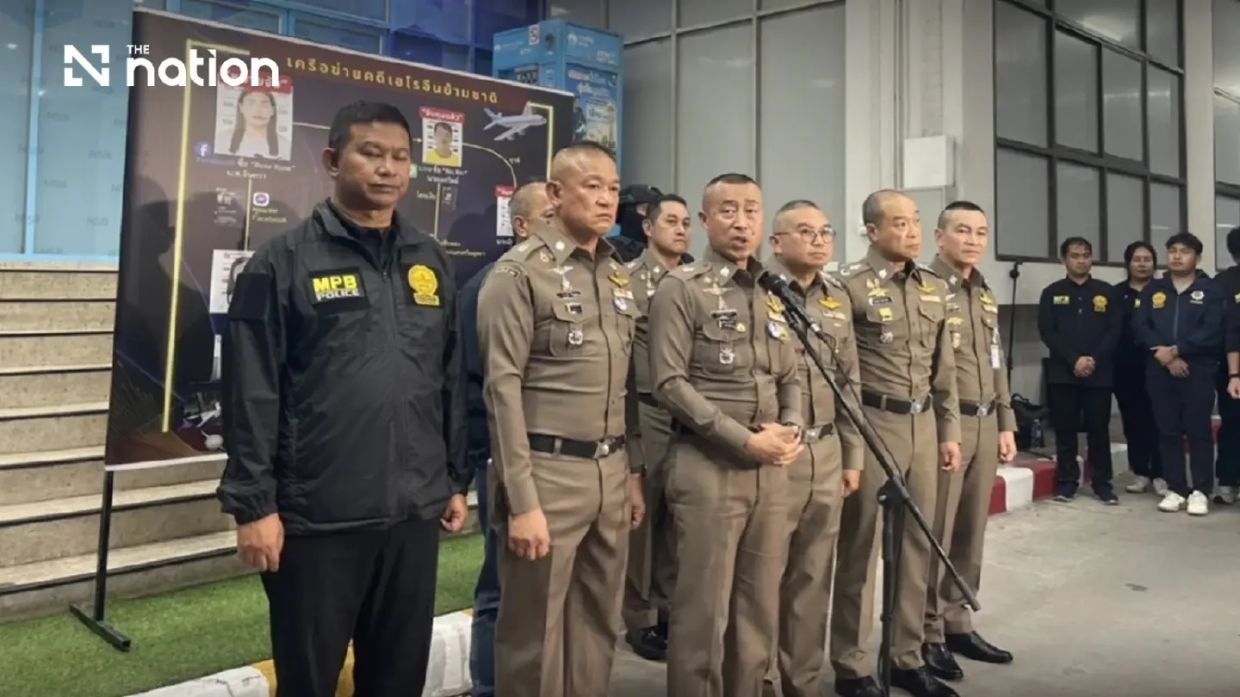
Thai police have issued an arrest warrant for a woman identified as Chantra, operating under the online alias 'RoseRose', who is suspected of directing a cross-border heroin-trafficking network that employed ingenious concealment methods and recruited commercial airline staff as couriers. Deputy National Police Chief Pol Gen Samran Nualma confirmed that Chantra abruptly left Thailand through an unofficial frontier crossing after learning that investigators were tightening their grip on the operation, with authorities believing she has since crossed into a neighbouring country. The development marks a significant turning point in what police describe as a carefully orchestrated smuggling scheme that reveals the evolving sophistication of drug-trafficking networks operating throughout the region.
The investigation gained momentum following the interrogation of Ekkawit, a key operative accused of managing a Line messaging account under the username 'Rin Rin' and serving as a critical liaison within the distribution chain. During questioning on the evening of July 10, Ekkawit provided investigators with detailed confessions linking him directly to the trafficking operation, corroborated by verification checks conducted with Line Thailand. The evidence trail demonstrates how modern messaging platforms have become essential infrastructure for international drug networks, allowing operators to coordinate movements across borders with relative anonymity and leaving digital footprints that investigators can potentially follow.
According to police reconstructions based on Ekkawit's admissions, the operational mechanics of the network reveal meticulous planning and role specialisation. Ekkawit's primary responsibility involved purchasing elephant-print bags in Chiang Mai, a northern Thai city known as a commercial hub, then forwarding them to the RoseRose network. Once the bags were returned, they arrived sealed with heroin packages concealed within the lining or structure, at which point Ekkawit would pass them to a man identified as Uthai for further distribution down the supply chain. This division of labour—with individuals handling procurement, concealment, logistics, and final delivery as separate functions—represents a common strategy among sophisticated trafficking organisations designed to compartmentalise knowledge and limit exposure if any single link breaks.
The involvement of a commercial air hostess as a courier introduced an international dimension to the operation and would likely have enhanced the network's confidence in moving contraband undetected. Ekkawit claimed this represented the first occasion the network had utilised aviation personnel, suggesting they had been testing recruitment strategies or responding to opportunity. Police allege that RoseRose deliberately targeted individuals through Facebook groups where people offer courier services for others, privately messaging prospects and gradually cultivating relationships before proposing shipping arrangements. However, investigators remain uncertain whether the air hostess fully understood what the elephant-print bag contained, a distinction that carries significant legal implications in Australian proceedings.
The sourcing of heroin through northeastern Thailand and from neighbouring Laos indicates a well-established supply corridor that authorities have only partially dismantled. Police believe the drugs entered Thailand via Phayao province, then flowed through distributors connected to larger networks operating across the Thai-Lao border region. This geographical pattern reflects longstanding trafficking routes in the Golden Triangle, where porous boundaries and limited interdiction resources enable consistent drug flows from production areas in Myanmar and Laos into Thai distribution networks. The identification of this specific entry point provides actionable intelligence for future enforcement operations, though disrupting established supply lines typically requires sustained bilateral cooperation.
Chantra's profile as the elder sister of Ekkawit's sister-in-law suggests family connections may have facilitated her rise to leadership within the network. Her frequent movements between Thailand and Laos caught police attention and prompted suspicions that she maintained direct contacts with international trafficking organisations operating across the border. Unlike lower-level operators, Chantra appears to have exercised strategic control—selecting couriers, arranging concealment, managing communications—indicating she occupied a command position rather than merely participating in logistics. The emergence of female trafficking organisers leading transnational networks represents a notable trend in Southeast Asian drug enforcement, though it remains relatively underreported compared to male-dominated trafficking groups.
The digital evidence collected during the investigation—chat records, messaging patterns, and account verification information—demonstrates how contemporary trafficking operations generate substantial electronic traces. Police obtained supporting documentation through informal cooperation with commercial technology platforms, though the case reveals gaps in formal processes for securing judicial cooperation in cyberspace investigations. The communications patterns across multiple accounts and the consistency of messaging protocols indicated to investigators that this represented an organised operation rather than an isolated smuggling incident. The request to Facebook for account holder verification reflects ongoing challenges in definitively establishing identity through social media platforms, a problem that complicates prosecutions across jurisdictions.
Police have carefully distinguished this network from separate trafficking groups, notably one investigated by the Office of the Narcotics Control Board that resulted in arrests in Loei province. The differentiation relies partly on trafficking routes and organisational structure, with the RoseRose network maintaining consistent ingress through Phayao, suggesting distinct supplier relationships and distribution territories. This categorisation reflects how Thai law enforcement now employs route-based analysis to map trafficking territories and identify organisational boundaries, a more sophisticated approach than previous methods. Understanding these distinctions proves essential for developing targeted enforcement strategies rather than treating all drug operations as identical phenomena requiring identical responses.
The investigation remains incomplete despite substantial progress. Police plan to seek continued detention of Ekkawit following his appearance at the Criminal Court on Ratchadaphisek Road on July 11, and prosecutors will oppose bail applications given the alleged severity of offences and the ongoing examination of additional network members. Investigators anticipate that questioning Ekkawit further may yield additional information about other participants, suppliers, and distribution arrangements that would expand understanding of the network's full extent. The incomplete nature of the investigation also reflects the reality that dismantling transnational trafficking requires systematic work across multiple stages, with initial arrests often representing merely the beginning of extended prosecutorial processes.
The case carries implications extending beyond Thailand into the regional enforcement architecture. Australian authorities have responsibility for processing the air hostess case, a situation that raises questions about her knowledge, voluntary participation, and culpability. Thai police have indicated willingness to provide evidentiary support to Australian prosecutors should they request it, representing the type of bilateral cooperation essential for managing drug trafficking as a regional problem rather than isolated national incidents. However, differences in legal standards, evidential requirements, and sentencing frameworks between jurisdictions can complicate proceedings and create inconsistent outcomes. The investigation ultimately illustrates how contemporary drug networks operate across legal boundaries with ease, while law enforcement remains largely constrained by national jurisdiction, a fundamental asymmetry that continues frustrating enforcement efforts throughout Southeast Asia.

