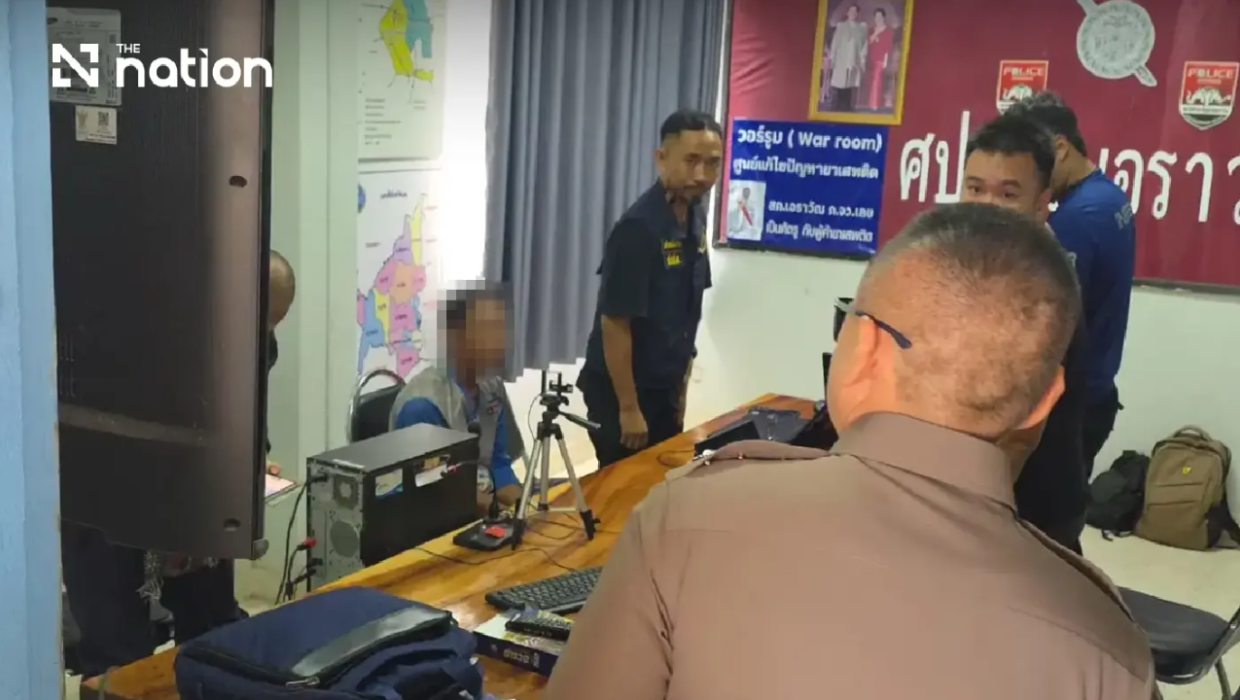
Thai police have arrested a husband-and-wife team in the northeastern province of Loei as authorities expand their investigation into what officials believe is a transnational heroin smuggling operation. The detentions follow the arrest of a Thai Airways flight attendant in Melbourne, Australia, who was apprehended at the airport with roughly one kilogramme of heroin concealed in her luggage, according to reports from Thai law enforcement agencies.
The case underscores the vulnerability of Thailand's aviation sector to drug trafficking schemes and raises questions about how narcotics enter international supply chains through legitimate travel routes. Thai police and the Office of the Narcotics Control Board determined that someone within Thailand had prepared and dispatched the parcel eventually intercepted in Australia, prompting them to shift their focus domestically.
On July 2, investigators from Chiang Khan Police Station initially searched a house in That subdistrict after identifying two suspects—43-year-old Athit and 42-year-old Thatsaphon—as potentially connected to the operation. Finding neither individual at the specified residence, authorities expanded their search to nearby rubber plantations and work sites, reflecting a pattern common in rural Loei province where informal employment obscures the movements of suspects.
Police traced Athit to a temple in Sri Songkhram subdistrict, where he was employed repairing the roof of Wat Tham Pha Mak Ho. Officers from the Narcotics Control Board and associated police units took him into custody at Erawan Police Station for initial questioning. During this preliminary phase, Athit reportedly acknowledged accepting payment to dispatch parcels on six separate occasions, revealing a pattern suggesting his involvement was neither isolated nor casual.
According to police records, Athit confessed to receiving 8,000 baht—approximately US$240—per parcel delivery, compensation provided by a national of Laos. Three of the parcels were routed through a commercial parcel service operating in Chiang Khan district, with the remaining two originating from Ban That and one from Erawan district. The most recent shipment left Thailand on June 28, 2026, timing that aligns suspiciously with the Australian airport interception.
Authorities subsequently apprehended Thatsaphon, identified as a Lao national and Athit's spouse, after locating a black Mitsubishi Triton pickup truck bearing Loei registration plates abandoned in a rubber plantation within Pha In Plaeng subdistrict. The discovery of the vehicle in a remote agricultural area suggests deliberate measures to conceal the couple's movements and avoid detection by highway checkpoints or urban surveillance. When questioned at Erawan Police Station, Thatsaphon denied involvement and claimed ignorance of any smuggling scheme, a standard opening position in preliminary interrogations.
The case reveals structural vulnerabilities in how international drug networks recruit personnel across borders. By employing individuals from neighbouring Laos and utilising agricultural workers whose movements are harder to monitor, traffickers exploit the porous nature of rural border communities and the informal employment landscape that characterises much of northeastern Thailand. The use of modest per-parcel payments suggests the network deliberately keeps individual participants economically insulated from the overall operation's scope, making it difficult for any single arrested person to expose the full network.
Officials from the Narcotics Control Board have publicly characterised this operation as emblematic of contemporary transnational drug smuggling methods. The agency's secretary-general noted that networks increasingly distribute risk across multiple jurisdictions and operatives, deliberately fragmenting the supply chain so that disruption at any single point requires coordination among multiple countries. Thailand's cooperation with Australian law enforcement proved instrumental in identifying links back to the source country, demonstrating the growing importance of bilateral intelligence-sharing in combating organised narcotics trafficking.
The investigation will now advance to the formal questioning phase conducted by the Office of the Narcotics Control Board, where authorities will attempt to trace connections upward through the supply chain. Police are specifically seeking to identify individuals who ordered the shipments, those who provided financial backing, and anyone else who facilitated the operation at various stages. This layered approach reflects recognition that street-level couriers and logistics personnel typically possess limited knowledge of the enterprise's full dimensions.
Thailand's narcotics authorities have signalled commitment to intensifying scrutiny of cross-border smuggling networks operating through the country. The Narcotics Control Board plans to strengthen coordination with foreign law enforcement agencies, enhanced surveillance of known trafficking transit points, and targeted disruption of financial mechanisms used to move money between operatives across international boundaries. This announcement aligns with the Thai government's stated drug-suppression policy, though implementation challenges remain significant given resource constraints and the sheer volume of cross-border traffic in Southeast Asia.
For Malaysian observers, the case illustrates how organised crime networks exploit geography and employment informality throughout the region. Thailand's relatively porous borders and substantial migrant worker populations create opportunities that traffickers systematically abuse. The investigation's reliance on international cooperation also underscores why regional approaches to drug enforcement—including mechanisms like the ASEAN framework—remain essential, particularly as networks become increasingly sophisticated in distributing roles and concealing their operations through legitimate commercial channels like parcel services.

